From the journal

Beizhen Temple: Giving a Mountain an Audience

Ordered halls and inscribed stone reveal how a landscape became a participant in imperial ritual.

In the same city · Jinzhou ↗
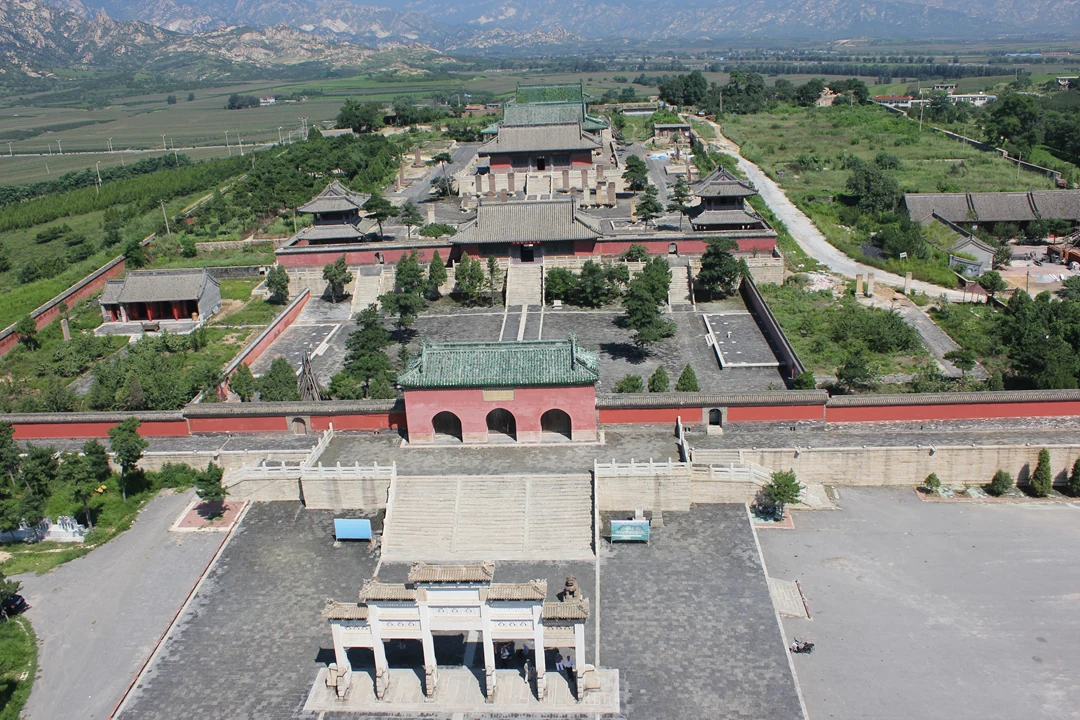
A stone archway, red gateway, courtyards and tiled halls align in front of a rocky mountain range.
The sequence of gates, courtyards and halls at Beizhen Temple.

A northern guardian

Beizhen Temple is dedicated to the deity of Yiwulüshan. The mountain belongs to the traditional group of Five Guardian Mountains, or Five Zhen, a system distinct from the better-known Five Great Peaks. Beizhen means the northern guardian, giving a geographical direction a ceremonial identity.

A historical study of the adjoining Qing imperial lodge traces the temple’s foundation to 594. Changes of dynasty, a new ruler’s accession and troubling conditions in the natural world could occasion state sacrifice. The mountain was addressed through ritual, as part of how rulers represented order across their realm.

An approach arranged in stages

The complex rises along a north–south axis. A stone arch and gateway lead toward the Divine Horse Hall and the principal halls beyond. Bell and drum towers flank the sequence; inscription pavilions introduce a different kind of presence, the written record.

This arrangement makes approach gradual. Thresholds divide one space from the next, and lateral buildings frame the forward movement. The succession of gateways and courts gave state ceremony an ordered route through the compound. The mountain itself lies beyond the compound: the architecture offers a place to address it without enclosing it.

What the stelae remember

The surviving Yuan, Ming and Qing stelae record honours, ritual occasions, repairs and imperial verse. A carved stone base, a formal heading or a densely written panel makes visible the labour of making an event permanent. The inscriptions preserve the occasions and language through which successive courts honoured the mountain.

The compound also once adjoined Guangning, an imperial lodge used in the Qing court’s northeastern travels. Much of that subsidiary architecture no longer stands; foundations preserve its position. The surviving foundations extend the temple’s history beyond the standing halls to the lodgings and service buildings once needed by the travelling court.

Continue exploring · Beizhen Temple ↗
Photo credits and rights
  1. The sequence of gates, courtyards and halls at Beizhen Temple.Source: Liaoning Provincial Department of Culture and Tourism, Cultural Heritage Administration Division. Photographer not identified; rights unknown. · Rights status unknown Photo source ↗ Original aspect ratio retained. Display copies resized only when needed; no enlargement, crop or retouching.