The boat turns upstream
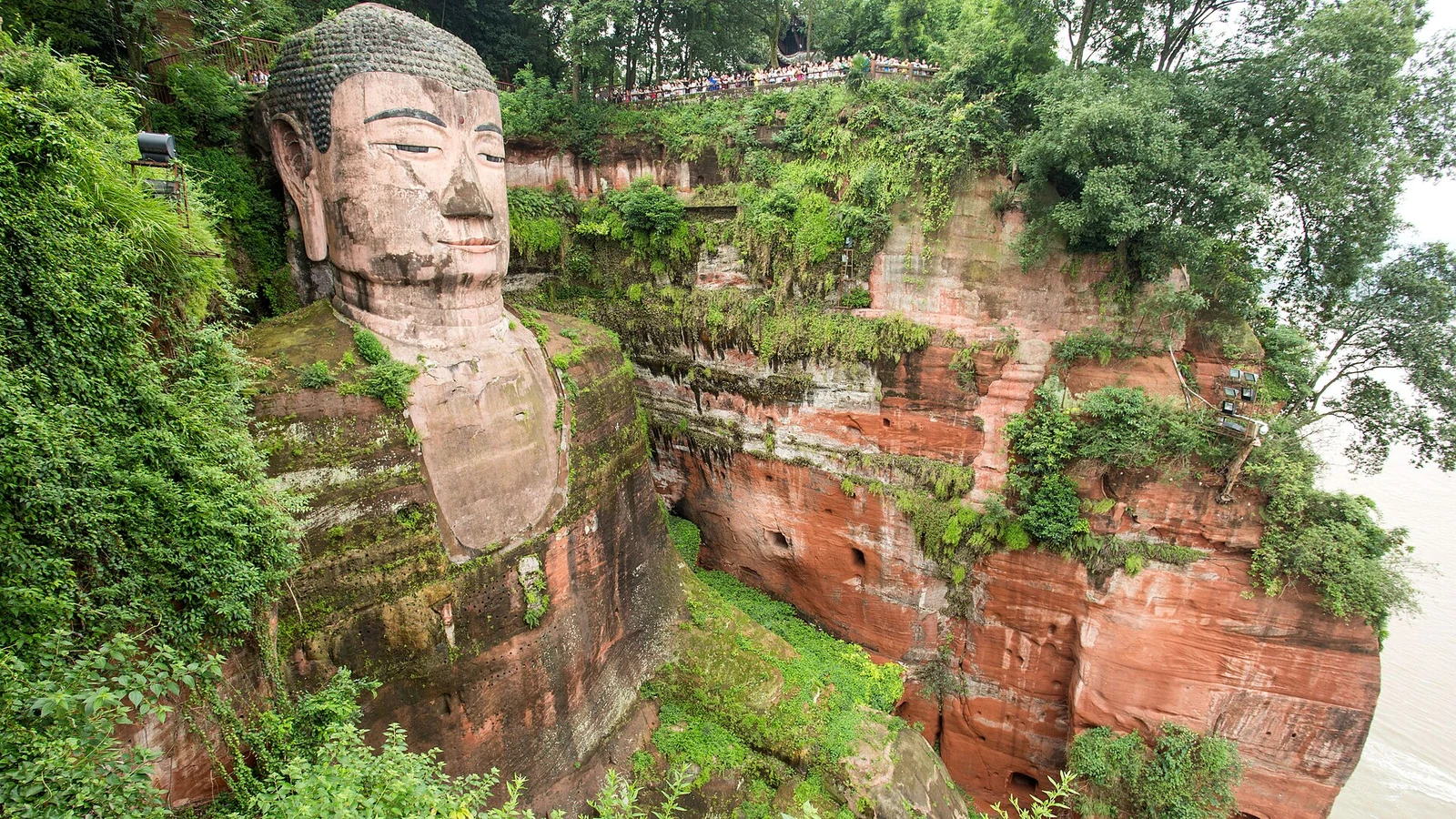
The boat leaves the bank below Leshan and turns upstream, and for a few minutes there is nothing to see but water and the back of the person in front. Then the cliff opens and the Buddha is there, not as a monument on a plinth but as a hollow cut in a rock face, with the river running past its knees. The engine drops to an idle so the boat can hold position against the current. The river here is wide and brown, and the far bank is low enough that the sky takes up more of the view than the land does. From the deck the figure cannot be taken in at once: the head is far above, the hands rest on the knees, and the water is loud enough that people stop talking.
Numbers the eye cannot do
The measurements exist because the eye cannot do this work from below. The figure is 71 metres tall; the head alone is about 14.7 metres and the shoulders about 28. The hair is worked as 1,051 coils, in rows that read from the water as a dark band above the forehead. Up close the coils are the size of a plate; from the water they are a texture. On the cliff path those numbers mean little, because you are inside the detail. From the river they become the only way to describe what is in front of you. The carving was cut between 713 and 803, and the scale was deliberate: a figure for people on boats, at a distance, on a river that took boats.
Water on soft stone
The rock is red sandstone, soft enough to cut quickly and soft enough to suffer. Rain runs down the face, seeps into the shoulders and collects in the folds of the robe. Behind the head and along the robes the builders cut channels that lead water away from the surface instead of through it, and from the boat those channels are hard to separate from shadow. The cliff above the head is stained and streaked. Soft stone also means that every detail is a compromise between depth and durability, and the cut is shallow where the weather is worst. The carving is not a solid object standing in weather. It is a shape in a wet hillside, and it is maintained as one.
Three rivers under one figure
The Min, the Dadu and the Qingyi meet here, and the water below the cliff is turbulent enough that the boat works to stay in place. The three rivers arrive with different loads and different colours, and the line where they mix shifts with the flow. A seated Maitreya 71 metres high at a confluence is a statement about the river as much as about the faith. The figure faces the water, and the water is what it was built to watch. The boat's wake reaches the cliff a moment after the boat does, and the water goes back to its line. The boat turns back downstream. The Buddha keeps facing the current; the current is the part that no one has had to rebuild.