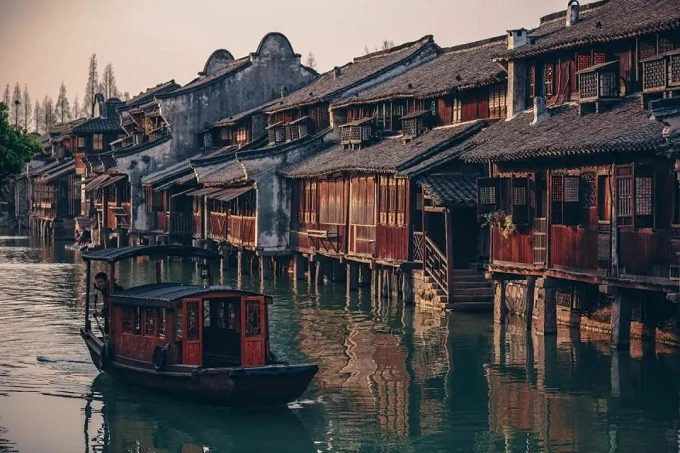
In Wuzhen, a building can reach beyond the bank towards the canal. Timber posts hold an upper room close to the water, while the street stays behind it. These riverside rooms are often called shuige, or water pavilions. The word describes a position as much as a shape: the house uses the edge between land and channel. Look below the windows as well as along the roof. Supports, steps and the line of the bank explain how the building found room beside the water. The east and west scenic areas today are carefully managed visitor spaces, where older forms are repaired and adapted for present use.
Jiaxing
Water at the Doorstep: How Wuzhen Faces Its Canals
In Wuzhen, water is more than a view. Bridges, riverside rooms and streets meet at the edge of everyday space.
In the same city · Jiaxing ↗Where the House Meets the River
Two Bridges in One View
A bridge in Wuzhen can frame another bridge. The passage between Tongji Bridge and Renji Bridge is known as Qiaoliqiao, roughly “a bridge within a bridge.” The pair meet at a right angle. From one position, one stone arch appears through the opening of the other; from the southern bank, their curves can reflect in the canal and form almost complete circles. This is not a grand monument set apart from the town. It is a small lesson in how the waterways, crossings, and streets fit together. The view changes as the stone opening shifts around the water. The same canal that carries boats also carries these reflections, so the architecture is never seen alone. It is always joined to movement, weather, and the opposite bank.
A Town Made of Near Edges
The canals make Wuzhen feel close-grained. A street can end at a bridge; a doorway can face the water; a roofline can continue across a narrow lane. From above, the town’s quarters and waterways form a connected pattern. At ground level, the experience is more intimate: a few steps take you from stone paving to a bridge, then down toward the river’s edge. The scenic areas today are maintained and organized for visitors, and buildings may be repaired or adapted for that use. Their arrangement still makes the older relationship legible: water was not merely scenery placed in front of the houses. It shaped where people could cross, gather, and make a threshold. Look for the changes of level and direction rather than a single postcard view. A waterside room, a bridge opening, and a lane turning toward the canal each show a different answer to the same local condition: the town has to live with water at its doorstep.