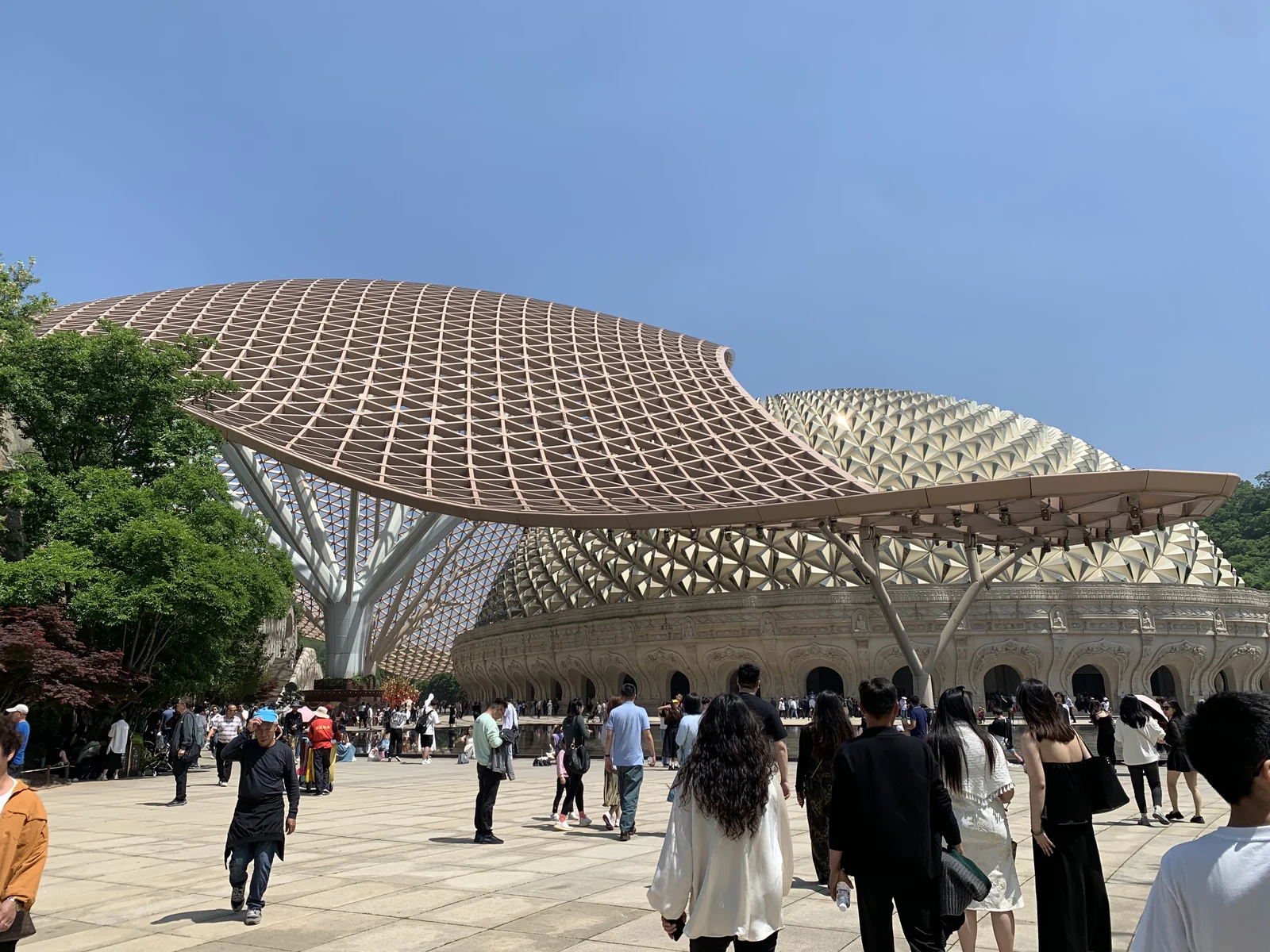
Niushoushan extends Nanjing’s story beyond the imperial and republican memorials of Zhongshan. Its main architectural encounter is contemporary: the cultural park opened in October 2015, and Usnisa Palace was built in relation to a former mining pit. The mountain has an older religious history, but the palace’s domes and underground halls are not surviving ancient buildings. Keeping those timescales separate makes the site more interesting.
Start outside with the two domes. The official interpretation likens the larger covering to a Buddha’s robe and combines lotus and jewel imagery in the smaller dome. Then compare this protective outer form with the ordering of the interior. In the elliptical Thousand Buddha Hall, a central reliquary tower and surrounding Buddha figures make devotion spatial: attention is directed towards a centre, while repeated images organise the surrounding field. The corridors introduce Chinese and Indian Buddhist themes, offering another thread beyond the scale of the architecture.
The palace houses a relic venerated as a skull-bone relic of Shakyamuni Buddha, brought here in 2015. This is a living religious setting as well as a designed visitor destination. Distinguish the presence of the relic from a promise that it, or every chamber, will be publicly visible. The useful comparison with Zhongshan is how different communities give belief and remembrance a monumental form.