Niushoushan lies south of Nanjing. Its name, “Ox Head Mountain,” comes from the outline of its paired eastern and western peaks. Two destructive mining operations took place on the western peak between 1937 and 1958, leaving a deep quarry. The Foding Palace now stands on that former mine site. Elsewhere on the mountain, older Buddhist traces include Hongjue Pagoda. In the Tang dynasty, the monk Farong taught here in a tradition known as Niutou Chan, or Oxhead Chan. These layers—mountain, mining, temples and teaching—each have a history that predates the contemporary palace.
Niushoushan
Niushoushan: Inside a Contemporary Buddhist Monument
At Niushoushan, a mountain with a long Buddhist history, the Foding Palace is a new work of architecture. Its layered domes, buried halls and devotional purpose make that meeting of old place and present-day design legible.
In the same city · Nanjing ↗A mountain shaped by time
A contemporary building in a former quarry
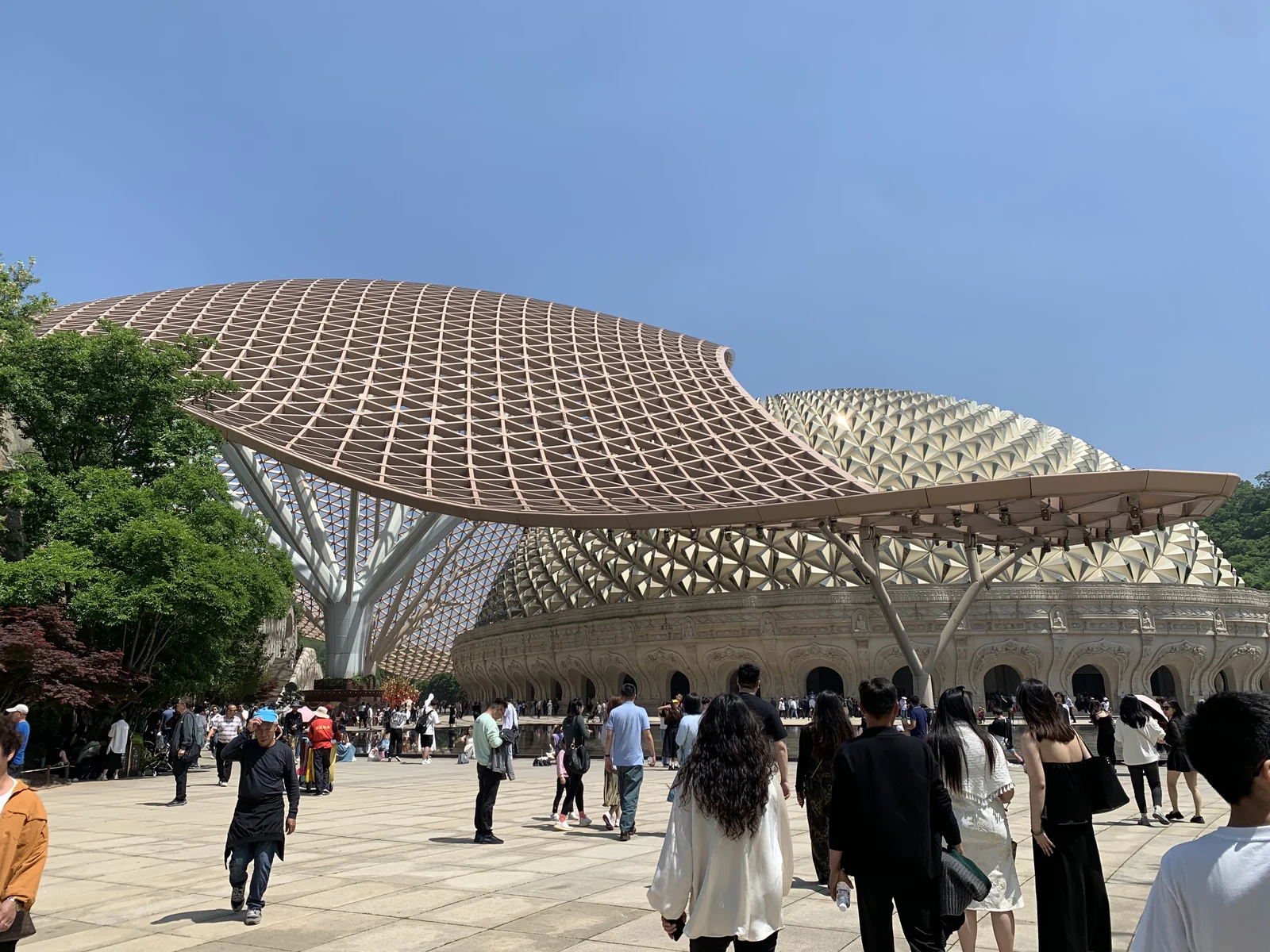
The Foding Palace opened with the cultural area in 2015. It was built within the old western-peak quarry as a place for long-term enshrinement of the Buddha’s parietal-bone relic, revered by Buddhists. The scenic area describes a large outer dome and a smaller dome above the palace’s underground core, interpreting the pair as outer and inner offerings. The larger dome responds to the eastern peak; the palace occupies the former western quarry. The palace combines religious rooms with spaces that present Buddhist culture and art.
Nine levels beneath the domes
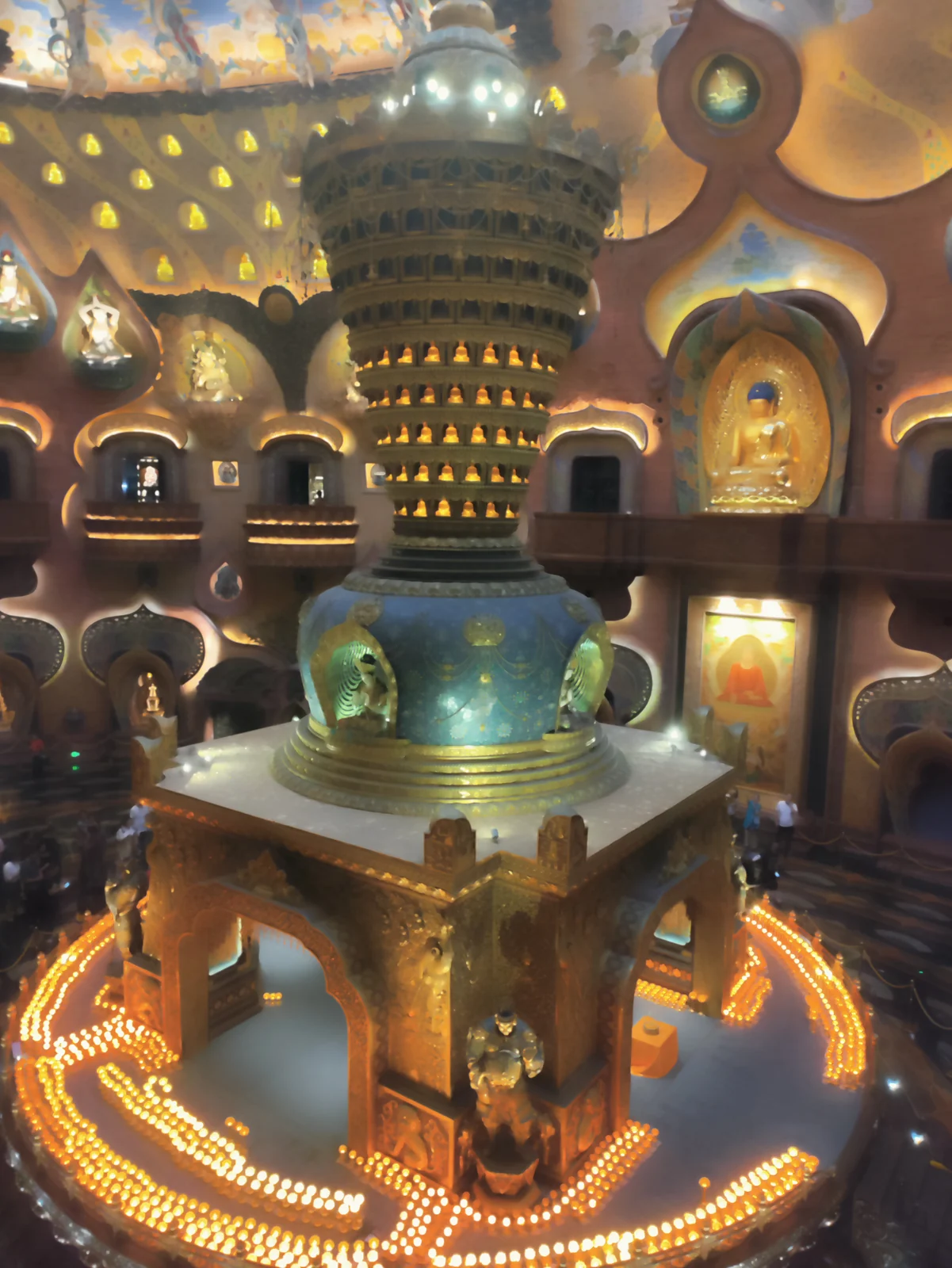
The palace has nine levels: three above ground and six below. Its main spatial sequence is named Chan Realm Panorama (禅境大观, Chánjìng Dàguān), Relic Hall (舍利大殿, Shèlì Dàdiàn) and Relic Repository (舍利藏宫, Shèlì Cánggōng). That arrangement moves from a broad interpretive space toward increasingly inward religious rooms. Its gardens represent the Buddha’s birth and awakening, with the lotus theatre between them. The Relic Hall contains the Thousand Buddha Hall, an oval chamber under a vaulted ceiling, with the surrounding Ten-Thousand-Buddha Corridor occupying underground levels three to five. Red, yellow and dark gold give the hall its visual register. Repeated figures and patterns organize the walls and draw attention to the central reliquary tower. The central reliquary tower rises 21.8 metres, giving the hall a clear vertical centre. The Thousand Buddha Hall follows a five-direction arrangement: the relic tower stands at the centre, with four Buddhas around it.
Light and the visitor’s route
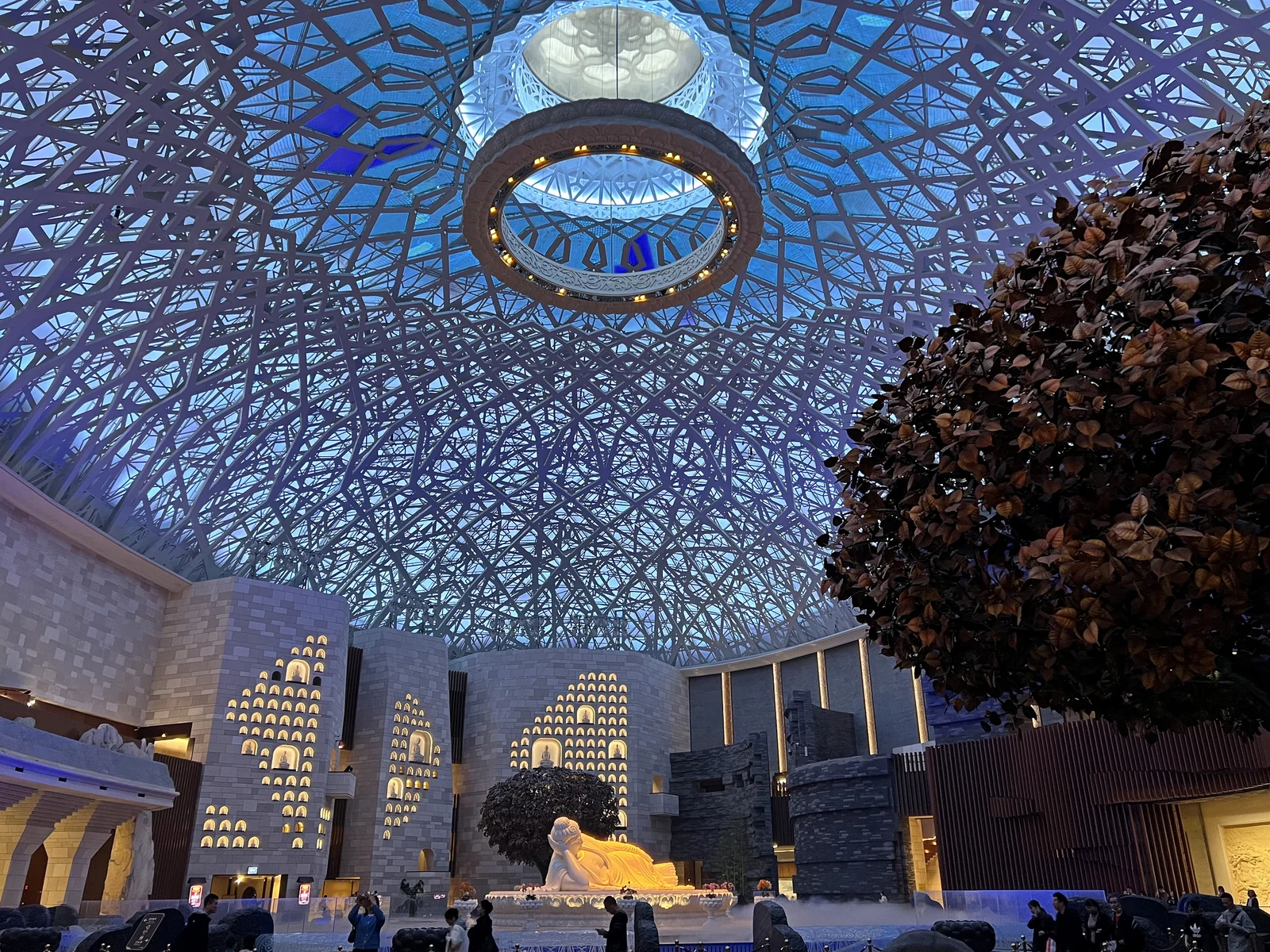
As visitors move down from the entrance levels, changes in ceiling height and illumination distinguish one threshold from the next. In the Thousand Buddha Hall, the vaulted form gathers the repeated images around a central axis; the tower stands at its centre. Beyond it, lower corridors present distinct themes: Chinese Buddhist scripture and paintings on level three, Indian Buddhist stories on level four, and the Buddha’s past lives and relic culture on level five. Contemporary architecture shapes the light across rooms that move between cultural interpretation and religious use. The route moves from cultural interpretation toward religious use, with scripture and art in the lower corridors preceding the sanctuary.
A sanctuary with a living purpose
At the deepest level, the Relic Repository includes the Sanctuary Hall, where the relic is enshrined long term. A dark palette, a circumambulatory passage and the central reliquary establish a different mood from the brighter halls above. The relic is shown to the public on designated occasions; ordinary visits do not guarantee a viewing, and access follows the site’s arrangements. The mountain’s Buddhist history and the palace’s present-day religious purpose share one setting across distinct periods. One is a tradition shaped over centuries; the other is a contemporary building created for worship, cultural interpretation and the care of a revered relic. In the Relic Repository, a 66-metre corridor follows the six perfections and includes halls for incense, lamps, water and flowers.