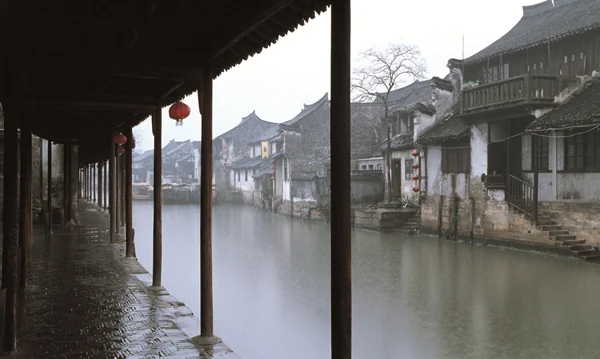
In Xitang, a roof can continue along the river for much longer than a single house. The covered riverside corridors are known as langpeng. Buildings and shopfronts stand on one side, while the canal remains close on the other. Posts support a tiled roof above the walking route. The arrangement is immediately legible: the water stays open to the sky, while the path gains shade and shelter. A long row of roofs, so attractive across the canal, answers a practical question at the scale of one person: where can a street continue when the weather changes?
Jiaxing
A Street Under a Roof
Xitang’s riverside corridor joins the canal to the shopfronts, making shelter part of the town’s everyday street form.
In the same city · Jiaxing ↗A Roof Beside the Water
The Shop Has Two Fronts
Under the corridor, the next doorway remains within easy reach. Shops open onto a walking route, and the water lies beyond its line of posts. The roof brings separate buildings into a continuous sheltered edge. It also makes a different kind of frontage from a street with a pavement on both sides. Across the channel, another row of buildings answers it; between them, boats and reflected rooflines occupy the gap. Xitang's history of handicrafts and trade helps explain why movement and shelter belong together here. Today's repaired and visitor-oriented streets continue to use that close relationship between the bank and the buildings.
A Historic Street in Use
The corridor makes more sense when seen from both directions. Across the water, notice the rhythm of its low roofs and upright posts. Beneath it, notice how the view becomes a series of openings, each offering a different piece of the canal. A bridge interrupts the line and carries the walk towards another bank. A lane leaves the water and enters the tighter space between houses. These changes give Xitang its particular scale. The covered walkway is a useful starting point, and the town becomes richer as you follow what connects to it.