From the journal

Wuyishan in Layers: Rock, River, Tea and Learning

Wuyishan’s red cliffs and winding water become richer when geology, tea gardens and the history of learning are read together.

In the same city · Nanping ↗

A cliff is the beginning of the story

A smooth red cliff above a bend of green water gives Wuyishan one of China’s most recognizable mountain landscapes. Yet the scene becomes more interesting when the eye travels beyond its strongest contrast. Trees occupy ledges and slopes. Tea is cultivated in suitable pockets of land. Paths lead towards inscriptions and places associated with teaching. Different timescales meet within the same view.

Wuyishan is a county-level city within Nanping in northern Fujian, as well as a name used for a much larger mountain setting. Its celebrated scenic area concentrates attention on the Nine-Bend Stream and surrounding peaks. The wider mountains contain other habitats and terrain. The landscape is best approached as a set of connected environments.

Water works on a varied foundation

The national park’s geological account identifies Late Cretaceous red sandstone and conglomerate as the main material behind the eastern Danxia landforms. Geological movement, weathering, erosion and collapse together shaped the relief. The higher western mountains include different rocks, so the red-cliff scenery should not be taken as a model for the entire region.

A river-level view makes the height of a cliff immediate. A high viewpoint reveals how the water turns around blocks of terrain. These perspectives complement each other: one emphasizes surfaces and scale, the other relationships. The landscape’s beauty comes partly from that tension between apparently solid forms and the route that water has found through them.

Tea adds the scale of human attention

Tea introduces another measure of the terrain. A cultivated patch has a different texture from woodland or bare rock, allowing the eye to distinguish managed ground within the larger setting. The celebrated product is Wuyi rock tea, an oolong made through skilled handling of the leaf. Its identity connects place with a sequence of decisions after harvest.

A tea garden therefore belongs to two landscapes at once. One consists of soil, exposure, rainfall and nearby vegetation. The other reaches towards workshops, merchants and drinking tables. Looking at a row of bushes beside a rock face, the viewer can begin with the physical setting, then follow the leaf into craft and commerce. The scenery becomes a place of work as well as admiration.

Tall dark rock walls frame trees and shrubs in a narrow ravine.
The rocky ravine of Jiulongke in Wuyishan.
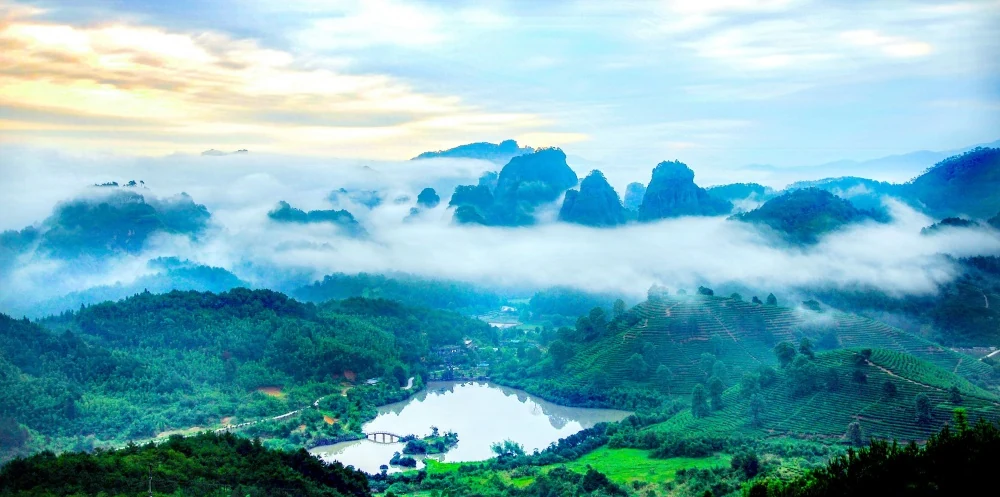
Cloud drifts between rocky green hills above a pond and rows of tea bushes.
Cloud and tea fields share the Wuyishan landscape.

A valley where people came to study

Wuyi Jingshe, founded by Zhu Xi in 1183 near the fifth bend, gives the cultural landscape a specific human anchor. An academy requires buildings, books, teachers and students; its setting also becomes part of how later generations remember it. Today’s reconstructed complex makes that association visible, while the valley retains the spatial relationship between learning place, stream and mountain.

UNESCO recognized Mount Wuyi for cultural and natural values together in 1999. That pairing is a useful invitation to look across categories. A cliff can carry writing. A river can connect a scenic experience with the history of teaching. Cultivated ground can sit within a landscape valued for its biodiversity.

The layers do not need to be understood all at once. One view may begin with colour, another with a carved character or a cup of tea. Wuyishan rewards the gradual discovery that each belongs to a larger, inhabited mountain world.

Continue exploring · Wuyishan ↗
Photo credits and rights
  1. The rocky ravine of Jiulongke in Wuyishan.福建省农业农村厅 / 福建绿色食品发展中心 · Rights status unspecified Photo source ↗ Original aspect ratio retained. Display copies resized only when needed; no enlargement, crop or retouching.
  2. Cloud and tea fields share the Wuyishan landscape.福建省农业农村厅 / 福建绿色食品发展中心 · Rights status unspecified Photo source ↗ Original aspect ratio retained. Display copies resized only when needed; no enlargement, crop or retouching.