From the journal

How Water, Trees and Stone Organize Huangyao

Huangyao in Zhaoping County takes shape through its waterways, stepped bridges, shaded streets and the meanings people have attached to its hills.

In the same city · Hezhou ↗
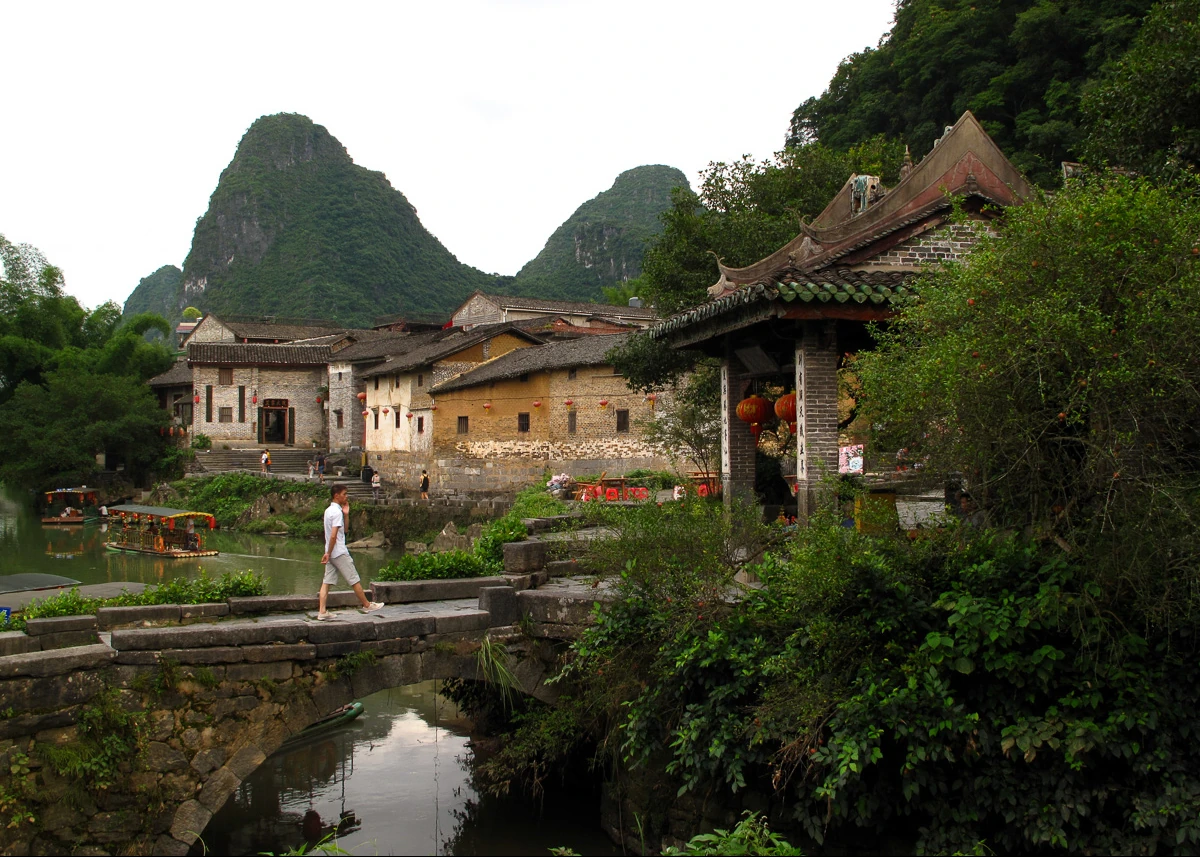
A stone bridge spans Huangyao’s waterway beside old buildings and distant karst hills.
Bridge, waterway and settlement in Huangyao, Hezhou. Source-reported photograph date: 2017-06-29.

Water breaks up the town

Huangyao belongs to Zhaoping County in Hezhou, eastern Guangxi. Its familiar stone streets are only one part of how the town is organized. The Guangxi civil-affairs account names the Yaojiang, Xiaozhujiang and Xingning waterways among its defining features. Hills, stream edges and crossings interrupt the built fabric, changing the scale and direction of a walk.

A narrow lane may open toward a stream, while a building turns one face to the street and another to the water. Crossings connect small districts without making them identical. Calling Huangyao simply a water town misses the particular combination of sloping ground, waterways and stone surfaces that gives it character.

A crossing changes the rhythm of walking

China Tourism News describes Dailong Bridge as a stepped stone arch. Its approach changes level before carrying a pedestrian over the water. The arch creates a passage beneath and a route above; it is both an engineering form and a threshold in the town. Other crossings give the town a variety of routes and forms.

The bridge’s approach and the lane feeding into it shape the experience together. A bend, a flight of steps or a sudden open view can mark a transition between nearby districts. The bridge belongs to a wider network of paths and waterways among the town’s inherited and renewed structures.

The canopy forms a separate layer

Huangyao’s scenic-area tree inventory records species and locations, including figs and camphor trees near streets, institutional grounds and the old theater. Different trunks and crowns create different patterns of shade and different relationships with nearby buildings.

Foliage can connect spaces that walls divide. A trunk may narrow a route; a spreading crown can make an exposed area feel enclosed. Inventory ages and building dates are separate evidence. A tree may outlive the structures around it, while a historic setting may include younger planting. Both are part of the town’s living fabric.

The landscape was also a social argument

Scholar Mai Sijie’s study of Qing Huangyao examines how lineage organization and fengshui interpretations shaped local society. Dailong Bridge appears as more than a convenient crossing: its name and position were connected with ideas about drawing auspicious influence from the surrounding landscape. The study links these interpretations to claims about authority and the organization of community space.

The landscape could express belonging, prosperity and order. Accounts of dragon veins or protective hills belong to cultural interpretation rather than geology. Names, shrines and inscriptions preserve clues to how particular groups understood the town, alongside the physical waterways and slopes.

A lived-in town has more than one timescale

Regional heritage descriptions identify Ming- and Qing-period buildings and stone-paved streets. These give Huangyao several timescales at once: inherited routes, surviving structures, and the repairs and services that support present use. Older routes and new uses share the same streets.

Paving, thresholds, drains, roof edges, tree shade and water meet along an ordinary stretch of street. Their connections explain how the town works as a place. A bridge, an old tree and a lane can each be memorable; their relationship is what brings Huangyao’s built and natural elements together.

A stone-paved lane passes between old masonry buildings in Huangyao.
A daytime lane in Huangyao, Hezhou, photographed on 29 June 2017.
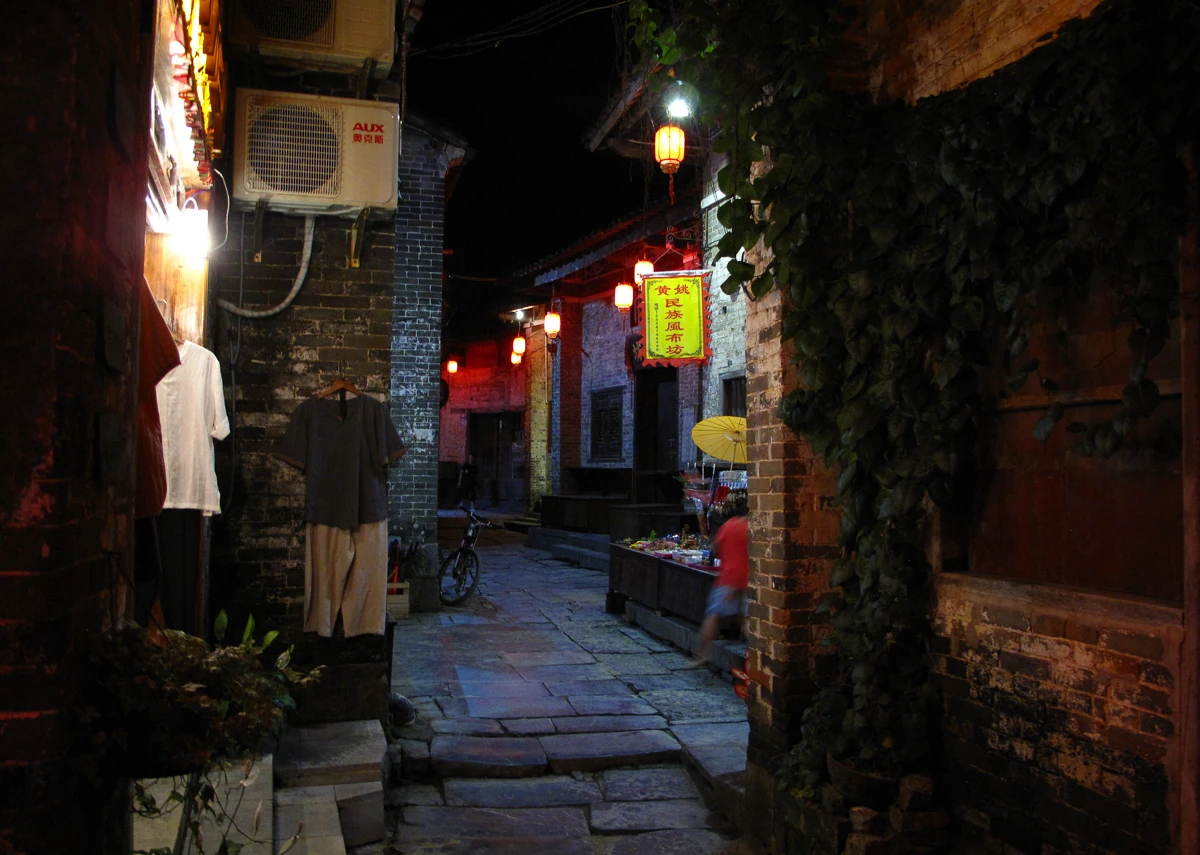
Warm lights and lanterns illuminate a stone-paved lane in Huangyao after dark.
Lanterns and signs along Huangyao’s lanes after dark, photographed on 29 June 2017.
Continue exploring · Huangyao Ancient Town ↗
Photo credits and rights
  1. Bridge, waterway and settlement in Huangyao, Hezhou. Source-reported photograph date: 2017-06-29.Rutger van der Maar · CC BY 2.0 Photo source ↗ Rights information ↗ Resized and converted to WebP; full composition retained.
  2. A daytime lane in Huangyao, Hezhou, photographed on 29 June 2017.Rutger van der Maar · CC BY 2.0 Photo source ↗ Rights information ↗ Resized and converted to WebP; full composition retained.
  3. Lanterns and signs along Huangyao’s lanes after dark, photographed on 29 June 2017.Rutger van der Maar · CC BY 2.0 Photo source ↗ Rights information ↗ Resized and converted to WebP; full composition retained.