From the journal

Qianshan: Pines, Stone and the Shape of a Mountain

A rock cleft, a named pine and a terrace beneath a temple roof offer three scales for reading Qianshan. The pear-growing country adds a fourth: a mountain landscape that also produces a harvest.

In the same city · Anshan ↗
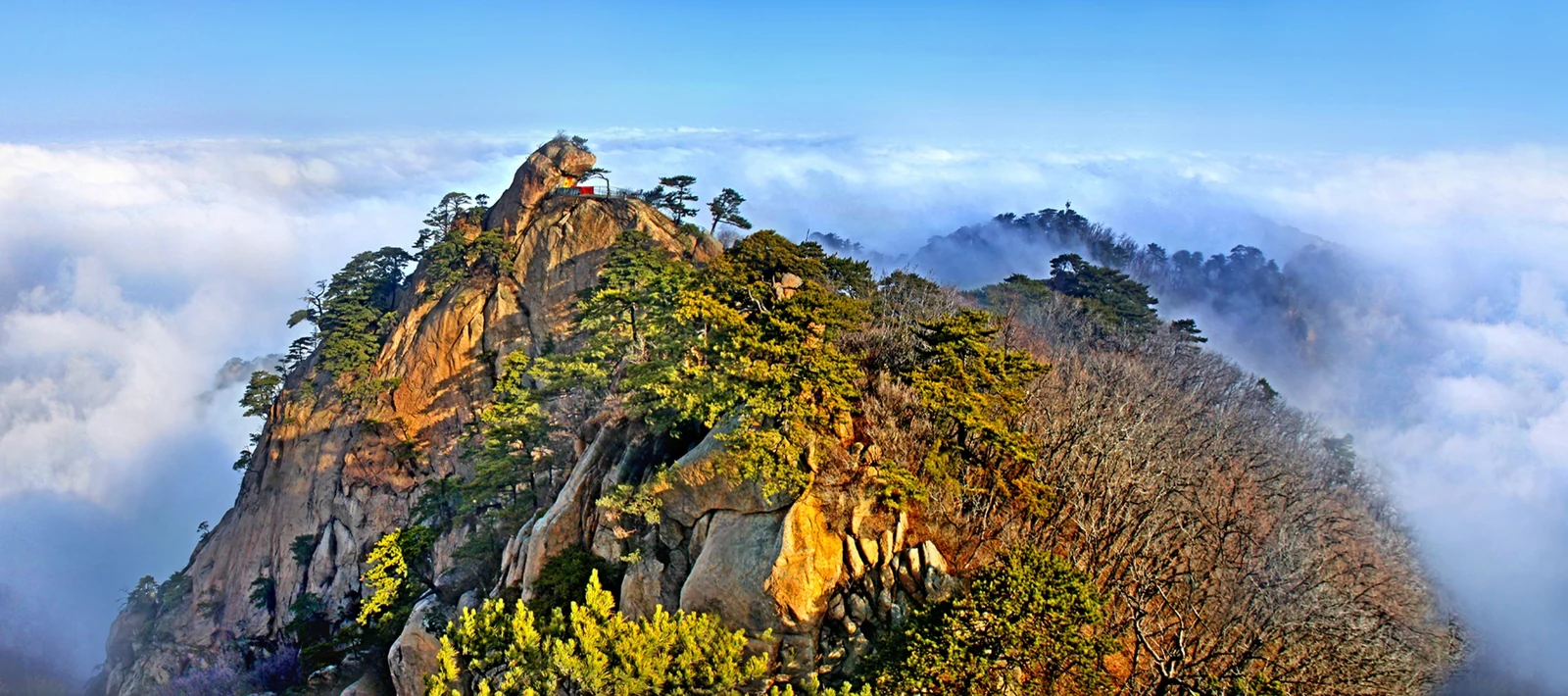
Pines grip a steep golden-grey ridge with a small railed viewing platform above drifting cloud.
Rock and pine above the clouds at Qianshan, Anshan.

A landscape given names

Qianshan’s longer name, the Thousand Lotus Mountains, carries a traditional image of many peaks opening like petals. The familiar story gives the mountain 999 summits. The number gives poetic form to a horizon crowded with summits.

More revealing are the smaller names. Parrot Rock gives an animal’s identity to a silhouette; a name such as Tianshangtian, literally a heaven above heaven, makes height into an experience. A complicated horizon becomes a sequence of named forms: a bird, a height beyond another height, a narrow opening in stone. The language makes particular places memorable within the larger mountain.

The mountain at close range

The narrow cleft called Yizitian changes the proportions of the landscape. In the scenic association’s description, it is straight and confined, with the sky visible as a thin opening above. What matters is the contrast between an enclosed passage and the wider ridges nearby. Rock that forms a distant outline becomes an immediate boundary around the body.

Pines provide a different kind of line. The association’s account of the Tianshangtian area repeatedly brings crags and old trees together, including the pines by Parrot Rock. The eye can follow a trunk and its branches across an irregular stone surface, then out towards another ridge. A branching crown spreads across the hard outline of a crag. The trees give a living scale to surfaces that can otherwise seem almost abstract.

Making room for a temple

At Longquan Temple, the provincial architectural inventory records three stone platforms and buildings fitted between steep sides. The principal halls occupy the centre, while bell, drum and book-storage buildings take positions on the flanking ground. The southwest entrance rises by a turning path on the hillside.

The terraces give ritual buildings level space without concealing the slope that makes such space difficult. Steps, retaining edges and changes of height are therefore part of the architecture’s meaning. A hall can have a formal front and still belong to a route that bends with the hillside. The terrain explains why the approach is as important as the final view of a roof.

Blossom is the beginning of a crop

The country around Qianshan adds a cultivated season to the rock-and-pine landscape. The pear-blossom festival that opened here on 21 April 2024 brought spring flowering into the mountain’s public celebrations. Blossom also points forward to fruit, work and processing.

At the 2019 festival, local Nanguo pear cooperatives and businesses presented juice, wine, dried fruit and pear paste as well as pears. Those products make the relationship between a spring spectacle and an agricultural economy unusually clear. The same flower that attracts a camera begins a crop whose uses extend beyond the weeks of fresh fruit.

Continue exploring · Qianshan ↗
Photo credits and rights
  1. Rock and pine above the clouds at Qianshan, Anshan.Source: Liaoning Provincial Department of Culture and Tourism / People’s Government of Liaoning Province. Rights not independently licensed. · Rights status unknown Photo source ↗ Original aspect ratio retained. Display copies resized only when needed; no enlargement, crop or retouching.