From the journal

Xiuyan Jade: Carving with the Stone

A lid that fits, a thin vessel wall and a chain that moves all begin with decisions about what to leave in a block. Xiuyan’s carvers make those decisions visible.

In the same city · Anshan ↗
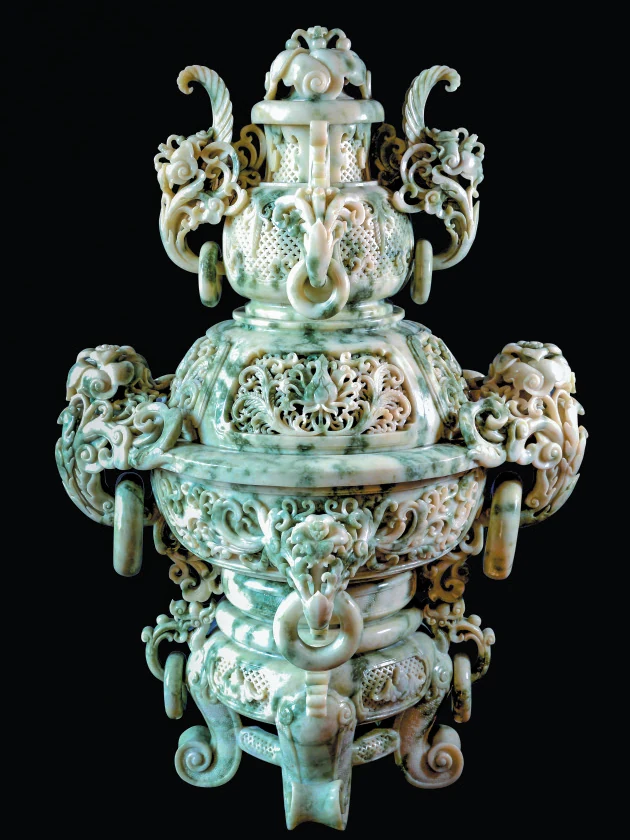
A pale green carved vessel has layered bodies, pierced panels, curling ornaments and loose-looking rings against a dark backdrop.
An ornamental vessel illustrating Xiuyan jade carving, with pierced panels and ringed handles.

A place name is not a mineral test

Xiuyan Manchu Autonomous County is associated with more than one jade material. Gemological accounts use Xiuyan jade for familiar serpentine material, while geological research also identifies nephrite deposits in the county. Serpentine and nephrite are distinct. The place name, the trade name and the composition of a particular object are therefore different kinds of information.

Within a workshop, the geographic name gives way to the particular block. Colour can vary through it; a flaw can interrupt a promising area; its dimensions limit the form that can be retained. Those properties enter the design before a finished figure or vessel has emerged.
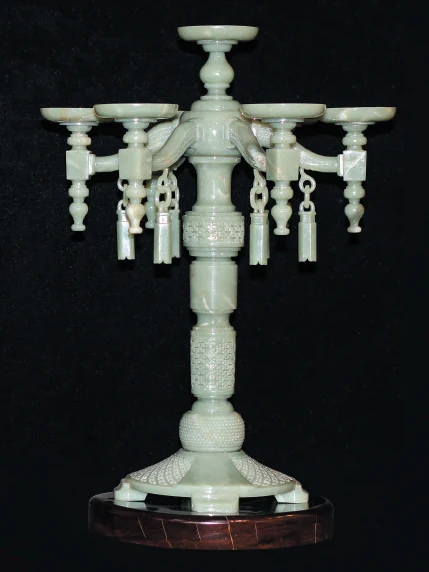
A pale green jade stand branches into shallow cups, with ring-linked hanging pendants above a dark circular base.
A branched ornamental stand presented as an example of Xiuyan jade carving.

The demands of a vessel

Xiuyan’s tradition is especially associated with su huo, a workshop category that includes vessels modelled on older ceremonial forms. The term does not mean an absence of difficulty. A jar or incense vessel has an outside silhouette, an interior and often a lid: surfaces that must agree with one another.

A 2023 published profile describes Wang Yunxiu working with an electric grinder and explains the discipline of straight walls, an even interior and a properly fitting lid. It also describes a different response to a flaw: he developed openwork plum blossoms around the troublesome part of the material. The vessel demands regular surfaces, while the flaw demands a change of plan. Wang’s openwork turns the troublesome area into an active part of the design.

How a stone chain can move

Movable rings and chains are among the techniques recorded for Xiuyan carving. Their fascination is structural: separate links can remain connected even though the work began as solid material.

A practitioner’s account by Beijing carver Chen Pingyuan explains the general method through his own linked-vessel work. Vessel and chain are planned within one block. The position, size and angle of each ring have to be established before enough material is removed to free it. A misplaced cut can break the continuity that the whole design depends upon.

The empty spaces are consequently as important as the remaining stone. The maker must create room for movement without cutting away the material that makes the link complete. The stone stays rigid; the spaces between the links make movement possible.

A tradition carried by particular people

The National Library of China’s record traces Wang Yunxiu’s training to He Desheng and Fei Yongxiang. After the county jade factory closed in 1993, he established the Youlian workshop and continued teaching vessel carving. The change of workplace is significant: a skill associated with a factory had to find another setting in which people could practise and learn it.

His recorded works include Qinian Dian, named for the Hall of Prayer for Good Harvests, and Tianji Zun, a vessel whose title invokes a celestial rooster. Such names connect carving with architectural and ceremonial vocabularies. A vessel can carry the memory of an older ritual form; an architectural subject can turn a familiar building into an object shaped from one chosen material.

From a lid to an architectural object

The national heritage record identifies another ambitious object, the tower-shaped incense burner Huaxia Lingguang, in the collection of the Great Hall of the People in Beijing. It takes the vessel tradition towards an architectural scale and vocabulary. The work carried the county’s vessel-making tradition into a national ceremonial setting.

Set beside a fitted lid or a moving link, such a work suggests the range contained within the county’s carving tradition. Technical achievement is not only a matter of making something larger or more intricate. It can lie in the meeting of two surfaces, in a colour change retained within a design, or in the small clearance that allows one stone ring to pass through another.

Continue exploring · Xiuyan Manchu Autonomous County ↗
Photo credits and rights
  1. An ornamental vessel illustrating Xiuyan jade carving, with pierced panels and ringed handles.Source: Liaoning Provincial Department of Culture and Tourism, Intangible Cultural Heritage Division. Photographer not identified; rights unknown. · Rights status unknown Photo source ↗ Original aspect ratio retained. Display copies resized only when needed; no enlargement, crop or retouching.
  2. A branched ornamental stand presented as an example of Xiuyan jade carving.Source: Liaoning Provincial Department of Culture and Tourism, Intangible Cultural Heritage Division. Photographer not identified; rights unknown. · Rights status unknown Photo source ↗ Original aspect ratio retained. Display copies resized only when needed; no enlargement, crop or retouching.