From the journal

How a Museum Was Made: Lüshun’s Building and Far-Travelled Collections

An Ionic portico, Central Asian objects and repaired Buddhist manuscripts open three different histories of the same institution.

In the same city · Dalian ↗
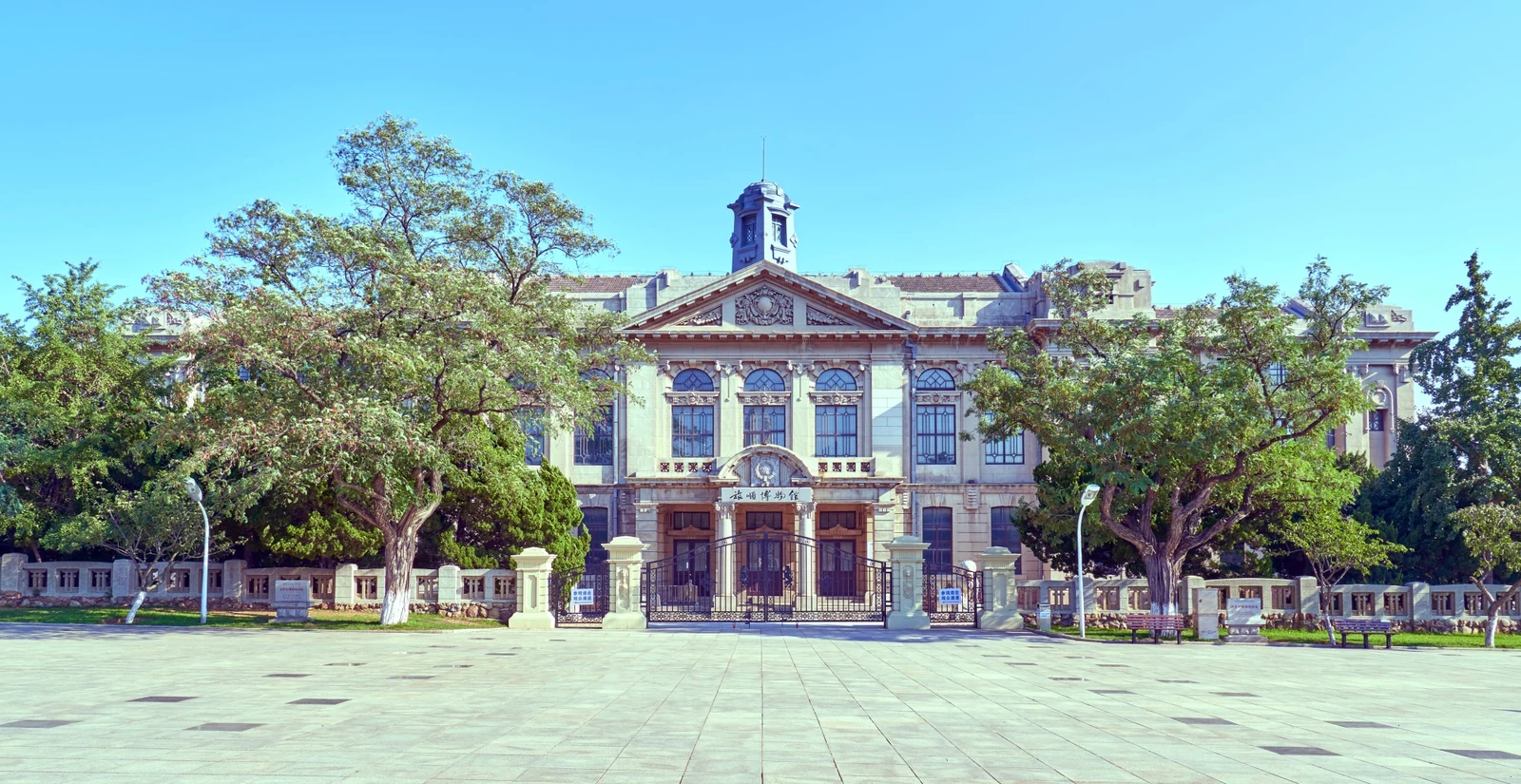
The main building of Lüshun Museum, with its central pediment, tall columns, arched windows and gated entrance.
The main building of Lüshun Museum, opened in 1918.

Two dates at the entrance

The institution and its main building did not open on the same day. Lüshun Museum’s official institutional opening was 1 April 1917; the present main building opened on 22 November 1918. The collection had begun receiving visitors before the monumental building was ready.

Architect Matsumuro Shigemitsu designed the building on foundations intended for a Russian soldiers’ club. The Ionic portico places its scroll-like column capitals in a conspicuous position at the entrance, while the composition draws on more than one architectural vocabulary. The inherited foundation and later design make the building itself an object with successive authors, rather than a neutral container that appeared when the collection was ready.
The route from expedition to collection

Some of the museum’s Central Asian holdings came from expeditions organised by the Japanese Buddhist figure Ōtani Kōzui between 1902 and 1914. The museum’s own account records their arrival in Lüshun’s custody in 1916 and purchase for the collection in 1929. That sequence places the objects within the collecting networks of the colonial era.

An acquisition date answers only one provenance question. It does not by itself explain the circumstances in which each object left its original setting. A stele fragment, manuscript or religious image carries a history before entering the museum, and its displacement may separate it from a building, community or larger archaeological group. The fragments of the Beiting Longxing Temple stele make that incompleteness tangible: a broken monument can preserve text while losing much of the setting that once gave it meaning.

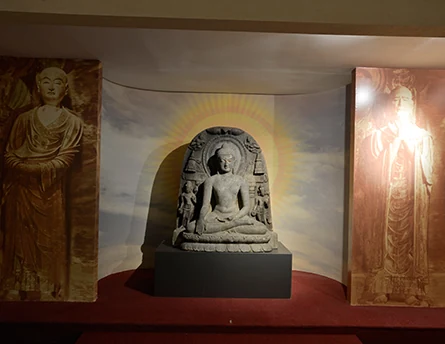
A seated Buddhist figure on a dark plinth in Lüshun Museum’s Silk Road gallery, framed by exhibition panels.
A seated Buddhist figure displayed in Lüshun Museum’s Silk Road exhibition.

The repair is part of the manuscript

Recent research offers a different scale of attention. The museum’s publication of fourteen Dunhuang manuscripts includes discussion of paper used to mend a Lotus Sutra. Repair strips preserve evidence associated with the tenth-century monk Daozhen. Such pieces are not merely damage to be ignored in favour of the main text; they can become historical evidence in their own right.

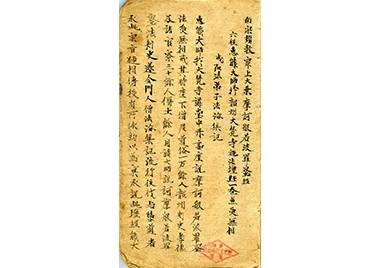
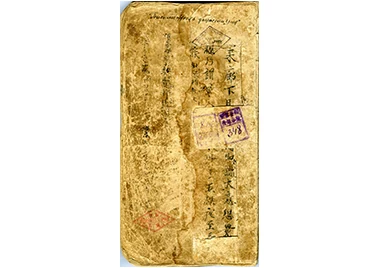
Another manuscript, of the Platform Sutra, preserves features such as punctuation and binding. These details concern how a text was handled and read. A book is not only a sequence of words that could be transferred without loss to a modern page. Paper, joins, annotations and sewing can retain traces of its material life.

A worn outer leaf of Lüshun Museum’s Platform Sutra manuscript, with handwritten Chinese text, labels and collection stamps.
The outer leaf of the Platform Sutra manuscript held by Lüshun Museum. The paper, labels and stamps are part of the object’s material history.
Vertical columns of Chinese writing on a yellowed leaf of Lüshun Museum’s Platform Sutra manuscript, with a red stamp near the lower edge.
A text leaf of the Platform Sutra manuscript held by Lüshun Museum.

The collection keeps changing intellectually

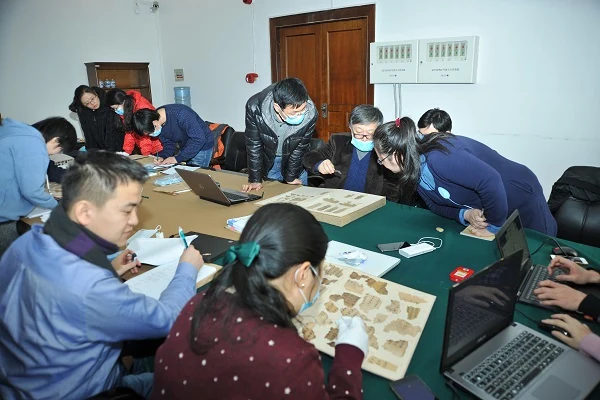
The museum’s separate work on Xinjiang manuscript fragments demonstrates why findspots and collection groups need to remain distinct. Dunhuang material and manuscripts associated with places such as Turfan should not be folded into a single undifferentiated “Silk Road” cache. Publication and comparison can reconnect fragments intellectually even when their physical histories remain complicated.

Scholarly publication gives these objects another life beyond the gallery. Reproductions make a repaired edge, a binding or a small fragment available for comparison with material held elsewhere. Earlier collecting dispersed the objects; later research can recover some of the relationships between them.

Researchers gather around tables to examine manuscript material beside open laptops.
Researchers at work in a photograph published with Lüshun Museum’s account of its Xinjiang document project.
Continue exploring · Lüshun Museum ↗
Photo credits and rights
  1. The main building of Lüshun Museum, opened in 1918.Source: Lüshun Museum official website. Photographer and image license not stated. · Rights status unknown Photo source ↗ Original aspect ratio retained. Display copies resized only when needed; no enlargement, crop or retouching.
  2. A seated Buddhist figure displayed in Lüshun Museum’s Silk Road exhibition.Source: Lüshun Museum official website. Photographer and image license not stated. · Rights status unknown Photo source ↗ Original aspect ratio retained. Display copies resized only when needed; no enlargement, crop or retouching.
  3. The outer leaf of the Platform Sutra manuscript held by Lüshun Museum. The paper, labels and stamps are part of the object’s material history.Source: Lüshun Museum official website. Photographer and image license not stated. · Rights status unknown Photo source ↗ Original aspect ratio retained. Display copies resized only when needed; no enlargement, crop or retouching.
  4. A text leaf of the Platform Sutra manuscript held by Lüshun Museum.Source: Lüshun Museum official website. Photographer and image license not stated. · Rights status unknown Photo source ↗ Original aspect ratio retained. Display copies resized only when needed; no enlargement, crop or retouching.
  5. Researchers at work in a photograph published with Lüshun Museum’s account of its Xinjiang document project.Source: Lüshun Museum official website. Photographer and image license not stated. · Rights status unknown Photo source ↗ Original aspect ratio retained. Display copies resized only when needed; no enlargement, crop or retouching.