From the journal

Xingcheng: A City inside the Walls

Gates and a central crossroads make the old Ningyuan garrison legible, while residents, sewing workshops and screen stories keep its streets in the present tense.

In the same city · Huludao ↗
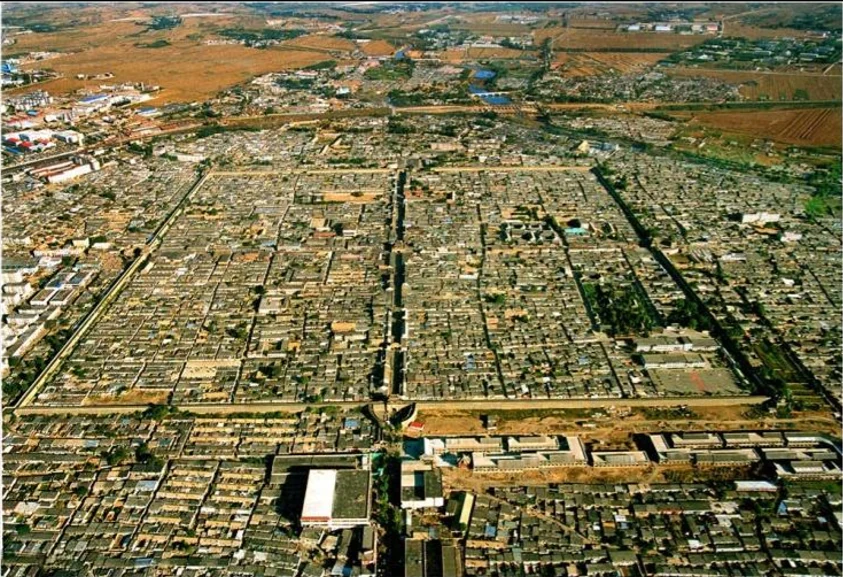
The roughly rectangular city walls enclose a dense grid of low roofs and straight streets, with farmland beyond.
An undated aerial photograph of Xingcheng Ancient City and its surrounding settlement.

A square with a centre

Xingcheng Old City occupies the old urban centre of Xingcheng, within Huludao. Founded in 1428 as Ningyuan, it belonged to the Ming dynasty’s system of fortified garrison towns. Its nearly square outline makes that planning easy to grasp: entrances on four sides connect to streets leading inward.

At the centre, the Bell and Drum Tower stands over four arched passages. A civic landmark is also a way through. Looking along the intersecting streets, it is possible to understand the city as an arrangement of movement rather than simply a wall enclosing monuments.

A two-storey tiled pavilion rises above a broad brick arch, with shops and pedestrians at street level.
Xingcheng’s Bell and Drum Tower, viewed from the east.

A city needs maintenance

The wall combines a stone foundation, brick exterior, rough-stone inner face and rammed-earth core. Its foundation in the fifteenth century was followed by major rebuilding in the 1620s, Qing repairs and modern conservation. The monument’s solid outline contains a succession of construction campaigns.

The city’s purpose changed with those campaigns. A Ming garrison became a place on the Qing emperors’ northeastern journeys, and the travelling court ordered further repairs. Military infrastructure acquired a role in imperial travel before becoming protected urban heritage.

A brick gateway supports a red two-storey pavilion, with a vehicle and pedestrians beneath the arch.
Chunhe Gate, the eastern gate of Xingcheng Ancient City.

More than a garrison

The Confucian temple adds another purpose to the town’s plan: honouring Confucius and supporting traditions of learning. Defence, education and public honour occupied the same small urban world.

The streets also contain work that has little to do with a Ming garrison. Xinhua reporters visiting in 2024 described residents chatting outside their homes and workers at sewing machines in small swimwear workshops. Xingcheng’s modern clothing industry has a place inside the old walls. The local past does not stop at the end of imperial history.

A television drama about swimwear entrepreneurs, Cheng Feng Ta Lang, used the old city as a setting. Its filming locations introduced another reason for people to stop in the lanes. A screen story, a working household and a historical monument may share an address, but they carry different dates and purposes. Together they sustain the streets as places of work, residence and remembrance.

Continue exploring · Xingcheng Old City ↗
Photo credits and rights
  1. An undated aerial photograph of Xingcheng Ancient City and its surrounding settlement.Source: Liaoning Provincial Department of Culture and Tourism, Cultural Heritage Administration Division. Photographer not identified; rights unknown. · Rights status unknown Photo source ↗ Original aspect ratio retained. Display copies resized only when needed; no enlargement, crop or retouching.
  2. Xingcheng’s Bell and Drum Tower, viewed from the east.Source: Liaoning Provincial Department of Culture and Tourism, Cultural Heritage Administration Division. Photographer not identified; rights unknown. · Rights status unknown Photo source ↗ Original aspect ratio retained. Display copies resized only when needed; no enlargement, crop or retouching.
  3. Chunhe Gate, the eastern gate of Xingcheng Ancient City.Source: Liaoning Provincial Department of Culture and Tourism, Cultural Heritage Administration Division. Photographer not identified; rights unknown. · Rights status unknown Photo source ↗ Original aspect ratio retained. Display copies resized only when needed; no enlargement, crop or retouching.