From the journal

Jiumenkou: Where a Wall Must Let Water Through

Nine openings reveal the practical problem of maintaining a boundary across a river.

In the same city · Huludao ↗
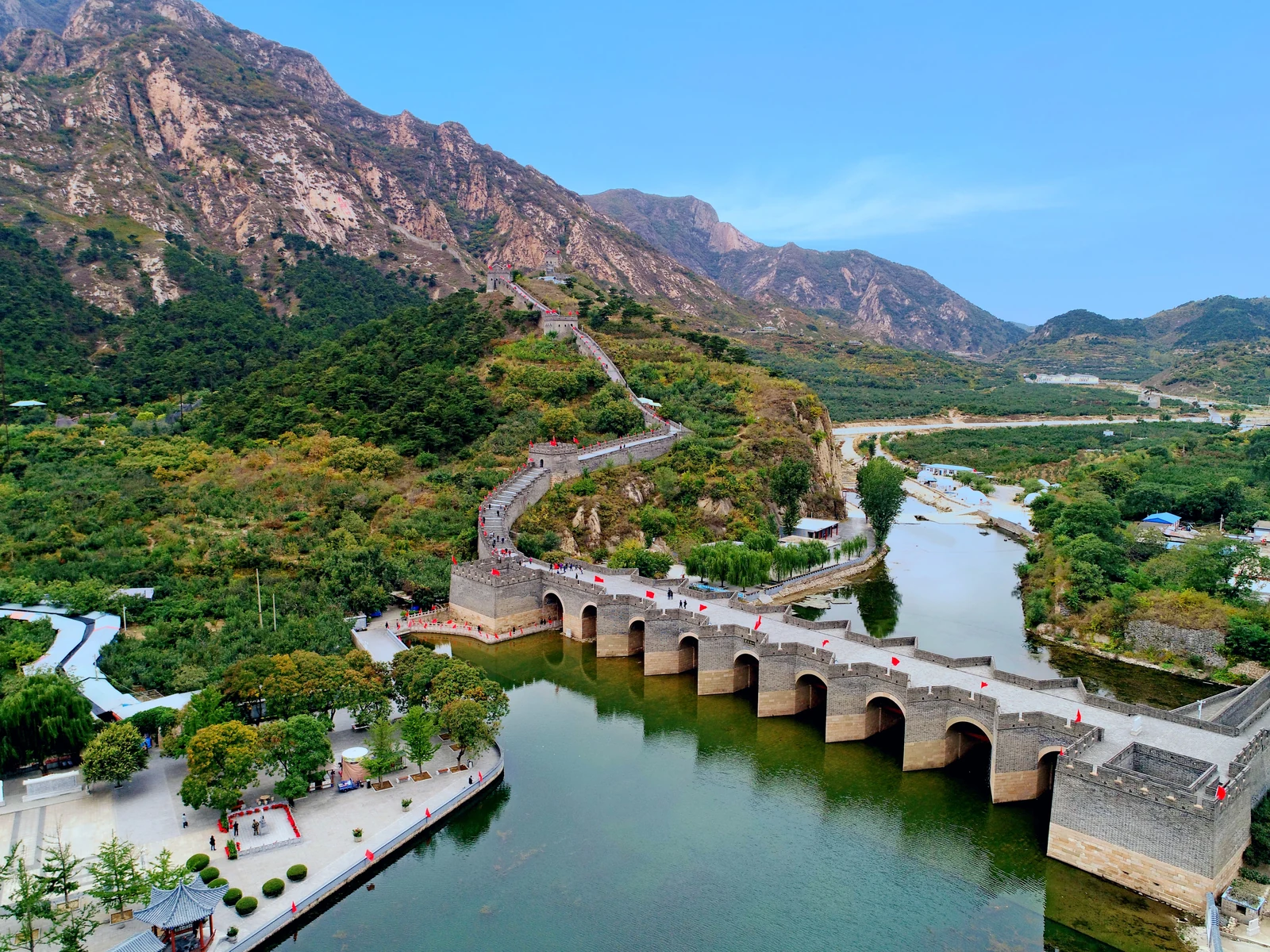
A stone wall crosses a river on arches and continues up a green, rocky mountainside.
The water crossing of the Great Wall at Jiumenkou, Suizhong County, Huludao.

Count the openings

At Jiumenkou in Suizhong County, the wall crosses the Jiujiang River. Eight piers divide the crossing into nine openings, giving the place its familiar name. The wall continues overhead while water has routes beneath it.

That arrangement states the builders’ problem clearly. A defensive line could follow a ridge, but a river could not simply be wished away. The crossing needed to preserve continuity above and passage below. The river channel is integral to the form of the fortification.

The work below the wall

The Ming pass is associated with construction in 1381. Its river engineering includes shaped piers and a stone-paved bed, with metal connectors joining parts of the stonework. Adjoining enclosures and wall sections made the bridge part of a defended passage rather than an isolated crossing.

The low-level details matter as much as the skyline. A foundation must meet uneven ground; piers must stand within a channel; openings must allow flow. The crossing accommodates moving water beneath a continuous defensive line, rather than attempting to close the river itself.

Four years beneath the familiar view

The present appearance also depends on twentieth-century archaeology. In a published recollection, excavation leader Feng Yongqian described work conducted from 1986 to 1989. Remains and measurements recovered during those four years supplied evidence for restoration.

Excavation recovered the arrangement of structures that had been damaged or lost. The present crossing combines surviving remains with reconstruction based on that investigation, giving the wall’s modern form a substantial archaeological history of its own.

A wall in a lived landscape

Jiumenkou stands by Xintaizi village. A 2024 local report describes produce stalls and the village economy around visitors, bringing an everyday scale back to the monumental setting.

The Great Wall was inscribed on the UNESCO World Heritage List in 1987 as a broad defensive system. Jiumenkou’s particular contribution is easier to appreciate through its local problem: a wall, a river and the people required to build, investigate and maintain the meeting between them.

Continue exploring · Jiumenkou Great Wall ↗
Photo credits and rights
  1. The water crossing of the Great Wall at Jiumenkou, Suizhong County, Huludao.Source: Liaoning Provincial Department of Culture and Tourism / People’s Government of Liaoning Province. Rights not independently licensed. · Rights status unknown Photo source ↗ Original aspect ratio retained. Display copies resized only when needed; no enlargement, crop or retouching.