From the journal

Zhaoling: A Royal Precinct Inside a Public Park

Hong Taiji’s mausoleum and Beiling Park occupy the same landscape, but they do not have the same boundaries or history.

In the same city · Shenyang ↗
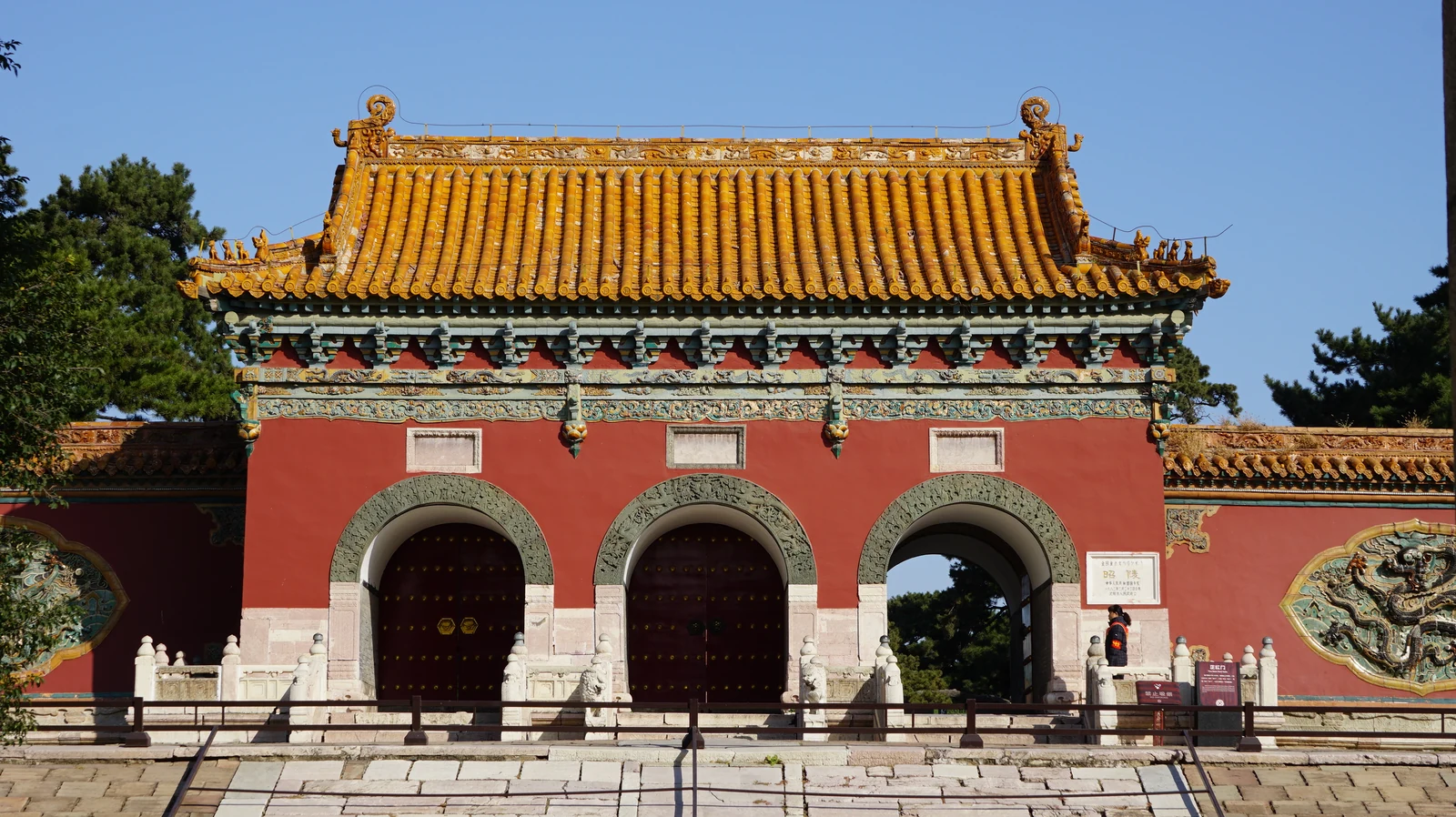
Three arched openings sit below one yellow-tiled roof in a red gate, flanked by glazed dragon panels.
Zhenghongmen, the ceremonial entrance to Zhaoling in Shenyang.

Two names, two scales

Beiling means Northern Tomb. In everyday use it also names the large public park surrounding Zhaoling, the mausoleum of Hong Taiji and Empress Xiaoduanwen. The tomb’s ritual courts and burial enclosure occupy a defined precinct within a wider recreational landscape.

Hong Taiji succeeded Nurhaci and proclaimed the Qing dynastic name in 1636. His empress, also known by her personal name Zhezhe, had shared the household world of Qingning Palace. Zhaoling makes that familiar palace relationship monumental: the ruler and empress are remembered together in a setting built for continuing dynastic rites.
A mausoleum made across reigns

Work began in 1643, the year Hong Taiji died. The empress was buried here in 1650, and the main early construction was substantially complete the following year. Subsequent Qing rulers enlarged and maintained the complex. The landscape should therefore be read as accumulated work rather than as the single architectural statement of a deceased emperor.

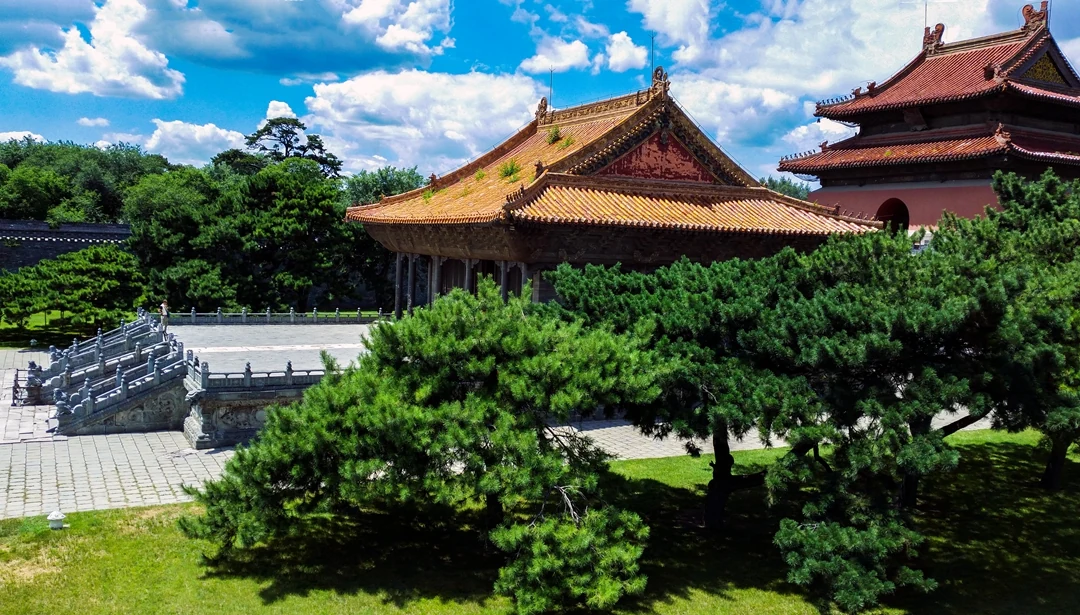
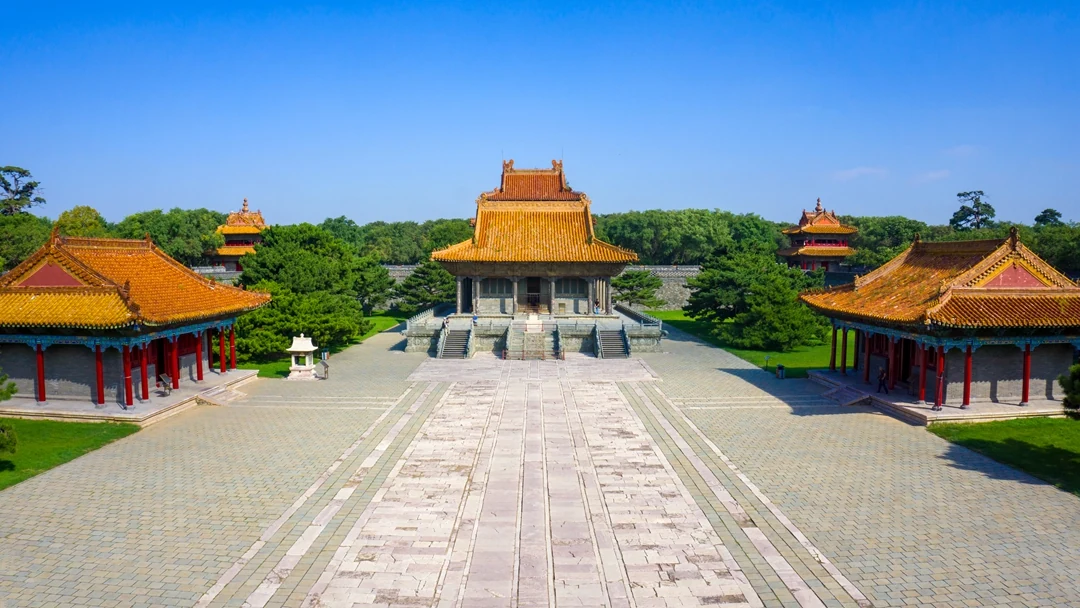
The main red gate, Long’en Hall and the tower marking the inner burial precinct belong to a progression of increasingly restricted spaces. An entrance establishes a threshold; a ritual hall accommodates offerings and commemoration; the burial enclosure protects another kind of place. Repetition of an axis connects these functions without making them interchangeable.

The long construction history is part of the meaning. To care for an ancestral tomb was to restate a relationship with the dynasty’s past. A later repair or addition can be historically significant even though it is not part of the first building campaign.

Pine trees partially screen a yellow-roofed hall, with a two-tiered tower rising behind it.
Long’en Hall and the Ming Tower amid the pines at Zhaoling.

The change in 1927

The grounds opened to the public in 1927. This introduced a new use into a landscape previously organized around royal commemoration. Beiling’s identity as a city park developed around a tomb whose principal buildings retained their ceremonial purpose in historical memory.

The wider park accommodates circulation, recreation and the needs of an expanding city. Within it, the mausoleum retains the prescribed sequence and enclosed courts of imperial ritual. Public life has grown around that older ceremonial core.

Zhaoling became part of UNESCO’s Imperial Tombs of the Ming and Qing Dynasties property in 2004, with defined property and buffer boundaries. Its royal precinct now sits within one of Shenyang’s established public landscapes.

A raised view follows a straight stone path through a courtyard toward a yellow-roofed hall, with matching side buildings.
The inner courtyard of Zhaoling’s walled square enclosure.
Continue exploring · Zhaoling Tomb and Beiling Park ↗
Photo credits and rights
  1. Zhenghongmen, the ceremonial entrance to Zhaoling in Shenyang.Source: Liaoning Provincial Department of Culture and Tourism. Image license not stated. · Rights status unknown Photo source ↗ Original aspect ratio retained. Display copies resized only when needed; no enlargement, crop or retouching.
  2. Long’en Hall and the Ming Tower amid the pines at Zhaoling.Source: Liaoning Provincial Department of Culture and Tourism. Image license not stated. · Rights status unknown Photo source ↗ Original aspect ratio retained. Display copies resized only when needed; no enlargement, crop or retouching.
  3. The inner courtyard of Zhaoling’s walled square enclosure.Source: Liaoning Provincial Department of Culture and Tourism. Image license not stated. · Rights status unknown Photo source ↗ Original aspect ratio retained. Display copies resized only when needed; no enlargement, crop or retouching.