From the journal

A Broken Calendar and a Monument Turned into Evidence

Two objects outside the September 18 museum carry radically different histories of the same event.

In the same city · Shenyang ↗
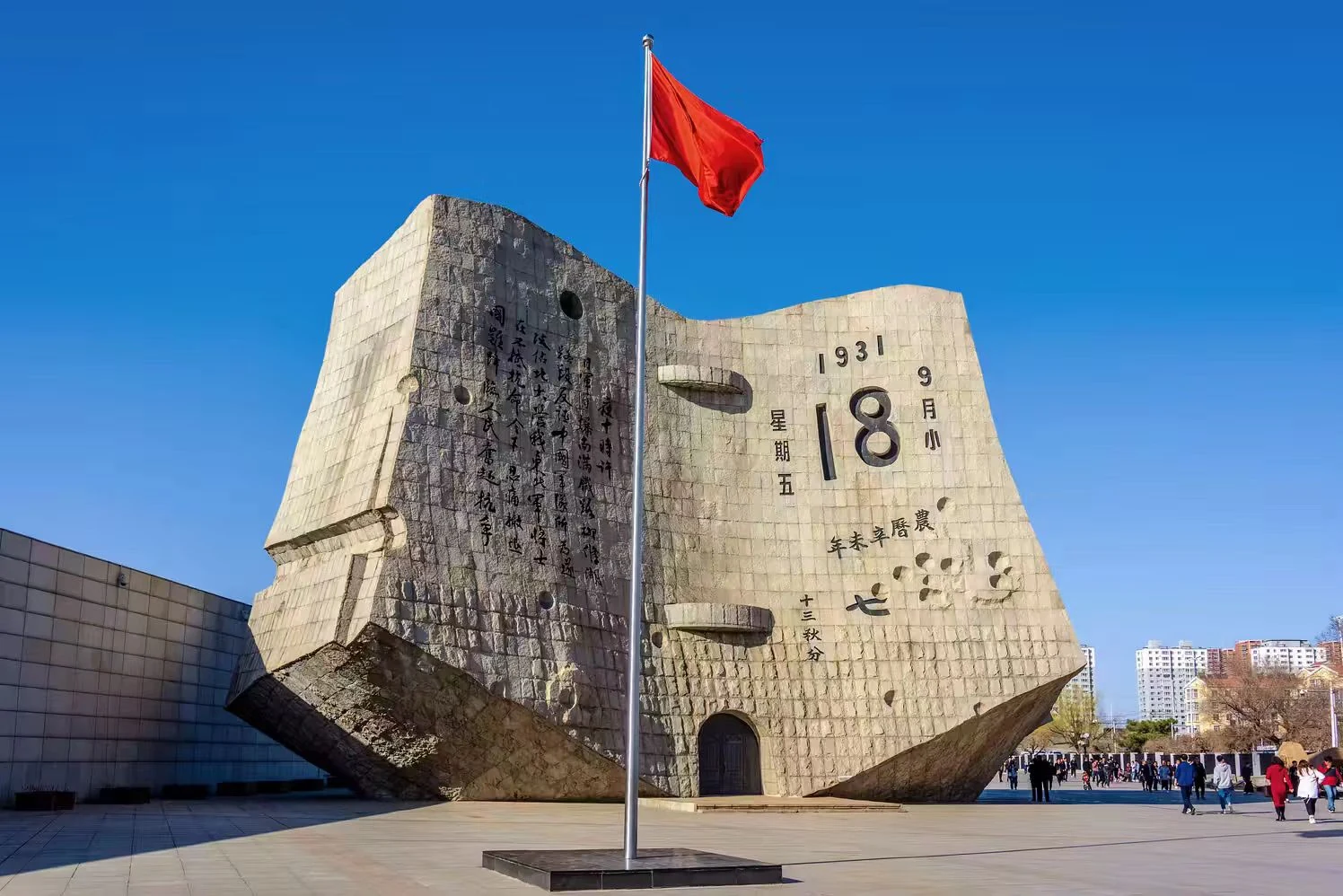
A large stone memorial shaped like a damaged calendar displays the date 18 September 1931, with a red flag in the foreground.
The calendar-shaped memorial at Shenyang’s September 18 History Museum.

The date before the monument

On 18 September 1931, Japanese army officers staged an explosion on the railway near Mukden, the name then widely used internationally for Shenyang, and used it as a pretext for military action against Chinese forces. The attacks led into the occupation of northeastern China. The postwar International Military Tribunal for the Far East examined the planning behind the incident in detail.

The date anchors the museum’s account of the invasion. Its outdoor monuments belong to later stages of that history: one was erected by the occupation authorities, the other created as a modern memorial to the rupture of 1931.

A page made too large to turn

The broken-calendar memorial translates a day into an architectural form. One side carries the date, while the other supplies an account of the event. Its deliberately damaged outline prevents the calendar from looking like a neutral instrument for counting days. A routine household object has become a public statement about rupture.

The device also changes the scale of remembrance. A calendar page is normally handled, replaced and discarded. Here its monumental size gives a single day a lasting place in the city. The material form is modern memorial design; it is not an object that survived the railway explosion.

Monumental scale and the damaged outline hold a fleeting calendar page in place. The design turns an ordinary household object into a lasting civic memorial.

An occupation-era object changes meaning

A surviving bomb-shaped monument provides a very different kind of evidence. Erected by the Japanese authorities in 1938 near the railway, it once served their commemoration of the incident. It was toppled after Japan’s defeat in 1945 and later moved into the museum’s care. Its present location should not be mistaken for the precise place where the original explosion occurred.

The object’s history contains a reversal. An inscription once intended to legitimize conquest can be preserved as evidence of the way conquest represented itself. Its preservation documents the occupation authorities’ attempt to give conquest a commemorative form. The physical object remains, but its authority is no longer accepted on its own terms.

That is a demanding kind of preservation. Destroying an unwanted monument and retaining it with a critical explanation are different choices. Here the latter allows an earlier political message to be inspected rather than simply repeated.

Remembering beyond the exhibition

The museum also belongs to Shenyang’s public calendar. A municipal report documents bells and warning sirens at the September 2025 commemorative ceremony. Those sounds extend remembrance beyond a display case, bringing a dated event into the present city.

The collection’s history includes a peace memorial donated by Japanese antiwar participants. That detail prevents national identity from becoming a substitute for examining individual positions and actions. The site addresses the aggression of the Japanese military while also preserving evidence of later opposition to war.

The broken calendar, the displaced monument and the commemorative sounds occupy different parts of the city’s memory. Modern design marks the date; an occupation-era object records the rhetoric of conquest; public ceremonies renew the act of remembrance.

Continue exploring · September 18 History Museum ↗
Photo credits and rights
  1. The calendar-shaped memorial at Shenyang’s September 18 History Museum.Source: Liaoning Provincial Department of Culture and Tourism, via the Liaoning Provincial Government website. Photographer and image license not stated. · Rights status unknown Photo source ↗ Original aspect ratio retained. Display copies resized only when needed; no enlargement, crop or retouching.