From the journal

Making Steel, Making Anshan

A sintering machine, a relocated furnace and a worker’s tool fixture tell different parts of Anshan’s industrial history. Together they explain how production depended on judgement as well as scale.

In the same city · Anshan ↗
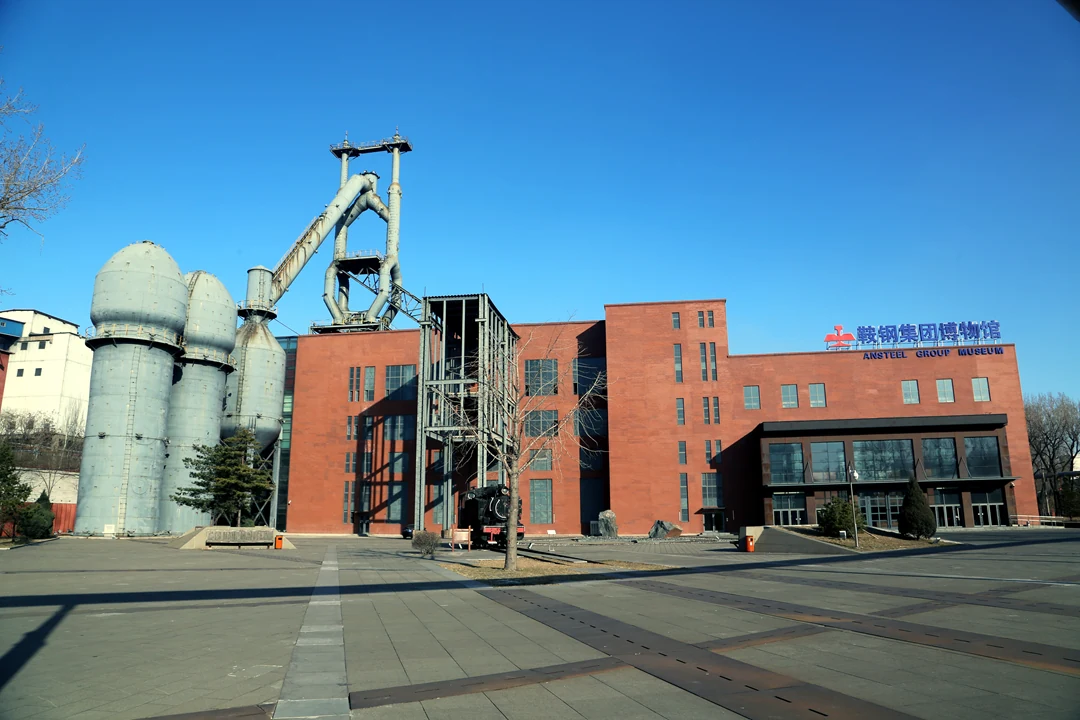
Red-brick Angang Museum building beside tall industrial cylinders and pipework in Anshan.
Angang Museum in Anshan, with the former No. 2 sintering workshop and the old No. 1 blast-furnace complex. The industrial structures now form part of the museum setting.

The building is part of the collection

Angang Museum occupies a former sintering workshop. Its retained frame, overhead crane and No. 4 sintering machine keep the scale of production within the exhibition. Sintering prepares fine iron-bearing material for a furnace by turning it into a more usable mass. The retained No. 4 machine entered service in 1957, using a Soviet design and equipment made in both the Soviet Union and China.

This makes the museum building unusually informative. A crane is not simply a dramatic object overhead: it points to lifting, maintenance and the weight of equipment. The machine’s position helps explain why a workshop needed its particular height and open space. The room was designed around work before it was designed around visitors.

Three transformations, not one

Ironmaking, steelmaking and rolling solve different problems. In a conventional integrated works, a blast furnace produces iron from ore. Steelmaking then adjusts the metal’s composition, including its carbon content. Casting turns liquid steel into semi-finished shapes; rolling passes hot material through shaped gaps to produce the required section or thickness.

A rail therefore carries evidence of more than a successful melt. Its profile must emerge through controlled shaping. A tube poses another requirement: a hollow product with a wall of usable consistency. Angang’s heavy-rail and seamless-tube production milestones in 1953 concerned these particular forms. A usable product joined metallurgy to controlled dimensions, allowing steel to leave the works as a component for transport or industry.

Forty-seven pieces of a furnace

The old No. 1 blast furnace had stopped production in 2005 before it became a museum object. Moving it was itself an engineering job. Ansteel’s retrospective describes the 2014 relocation: the ageing structure could not safely be lifted as a whole, so the shell was divided into 47 numbered sections, transported and assembled again. Workers planned cuts around riveted fabric and replaced damaged components where necessary.

Numbering, transport and reassembly gave the furnace a second construction history. Its first life had depended on keeping an industrial process running; its museum life depended on deciding what could be retained and how to support it. An LED installation now supplies the glow of simulated molten iron inside the retired structure.

What the worker knew

A 2024 report on Angang contrasts two ways of understanding a furnace. Earlier operators judged aspects of its condition from the size, brightness and movement of sparks; a modern control room brings together measurements such as temperature, pressure and gas permeability. The operator’s working vocabulary has expanded from the appearance of the metal to streams of instrument readings, each connected to conditions inside the furnace.

The museum’s worker stories are similarly concrete. Meng Tai salvaged spare parts during the rebuilding of production. Wang Chonglun’s universal tool fixture addressed machining work. A stored component or a small device can be less imposing than a furnace, but both reveal the recurring problems of a factory: a part wears out, a setup takes too long, a job needs a better method. Such objects make industrial history intelligible at the scale of a working day.

Beyond the factory gate

Anshan’s protected industrial heritage also includes residential and educational buildings. Their presence broadens the meaning of a steel city. Production required more than a sequence of machines; people had to live, learn and maintain skills around them.

The products also acquired a life beyond their practical uses. A 2021 temporary exhibition included replicas of a seamless tube made as a commemorative gift. An industrial section had become a symbol worth reproducing and displaying. Elsewhere, a salvaged spare part or a machining fixture brought the story back to keeping a workplace running. Both kinds of object belong to the city’s industrial memory: the product formally celebrated and the equipment needed for the next day’s work.

Continue exploring · Angang Museum ↗
Photo credits and rights
  1. Angang Museum in Anshan, with the former No. 2 sintering workshop and the old No. 1 blast-furnace complex. The industrial structures now form part of the museum setting.Source: Liaoning Provincial Department of Culture and Tourism, Cultural Heritage Administration Division. Photographer and image license not stated. · Rights status unknown Photo source ↗ Original aspect ratio retained. Display copies resized only when needed; no enlargement, crop or retouching.