From the journal

Yongling: Ancestry before Empire

At Yongling in Xinbin, imperial status reaches back into a family’s past. Four memorial pavilions, an offering hall and the archive of a fallen sacred tree show how that relationship was maintained.

In the same city · Fushun ↗

The family before the dynasty

Yongling belongs to Xinbin Manchu Autonomous County in Fushun. Its principal ancestors include Fuman, Giocangga and Taksi, respectively the great-grandfather, grandfather and father of Nurhaci, together with the more remote ancestor Mengtemu. Nurhaci was the leader who established the Later Jin state that preceded the Qing. He is buried at Fuling in Shenyang; his son Hong Taiji is buried at Zhaoling, also in Shenyang.

The difference is fundamental. Yongling honours the family before those rulers. Four memorial pavilions give the principal ancestors an architectural presence, while the later emperors’ visits turned an ancestral place into a focus of dynastic ceremony. The landscape is a genealogy that can be approached through buildings.
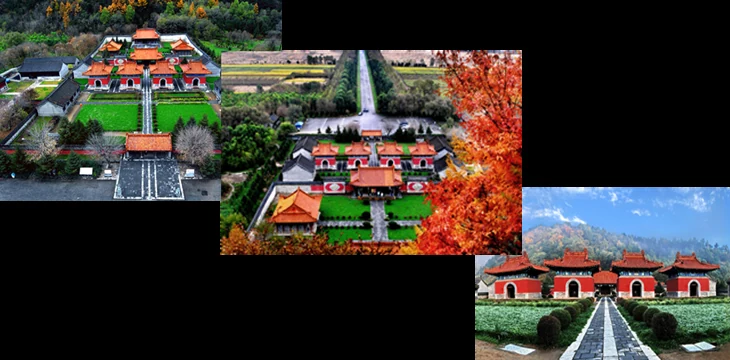
Three overlapping photographs show red-walled tomb buildings, tiled roofs, straight paths and autumn foliage at Qing Yongling.
Three views of Qing Yongling, presented together by the official source as a single composite image.

When descendants confer imperial status

In 1648, the four ancestors received posthumous imperial titles. Later descendants conferred on them a status they had never held in life. The titles changed the ceremonial position of the dead within the reigning family.

Political authority reached backwards, giving earlier generations a place in the reigning dynasty’s ceremonial order. The later name Yongling, adopted in 1659, also expressed continuity. Its importance did not depend on the ancestors having occupied the same offices as the descendants who honoured them.

Architecture for the living and the dead

Qiyun Hall stands before the enclosed burial area and served as a place for offerings. The hall provided a setting for the living to perform rites, while the burial mounds occupied the protected space behind it. The approach led through places of commemoration before reaching the enclosure of the dead.

The wider enclosure and its mountain setting belong to the same ceremonial conception. UNESCO’s account treats these tombs as designed landscapes, combining buildings with the placement of the dead in relation to their surroundings. Yongling joined the serial Imperial Tombs of the Ming and Qing Dynasties property in 2004, together with Fuling and Zhaoling. The three complexes bring successive family relationships into one heritage property: ancestors, Nurhaci and his son.

A fallen tree becomes a court emergency

An unusually vivid episode survives in drawings now held by the National Palace Museum in Taipei. An elm behind Qiyun Hall had received a sacred protective title from the Qianlong emperor in 1754. In 1863, a storm exposed its roots and tipped the tree against the hall’s eaves.

The Shengjing general Yuming urgently reported the damage to the empress dowagers Ci’an and Cixi in Beijing. An imperial commissioner, Jipu, was dispatched, while craftsmen drew the tree’s position and proposed ways to protect it. The drawings brought a difficult local problem before a distant court: roots, trunk, roof and supports had to be understood on paper.

The episode reveals how closely the dynasty connected an ancestral landscape with its own welfare. It also restores practical work to the story. A sacred title did not prevent storm damage; officials still needed reports and craftspeople still needed measurements.

Continuity includes repair

The 2004 ICOMOS evaluation distinguished Yongling’s principal historic buildings from reconstructed secondary kitchen and storage structures. The kitchens and stores recall the practical work around imperial ceremony. Offerings and visiting parties required preparation as well as a formal place in which to gather.

Yongling’s meaning emerges from these layers together: family descent, retrospective titles, the movement of imperial visitors, and the care of buildings and trees. The surviving archive makes the place particularly human. Behind the language of everlasting dynastic fortune were people assessing a leaning trunk and deciding how to keep it from damaging a roof.

Continue exploring · Qing Yongling ↗
Photo credits and rights
  1. Three views of Qing Yongling, presented together by the official source as a single composite image.Source: Qing Yongling official website, reproduced by the Liaoning Provincial Department of Culture and Tourism. Photographer and image license not stated. · Rights status unknown Photo source ↗ Original aspect ratio retained. Display copies resized only when needed; no enlargement, crop or retouching.