From the journal

Fushun Jet: A Dark Material Made to Shine

Jet links Fushun’s coal history to carving on a smaller scale. Chisels, polish and subjects as unexpected as a handbag show how makers turn a dark material into an object of attention.

A material with an industrial neighbour

Jet is a dark, coal-related organic gem material that can be carved and polished. In Fushun it is known as meijing, and sometimes by the evocative trade expression coal jade. That expression describes its valued appearance and use; it does not make it a jade mineral.

It is also different from amber, although the two appear together in Fushun’s craft businesses and heritage accounts. Amber is fossilised tree resin. One workshop can therefore handle two different organic materials, each requiring its own choices of form and finish.

The connection with coal is nevertheless important to the city’s story. A material from an industrial resource setting could be selected for its ability to hold a form and take a polish, rather than be understood only through fuel and extraction.
A sequence of judgements

The national craft record names operations such as cutting, scraping, drilling, grinding and polishing. These are different kinds of action, not one universal recipe to be followed mechanically. Rough shaping establishes volume; more selective removal defines a figure, an opening or a vessel. Surface work changes how light travels across the finished form.

The Shuanghexing workshop’s profile describes choosing a piece, assessing it, drawing a design and then carving. Its history also describes woodworkers’ chisels and plane blades used in amber carving, the related craft practised alongside jet. The inherited vocabulary of tools connects the crafts through controlled removal: the edge meets a surface and takes away a chosen amount.

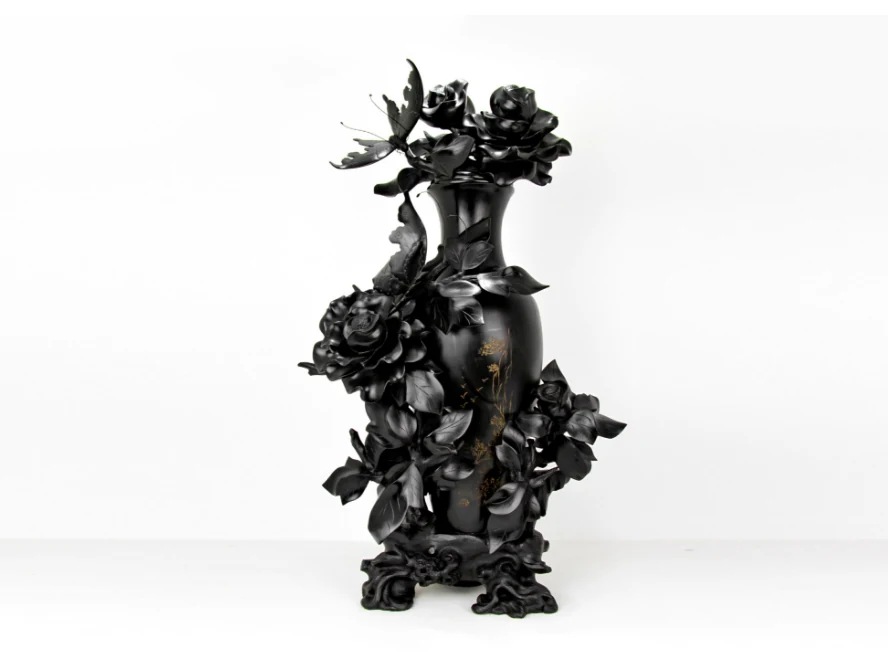
A polished black surface can make a contour especially important: light catches a ridge or curves across a rounded part while a recess remains dark. That is an optical reason to attend to shaping and finish together. Shine alone cannot explain the work.

A glossy black carved vase is surrounded by flowers, leaves and a butterfly, standing on an ornamental base against white.
A polished black carving shown in Fushun’s official heritage overview; the page does not identify its material, maker or title.

From workshop history to a handbag

The national heritage account names Zhao Kunsheng and Zhao Jinglin in the early-twentieth-century transmission of Fushun jet carving. Their place in the record gives the craft a history of makers rather than an anonymous origin in the mine. Later workshops continued to teach and develop its figure, animal and vessel forms.

A particularly revealing group of works travelled to the China International Import Expo in 2023. The official report lists Handbag and Gloves alongside One-Horned Rhinoceros and Ancient Beast Incense Burner. The delegation included the provincial heritage practitioner Wu Peng.

A handbag and gloves bring a different material association to the group. They are familiar through carrying, touch and flexibility; the carved versions depend on a rigid, polished form. Beside the animal and incense vessel, these domestic subjects extend the workshop’s repertoire into the things people wear and use.

What an archive can keep

A 2023 provincial response about protection of the craft describes written, photographic and video documentation, together with a publication on Fushun jet carving. These formats preserve different evidence. A photograph can record a finished profile; moving images can show how a maker holds a tool or changes direction. Neither is quite the same as developing that judgement through practice.

Selection, shaping and polish join the material’s geological life to the maker’s working life. A successful vessel or figure depends on decisions too small to appear in a history measured only in industrial output. In a carver’s hands, a resource associated with extraction becomes an object intended to be held, examined and kept.

Continue exploring · Fushun ↗
Photo credits and rights
  1. A polished black carving shown in Fushun’s official heritage overview; the page does not identify its material, maker or title.Source: Fushun Municipal Bureau of Culture, Tourism, Radio and Television. Photographer and image license not stated. · Rights status unknown Photo source ↗ Original aspect ratio retained. Display copies resized only when needed; no enlargement, crop or retouching.