From the journal

A Red Beach Made of Small Plants

The broad sweep of colour begins with the leaves of a salt-tolerant plant, not with red sand.

In the same city · Panjin ↗
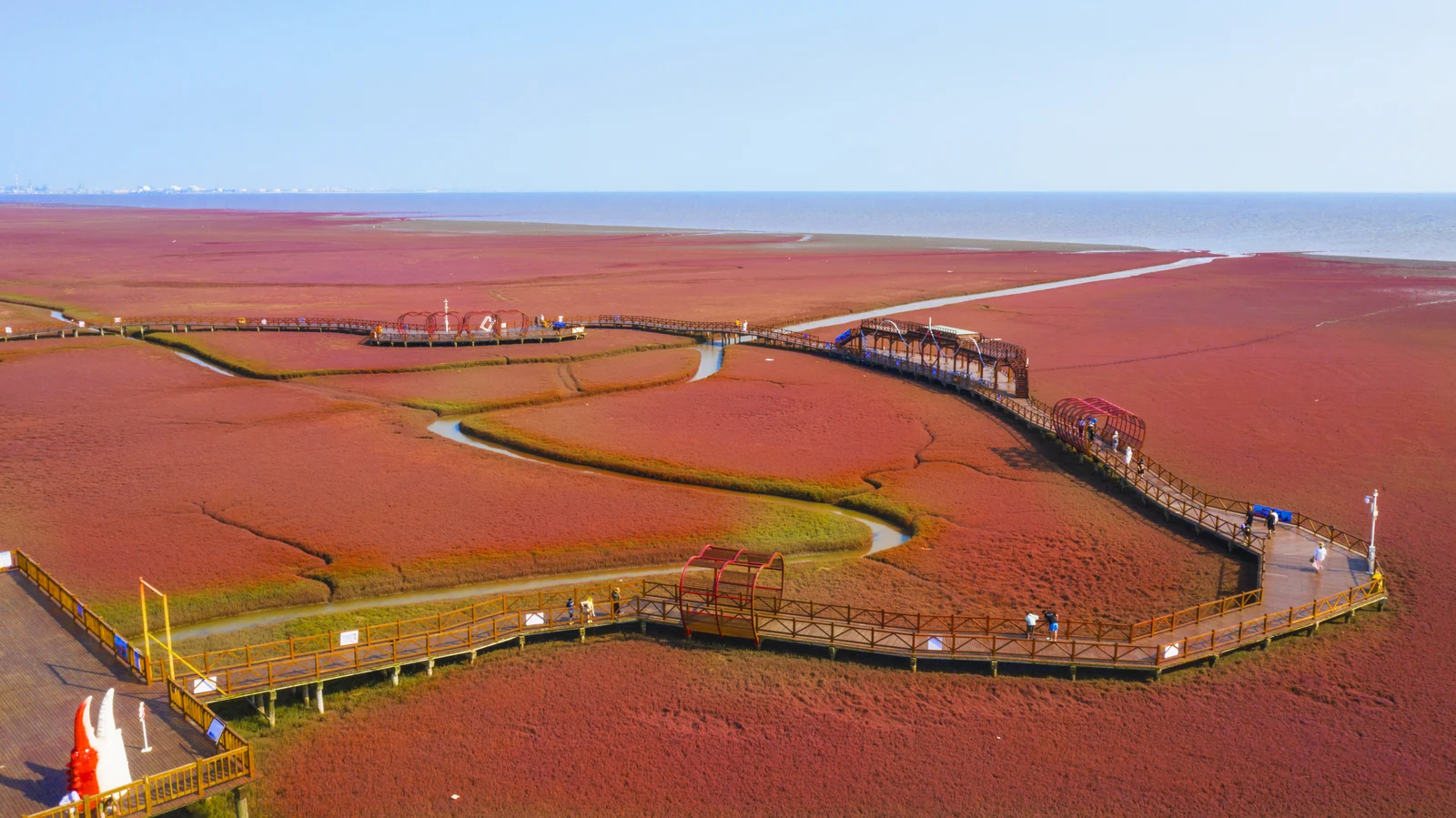
A wooden boardwalk curves over red wetland plants beside a winding channel and the open coast.
Red Beach in Panjin, where red wetland vegetation meets tidal channels and the coast.

From a carpet to a leaf

From a distance, Panjin’s Red Beach can look like a single sheet of colour. Its texture becomes clearer when the eye follows the edges: separate patches, water channels and bare spaces interrupt the red. The landscape is made from living plants rooted in coastal sediment.

The principal plant is Suaeda salsa, an annual herb adapted to salty conditions. In Chinese it is called jiǎnpéng. “Annual” is an important part of its story: each generation must establish itself, grow and produce the seeds from which the next will come. The apparent permanence of a famous view rests on that recurring, vulnerable cycle.

Colour inside the leaves

Red betacyanin pigments give the leaves their striking appearance. Scientists studying Suaeda have investigated how temperature and other environmental conditions affect pigment production. That makes the Red Beach a particularly vivid meeting of plant physiology and landscape.

A controlled temperature experiment published in 2023 found different pigment responses under different conditions. It helps explain why the colour is biological, rather than a stain applied to the shore. It does not provide a timetable for the exact day when an entire marsh will look its reddest: a living coast also has weather, salt, water and uneven growth to contend with.

The spaces between the red

The channels matter as much as the plants. Research in northern Liaodong Bay linked extensive marsh die-off after the 2015 drought to the way tidal water reached different areas. Patches farther from channels were more vulnerable in the study. The lines cutting through the colour are therefore part of the habitat’s working structure.

Local restoration has included planting and changes to water movement. That adds another layer to the view: some of what appears effortlessly natural has required observation, trials and repeated care. Red Beach is still a beautiful name, but the plant, the muddy gaps and the moving water make it more interesting than a colour alone.

Continue exploring · Panjin Red Beach ↗
Photo credits and rights
  1. Red Beach in Panjin, where red wetland vegetation meets tidal channels and the coast.Source: Liaoning Provincial Department of Culture and Tourism / People’s Government of Liaoning Province. Rights not independently licensed. · Rights status unknown Photo source ↗ Original aspect ratio retained. Display copies resized only when needed; no enlargement, crop or retouching.