The tool is not a pair of scissors. It is a knife about ten centimetres long, thin and narrow, clamped between two strips of bamboo and bound tight with fine cotton thread. Each is made by the person who uses it; they cannot be bought, and no two are quite the same. A design is drawn on thin white paper and the paper is laid down. The knife goes in with the tip vertical and follows the drawn line from the inside outwards, so that the shape is separated from its ground rather than cut around. This is why the trade speaks of carving even though the material is paper. Yuxian's cut is mostly yin, negative, with yang, positive, used for the passages that must stay whole, and the proportion is what gives the sheets their density. After cutting comes colour. Dye is mixed with alcohol and laid on with a brush, layer over layer, from the pale centre of a petal to its dark edge. Dyeing allows no error: colour is built in successive passes, and each one has to be right. One picture passes through more than twenty steps: the paper laid, ash dusted over it, the design traced, the cutting done, then the dyeing. The finished sheet is not a silhouette with colour behind it. Colour is part of the drawing, and the cutting is what holds the colour in place.
From the journal
Yuxian Paper Cuts and the Windows They Were Made For
Yuxian in Zhangjiakou cuts paper with knives, not scissors, and dyes the colour on by hand in more than twenty steps. The craft began as window decoration and is now a county industry with a national listing.
In the same city · Zhangjiakou ↗The knife, not the scissors
From window paper to a county trade
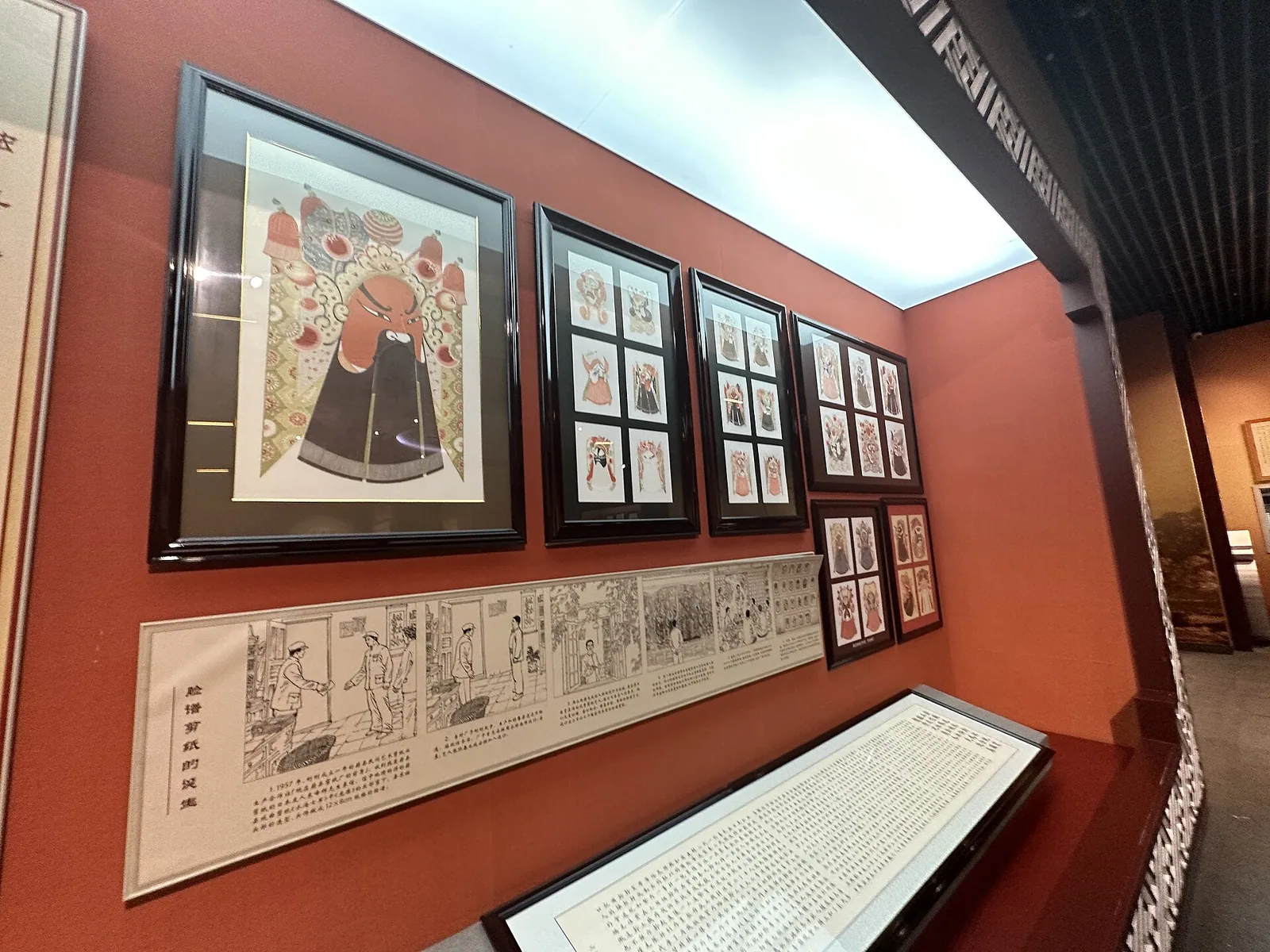
The craft began as window decoration, which is why the old name for the work is window flower, and the county's account of its beginning is unusually precise. In the Guangxu reign a silversmith named Liu Laobu put three things together: the woodblock-printed window paper brought in from Wuqiang, the embroidery patterns used by Yuxian women, and the synthetic dyes invented in Europe in the middle of the nineteenth century. He carved flowers and figures and coloured them, and that combination is the beginning of the dyed cut. In the 1920s two families, the Lü and the Zhai, were cutting opera figures and flowers, and their work set the standard of the early period. The artist who made the form cohere was Wang Laoshang, 1890 to 1951, from Nanzhangzhuang village. He reworked the crude early patterns, took figures from more than two hundred operas, some six hundred characters, and combined them with the look of Yangliuqing prints, Wuqiang window paper and local embroidery. He worked at the craft for more than forty years, and later cutters call him the founding master. He was a farmer, and the art world later called him a peasant artist; the county has built a memorial hall for him. His reworking of the old patterns is why the county can date its mature style to a single working life. Nothing about the result is accidental: the county's own description of the style is full composition, lively drawing and loud colour.
Colour as an industry
Yuxian paper cut entered the first national list of intangible cultural heritage in May 2006. In 2009 it was included, with other regional traditions, in the joint Chinese nomination of paper cut that UNESCO inscribed on its representative list; the inscription belongs to Chinese paper cut as a whole and names Yuxian among its components. The county counts three national inheritors, three at provincial level, sixteen at municipal level and forty-five at county level. Production is organised as an industry: in the late 2010s, sixteen of the county's twenty-two townships and ninety-six of its villages had cutters, with twenty-eight specialist villages, about 1,100 households and more than 30,000 people employed, producing over five million sets a year and selling in more than a hundred countries. The county government has run a paper-cut festival since 2010 and built four venues: a museum, a commercial street, a specialist village and a school. New work travels: in 2013, 126 Yuxian designs were chosen for a national public-service advertising campaign, and costumes patterned with Yuxian cut appeared at the 2022 Winter Olympics ceremonies. Zhou Shuying, a national inheritor, has added dyeing methods of her own and made a scroll of nine dragons, nine metres nine long, with more than two million cuts and hundreds of colours. Yuxian is itself a national historical city with twenty-one national key cultural relic sites, and the cut is the part of that inheritance that still employs people by the thousand.