From the journal

Cizhou kiln: black brushwork and everyday life on Hebei bowls

Cizhou ware was made for ordinary tables along the Zhang and Fu rivers: sturdy bowls, jars and pillows of coarse clay, covered in white slip and painted in black. Its potters wrote poems and painted scenes from plays, and the kilns produced the first overglaze enamels in China.

In the same city · Handan ↗

Clay, slip and a loaded brush

A Cizhou bowl begins with a clay the potters called daqingtu, great blue earth. It is iron-rich and coarse-grained, and it fires to grey-white or grey-yellow rather than to the clean white of Xing or Ding ware. The body is thrown on a wheel or built from slabs, with moulds used mainly for head-rests. Because the clay is not handsome in itself, the potter coats the whole piece in a white slip made from good kaolin — a layer the Chinese sources call huazhuangtu, makeup earth — and only then starts to decorate.

The decoration goes into that white ground. Lines are incised, facets carved, slip cut away to show a darker layer beneath, patterns stamped or rolled on, bands of parallel lines combed through the wet slip. In the earlier cut-slip pieces the background is often ring-matted: the end of a bamboo pressed into the slip leaves a field of small circles, a device borrowed from metalwork. A transparent glaze follows, and firing fixes black or brown against white.

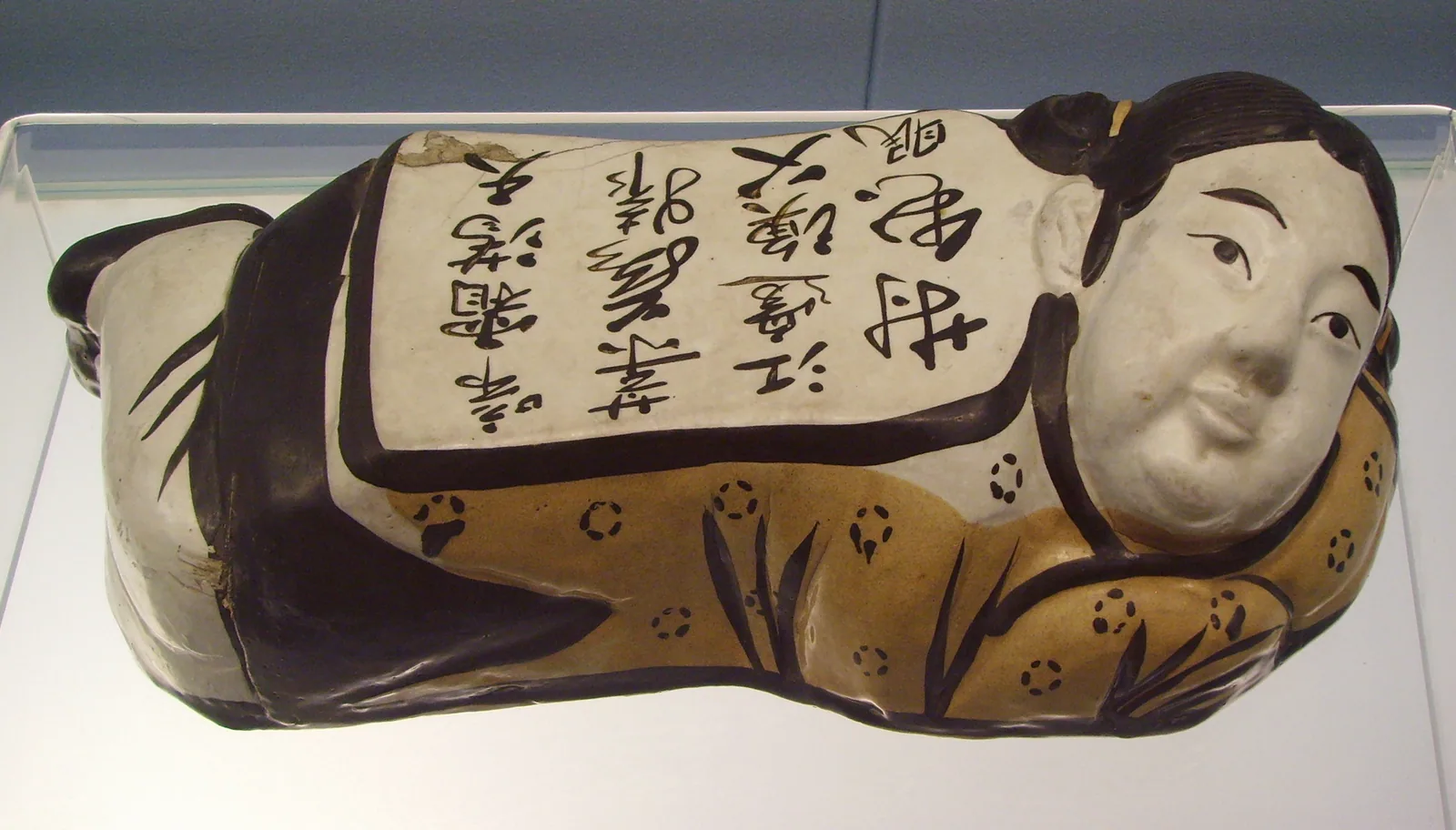
The effect reads at a distance. Cizhou is the one major Song ceramic family whose impact depends on contrasting colour rather than on a monochrome glaze. Court ceramics of the period were, in one description, relentlessly monochrome, and Cizhou ware does not appear among the tribute wares sent to the emperor. Its customers were ordinary. The vessels are sturdy and often large: wine bottles, jars, and the ceramic pillows used as head-rests. The flat top of a pillow left room for a landscape, a scene from a play, or a line of verse.
Two river valleys, three dynasties

Kilns making this ware stood along the Zhang and Fu rivers in what is now southern Hebei. From the Song to the Qing those basins lay under Cizhou, the prefecture that gave the ware its name; the prefecture is now Ci County, in Handan. Two districts matter most. One centres on Guantai in Ci County, with sites on both banks of the Zhang River. The other centres on Pengcheng, in the Fengfeng mining district, which earned the saying: in the south Jingdezhen, in the north Pengcheng. Clay, fuel and pigment lay close by, and the rivers supplied both water and cheap transport.

Because so many northern kilns made similar pots, scholars often prefer the term Cizhou-type. The wares run from the late Tang to the early Ming, with the strongest output between the eleventh and fourteenth centuries, through Northern Song, Jin and Yuan.

The Jin period changed the decoration. After the Song-Jin wars, some Jin emperors patronised Han literary culture and the painting and calligraphy of Song scholars. Potters answered with brushwork: poems, maxims and painted flowers on a white-slipped body, the style called white ground, black flowers. A variant reversed figure and ground. The potter outlined a motif, cut away everything around it, filled the cut area with a black pigment, then glazed and fired, so that white shapes sat in a black field.

Painted inscriptions became common on bottles, jars and pillows. A Jin pillow in the Ci County cultural centre carries a lyric by Su Shi; a white-glazed dish quotes a poem by the Jin writer Yuan Haowen. Yuan pillows show scenes from drama — Li Kui carrying thorns, Liu Yi delivering a letter — and Taoist plots, painted for people who knew the plays.

Workshop marks and a fired-in first

Cizhou ware is usually called popular, which is not the same as crude; many pieces are finely and carefully decorated. The repertory is wide: peonies, mallows and lotus in scrolling patterns; fish and birds; children at play; a boy fishing; dragons; landscapes; several figures set in a scene from literature or legend. Black-glazed and brown-glazed wares came from the same kilns, and the potters imitated the white of Ding ware and the special glazes of Jian tea bowls.

The kilns also made a technical first. Overglaze enamelling was developed at Cizhou around 1200, its earliest use on Chinese pottery; the earliest dated example, in Tokyo, is from 1201. The body was fired at about 1200°C, then painted with red, yellow and green enamels and fired again at about 800°C. The colours appear on small bowls, head-rests and figurines, some of them toys.

Potters marked their work. Head-rests, mostly of the twelfth and thirteenth centuries, are stamped with workshop names, among them the Zhang family of Henan; a seal found near Guantai reads Guxiang Zhang family made. Such marks are rare in Chinese pottery, and they tie a bowl or a pillow to a place.

The kiln sites were listed as a national key cultural relic in 1996. In 2006 the firing technique entered the first national list of intangible cultural heritage, nominated by the Fengfeng mining district. The painted decoration had a long afterlife: it anticipated the brushwork that would later dominate Chinese ceramics, and potters moving south at the start of the Yuan carried the manner toward Jingdezhen.

A boy-shaped Cizhou ware pillow, made in the Jin dynasty.
A boy-shaped Cizhou ware pillow from the Jin dynasty, in the collection of the Shanghai Museum.
Continue exploring · Cizhou Kiln ↗
Photo credits and rights
  1. A boy-shaped Cizhou ware pillow from the Jin dynasty, in the collection of the Shanghai Museum.Gerbil · CC BY-SA 3.0 Photo source ↗ Rights information ↗ Converted to WebP.