The Ding potters loaded the kiln with the bowls inverted. Placing a bowl mouth-down means the glaze runs down and gathers at the rim, and the rim itself is wiped clean of glaze before firing, which leaves a rough edge. It also lets several vessels be stacked in a single saggar. The Ding kilns made a stepped saggar for exactly this: bowls of diminishing size nested one above another, so that one column in the kiln carried more than one piece. The rough mouth is why so many Ding pieces carry a metal band, of silver or of a brassy alloy, around the rim. The second decision is the fuel. The earlier northern white wares, Xing among them, were fired with wood in a reducing atmosphere that lends the glaze a bluish cast. Ding changed to coal, probably in the tenth century, and the new atmosphere produced the warm, faintly yellow tone that is called ivory. The body is thin, the glaze nearly transparent, tinted white over a white or greyish clay, and the decoration is cut into the leather-hard surface or pressed into it in very shallow relief. Bowls and dishes dominate the output, vases are comparatively rare, and shapes such as the lobed rim were borrowed from metalwork. A bowl leaves the kiln with a rough mouth, an ivory skin and a carved lotus or peony scrolling under the glaze. The running glaze also left teardrop marks on some pieces, marks that later critics counted against the ware.
From the journal
Ding Kiln at Quyang: the ivory-white porcelain of the Song
The Ding kilns stood at Jianci village in Quyang County, west of Baoding, and worked from the eighth century to the fourteenth. They fired bowls upside down with coal, which gave the glaze its ivory tone, and their carved white ware was counted among the five famous kilns.
In the same city · Baoding ↗Fired upside down
The kilns at Jianci village
Ding ware takes its name from Dingzhou, the prefecture whose territory held the kilns in the Tang, but the workshops themselves stood at Jianci village in Quyang County, in the hills west of Baoding. They were in almost constant operation from the early eighth century to the mid-fourteenth, from the Tang through the Five Dynasties and the Northern Song to the Yuan, and their finest period was the eleventh century. The ware began by imitating Xing, the white porcelain of Lincheng and Neiqiu, and by the Song it had replaced Xing as the leading white ware of the north. Its reputation rests on the ivory glaze, on thin potting and on decoration cut with a knife or moulded. A writer of the Guiqian zhi called the Ding bowl the white of the world. The kilns were a folk enterprise, but from the middle of the Northern Song their quality brought court orders, and a chronicle records 2,000 pieces decorated with gold offered at the Zongde Hall. The same output served wealthy merchants and the scholar-literati as well as the palace. Not everyone thought the ware fit for an emperor: the rough rims and the drops of glaze that ran in firing were held against it, at least by the late Southern Song. Under the Jin, from 1115 to 1234, taste turned to dense moulded plant scrolls, and that vocabulary of shallow relief later fed into the blue-and-white decoration of Jingdezhen.
Finding the site in the twentieth century
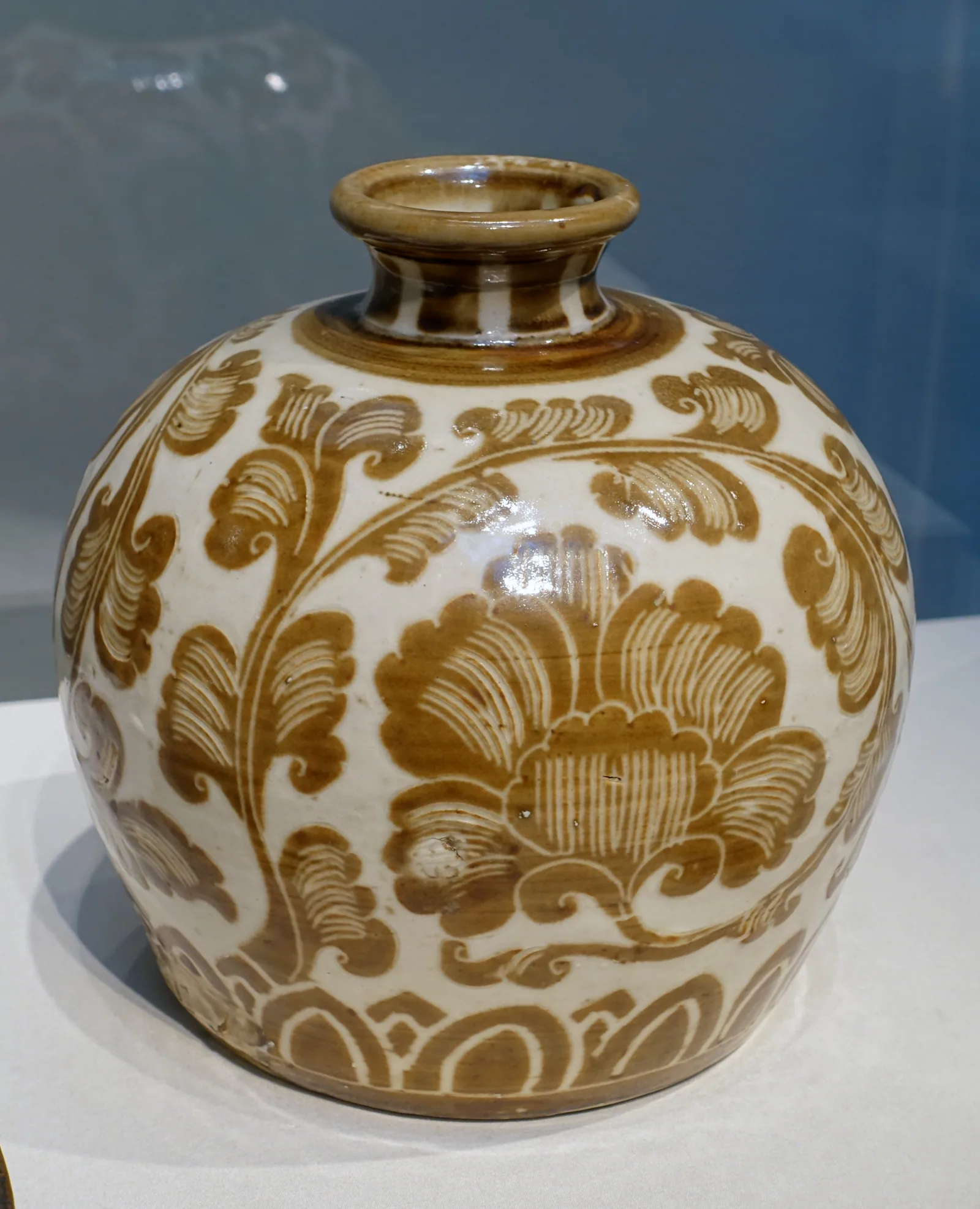
The site was found by a scholar. In 1934 Ye Linzhi, a professor at Beiping University, identified the kiln area; in 1941 the Japanese ceramic historian Koyama Fujio followed that lead and surveyed Jianci village, confirming it as the main source of Song Ding white ware. Small excavations by the Palace Museum and the Hebei cultural relics team followed in the 1950s and 1960s. The large campaign came in 1985, when a full excavation exposed kilns, a clay yard, wells, ditches, hearths and ash pits and produced more than 300,000 shards. The site was placed on the national list of protected cultural relics in 1986. Those shards carry the range of the kiln's output. Besides the white ware there were monochrome glazes in black, in brown and purple, and in green, known as black Ding, purple Ding and green Ding, rare enough that the black and the red survive mostly as whole pieces rather than as sherds. There were also pieces with brown painting under the glaze. The white ware itself divides into two techniques: knife-cut decoration on a wheel-thrown vessel, and from the late eleventh century moulds that carried the interior design, so that a pattern could be repeated exactly, while the outside of the bowl was still carved by hand. Chemical analysis has found that many pieces were made entirely of a kaolinitic clay, with no porcelain stone added. Quyang had itself been renamed in 820, in the Tang, to avoid the personal name of the emperor Muzong, and it has kept the name since.