At Lincheng the body of a white bowl begins as stone. The fine white clay of the Xing kilns was mixed from a red sandstone found at the kiln sites themselves, the material the potters call hongshashi. It is broken and ground, and, except for the translucent Sui ware, no quartz or feldspar was added to it as temper, so the mass behaves as a soft or semi-soft clay and must be worked until it will stand on the wheel. The glaze is a second recipe. It uses a glaze earth rich in magnesium oxide and calcium oxide, and it is finished with plant ash and burnt limestone. That earth is pounded in a mortar first and only then blended with kaolin. The order matters. A glaze that has not been broken down properly runs or crazes in the fire; a body that has not been wedged properly splits as it cools. The magnesium oxide in the glaze, with the phosphorus pentoxide in it, reduces dripping and cracking and leaves the surface whiter and smoother than it would otherwise be. The fine ware is potted thin enough that no slip is needed to hide the surface. The coarser grade is given a white slip instead. The pieces go into the kiln protected by saggars, and the kiln is fired with wood rather than coal. What comes out is white through the body, with a thin colourless glaze that often carries a faint blue cast.
From the journal
Xing Kiln at Lincheng and Neiqiu: white porcelain of the Tang
The Xing kilns in Lincheng and Neiqiu made white porcelain from a local red sandstone and a magnesia-rich glaze, and their thin bowls reached Chang'an, Iran and Japan. The ware ended celadon's monopoly in the north, and in the Song it was displaced by Ding ware from Quyang.
In the same city · Xingtai ↗Red sandstone, plant ash and a mortar
Silver, snow and the end of a monopoly
Xing ware was made from the Northern Qi into the Song, and the written record is densest in the Tang. Lu Yu, in the Classic of Tea in the eighth century, set the northern white against the southern green: Xing porcelain is like silver and Yue porcelain like jade; Xing is like snow and Yue like ice; in a Xing bowl the tea turns red, in a Yue bowl it turns green. The poet Pi Rixiu described the bowls as round as the fallen moon and light as rising cloud. The Tang geography record noted that the earth of Julu commandery in Xingzhou, like that of Kuaiji commandery in Yuezhou, was fit for pottery. By the Tianbao era Xing bowls were going to Chang'an as local tribute in quantity, and Li Zhao wrote that they were in use among high and low alike. That last sentence carries the change. The old monopoly of celadon ended, and two systems stood side by side, green in the south and white in the north. Fragments marked for the Ying storehouse and the Hanlin Academy have been found both at the Daming Palace and at the kilns. In the middle and late Tang the ware travelled to Iran, Iraq, Pakistan, Egypt and Japan, with pieces in the Belitung wreck and enough in Iraq to be called the Samarra type. A ninth-century Arab merchant, Sulaiman, wrote of cups so thin that the wine showed through.
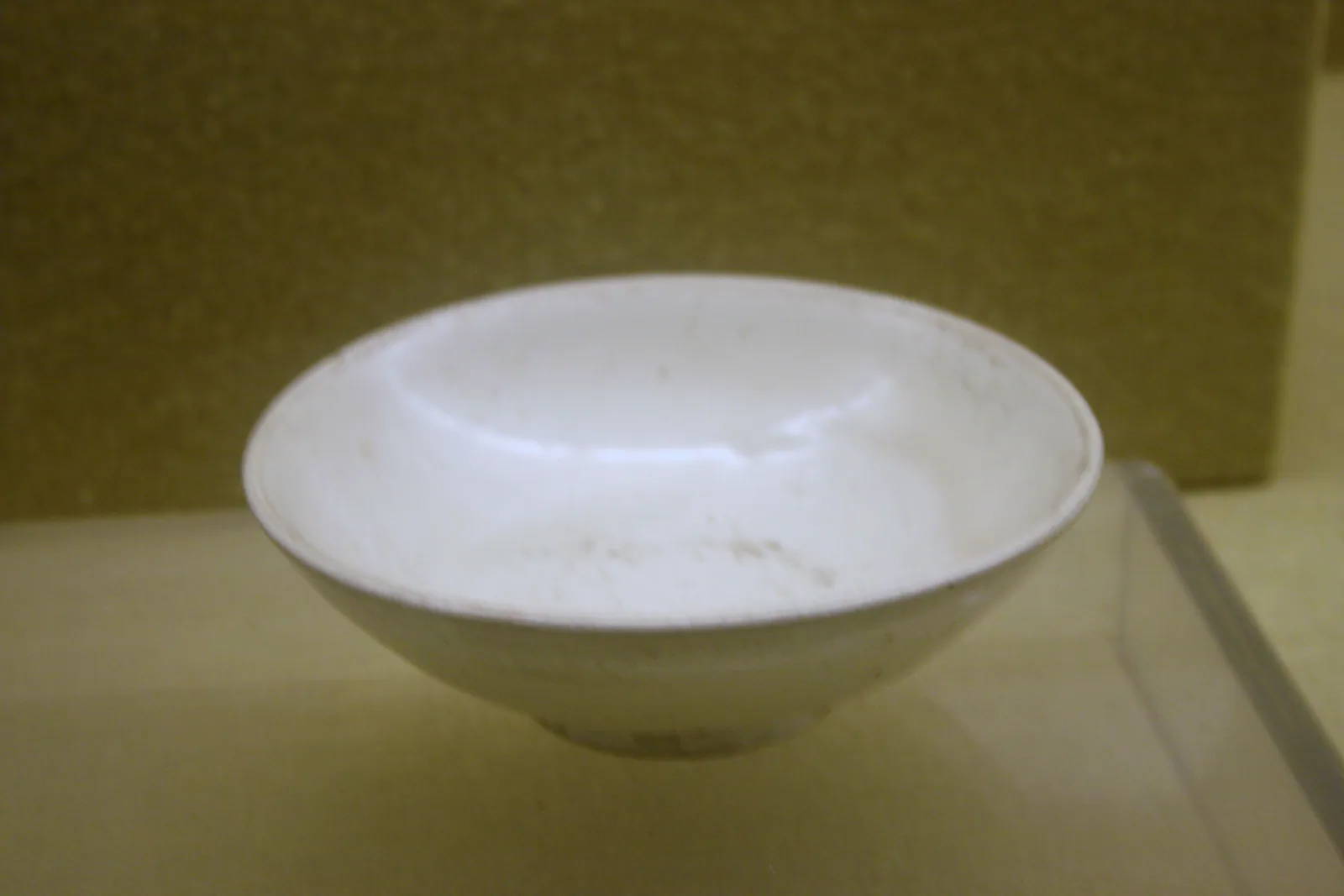
The trench at Neiqiu
For a long time the kilns were a name in texts and a scatter of shards in fields. That changed in 1980 and 1981, when kiln sites were excavated at Ciqun in Lincheng County. Later work identified many more sites in Neiqiu and in Xingtai county and city. The trenches cut from Northern Dynasties ground upward through Sui and Tang layers, and a large number of Jin and Yuan sites were found as well, so that one section can open on several centuries at once. The archaeology broadly follows the written arc: a rise in the Tang, a low tide at the end of the Tang and through the Five Dynasties, a revival in the Song, and a tail running into the Jin and Yuan. The end is legible in the record too. Ding ware, made at Quyang a little to the north, began by imitating Xing in the Tang, and by the Song the Ding kilns had replaced Xing as the leading producers of white ceramics in the north. The two are not always easy to tell apart, and Xing glaze is often the colder and bluer of the two. There is a further complication in the geography: Lincheng produced Xing ware although it did not belong to Xingzhou in the Tang, so the name of the ware covers a district wider than the prefecture that gave it. Western ceramicists argue over whether the body is stoneware or porcelain, since some pieces are fully vitrified and some are not; Chinese usage does not make the distinction, and the ware is porcelain. What remains is a long sequence of experiments in a very white clay, written in pits and ash layers.