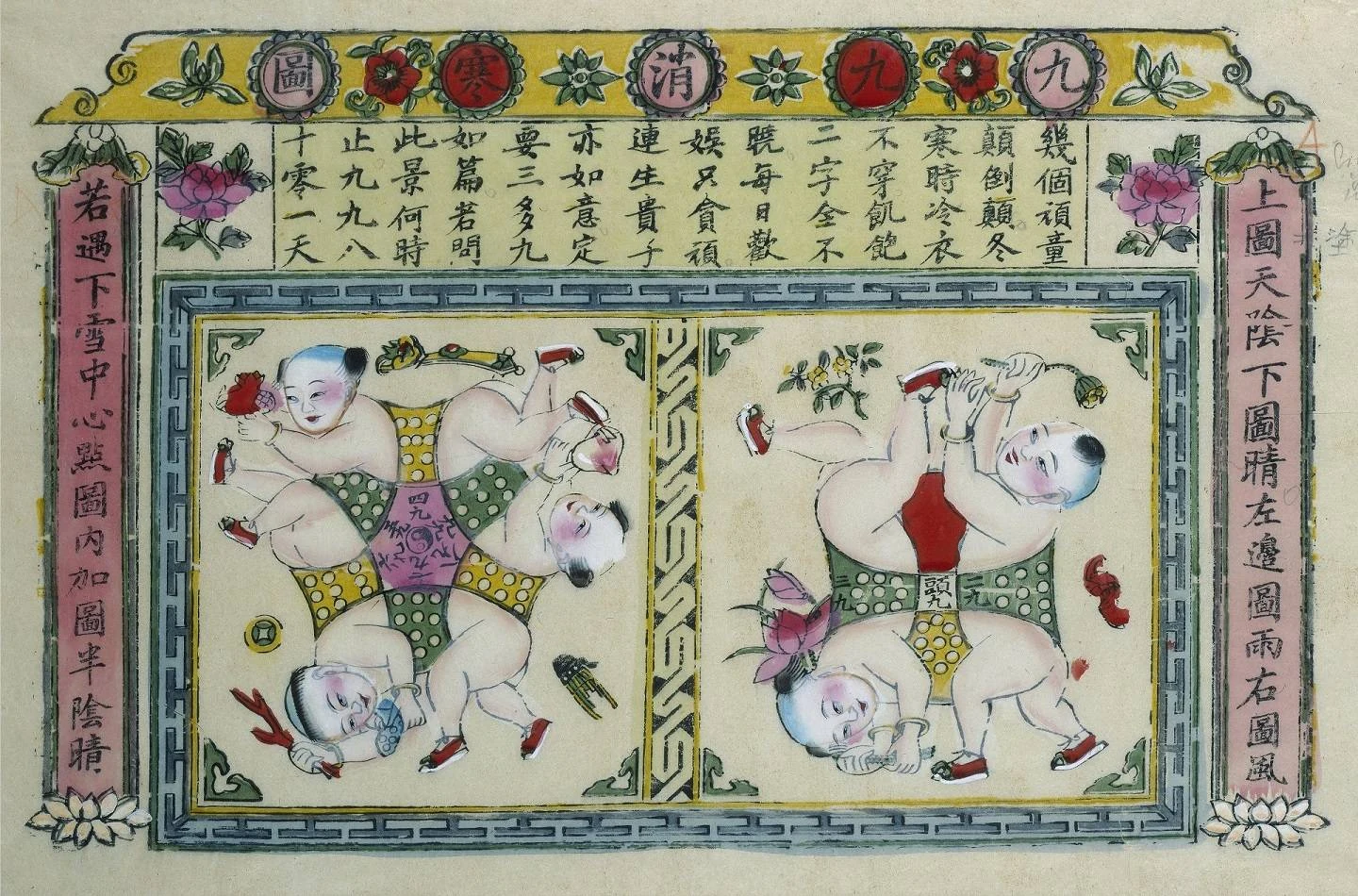
A Wuqiang print is built up in passes, one colour at a time. The block is cut in reverse, inked, laid on the paper and pressed by hand; the sheet is hung, dried and printed again with the next block and the next colour, until the picture is complete. The museum that holds the trade's collection describes four operations behind every sheet: drawing, cutting, printing and mounting, and one of its galleries is given over to exactly that sequence. The designs are not subtle in the way a painting is subtle. A door god at the museum entrance, armed and armoured, fills its paper; the colours are strong and set close together; the drawing exaggerates. The best-known image in the county is a puzzle as much as a picture: six children, formed from heads and bodies that share and shift, so that counting them takes a moment. It is called six children contending for the lead. The design derives from a Qing print used to count the nine cold periods of winter, a copy of which is in the British Museum, where circles on the children's bibs were dotted day by day from the winter solstice. A picture that began as a calendar is now the county's emblem, repeated on the lamp posts of its main street. The second gallery rebuilds a northern farmyard, so that the prints can be seen where they were meant to hang: the gate, the screen wall, the main room, the two side rooms, the stove and the shed.
From the journal
Wuqiang New Year Pictures and the Woodblock Behind Them
Wuqiang in Hengshui printed New Year pictures from woodblocks for farming households across north China. The craft peaked in the Qing, was rescued after 1949, and entered China's first national intangible heritage list in 2006.
In the same city · Hengshui ↗Block, ink and four processes
A peasant print
Wuqiang is a small county in Hengshui, on the central Hebei plain, and its pictures were made by farmers for farmers. It was formally made a county in 556, in the Northern Wei, and it calls itself the home of New Year pictures. The trade dates its beginning to the late Song and early Yuan and calls the Ming the period when it reached scale; the peak came in the Kangxi and Jiaqing reigns of the Qing, when annual sales are given as up to a hundred million sheets, sold across most of China. The subjects were the household and the year: door gods, kitchen gods, hall pictures, couplets, window flowers, lantern panels, square panels, scroll sets, calendars and painted surrounds for the heated brick bed. That range of formats is why the pictures matter as evidence. A set hung in fixed places, and the places were social: the gate, the yard wall, the main room, the elders' room, the room of a young couple, the stove, the animal shed. The print trade also recorded what happened. A print of 1905 shows the Qing army manoeuvring at Hejian; another shows a city of trams, aeroplanes and electric poles; the door gods issued in the winter of 1937 carry a slogan about fighting Japan. In the 1940s artists worked with painters from the Jin-Cha-Ji border region to make a new kind of print, and the county became a centre of the revolutionary New Year picture.
Rescue and the museum
The museum opened in 1985, the first in China devoted to New Year pictures. It occupies a site of 25,100 square metres with a building of 7,600, has been free to enter since January 2009, and holds more than 10,000 objects, mostly woodblocks and paper prints from the Qing onwards, of which 981 are graded cultural relics. Its collecting has the quality of rescue. In 2003, working in the old town at Jiucheng, a team opened the roof space of the Jia family house and found 159 blocks laid between the tiles and the reed matting; most were rotten, but fifteen were substantially complete, including a Qing line block of the picture of happy doves and another of three fish and the moon. Blocks of that quality are now national first-class relics, and the museum has become the country's main reference collection for the trade. The craft is listed: Wuqiang woodblock New Year pictures entered the first national intangible heritage list in 2006 as item 301, number VII-2, with the museum as protecting unit. Production continues, partly by traditional means and partly with computer-controlled cutting of new blocks, and the county's printers still sell the old repertoire alongside new designs. The museum is a national second-grade institution serving a county of about 175,000 people, and its five permanent galleries run from the conditions that produced the trade to the modern period, with separate halls for the craft and for the prints used in official integrity campaigns.