From the journal

Tangshan: the 1976 earthquake and the city rebuilt on its fault

Before dawn on 28 July 1976 an earthquake of magnitude 7.6 broke directly under Tangshan. In minutes most of the city's buildings were unusable, the mines and railways were damaged, and 242,000 people were dead by the official count. The city was rebuilt, and coal, steel and a port are the result.

In the same city · Tangshan ↗

The minute before the collapse

The express from Jining to Sanheshu left Tianjin on time at 3.06 on the morning of 28 July 1976, hauled by a diesel locomotive of the Shanhaiguan depot. At 3.42 it was running at about a hundred kilometres an hour between Beintang and Chadian. The driver saw the post of the signal ahead swaying, felt the locomotive thrown from side to side, and saw a broad blue flash along the south-eastern horizon. He read it as earthquake light and braked hard.

The shock arrived while the train was still slowing. The trackbed moved, seven coaches left the rails and 370 concrete sleepers were crushed. Because the speed had already fallen, the crew and all the more than 740 passengers got out alive.

Under the city the same seconds did far more. The rupture began about twelve kilometres beneath the southern part of Tangshan and ran north-east along a fault that passes under the centre. In the city the shaking reached XI on the twelve-degree Chinese scale. Within minutes 85 per cent of the buildings in the city had collapsed or were unfit to use, the water, power and communications systems had failed, and most of the highway and railway bridges were down or badly damaged. Some 10,000 miners were underground. The tunnels held, but the power was gone: no light beyond headlamps, no ventilation, no working lifts. Most of the miners were out within hours; some took two weeks to reach the surface.
Brick on a shallow fault

The plain made the damage worse. Tangshan sits at the northern edge of the Beijing–Tianjin–Tangshan plain, where sediment washed down from the Yan Mountains lies up to three kilometres deep, and the city stood on a shallow, recently active fault. Almost nothing had been built with earthquakes in mind. Tangshan was mainly a city of unreinforced brick buildings sitting on top of a major fault line, and the seismic risk had been greatly underestimated.

The hour mattered too. The first shock came at 3.42 in the morning, when most people were asleep, and there were no perceptible foreshocks to warn them. A year earlier, at Haicheng, a smaller quake had been met with precautions after a series of foreshocks, and the low toll there had been read as proof that earthquakes could be predicted. Tangshan had no such sequence, and no short-term warning was issued.

The official death toll is 242,000. The figure was not made public until November 1979, three years after the event, and in the interval estimates from outside China had filled the gap. The shock was felt 1,100 kilometres away, damaged nearly a tenth of the buildings in Beijing, and reached intensity VII as far as the Bohai coast and the hills north of Zunhua. A second shock of magnitude 7.0 followed at 18.45 that afternoon near Luanxian, and twelve aftershocks of magnitude 6 or more came after it.

Rails, shafts and a new city

The repair began before the rubble was cleared. More than 42,000 people were mobilised on the railways; the Tongxian–Tuozitou line opened on 3 August, one track of the Beijing–Shanhaiguan line on 7 August and both tracks on 10 August, with trains crossing temporary bridges at reduced speed. Power reached some of the mines within three days and some coal was cut within ten. De-watering the flooded shafts, overhauling the electrical equipment and rebuilding the surface works took a year and a half, and the pre-quake level of production was not reached until the end of 1977.

The city that replaced the brick town is a heavy industrial one. Tangshan has been a coal centre since the Kaiping mines opened in 1877, and it now produces steel, cement, glass, chemicals and ceramics; it is described as the porcelain capital of North China, and its port is among the ten largest in the country. Its industrial past is kept in the Kailuan National Mine Park and its water in Nanhu Park, both in Lunan District. The city's firsts are industrial as well: the first standard-gauge railway, the first railway workshop, the first steam locomotive and the first cement factory in China.

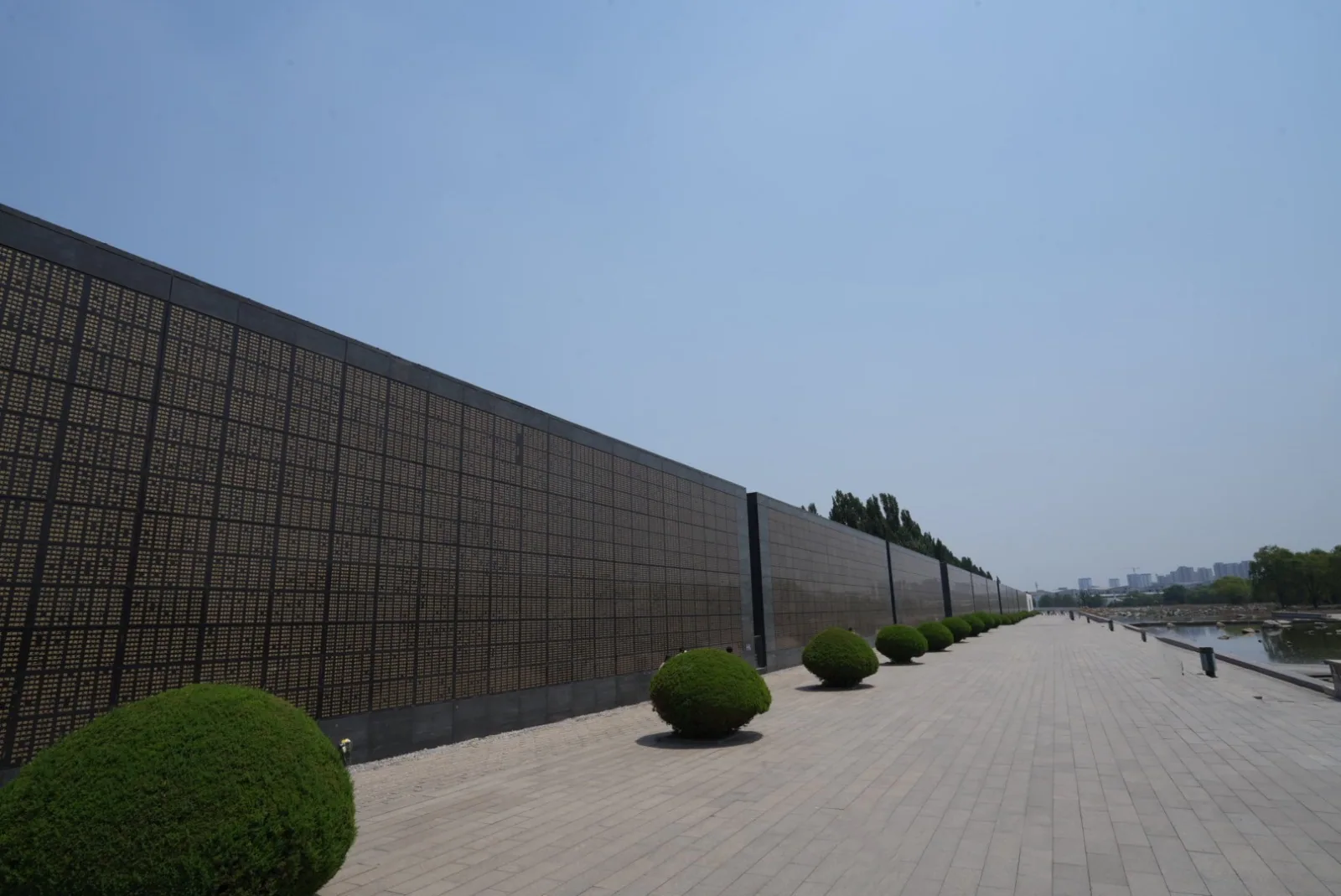
The earthquake has its own markers: the Anti-Seismic Monument in Anti-Seismic Square, and a memorial park whose wall carries the names of the dead, added to in several campaigns since 1992. Feng Xiaogang's 2010 film Aftershock took the earthquake and the decades after it as its subject.

The memorial wall of the Tangshan earthquake park, on the south side of the rebuilt city.
Continue exploring · Tangshan Earthquake Memorial Park ↗
Photo credits and rights
  1. The memorial wall of the Tangshan earthquake park, on the south side of the rebuilt city.Zinderboff · CC BY 4.0 Photo source ↗ Rights information ↗ Converted to WebP.