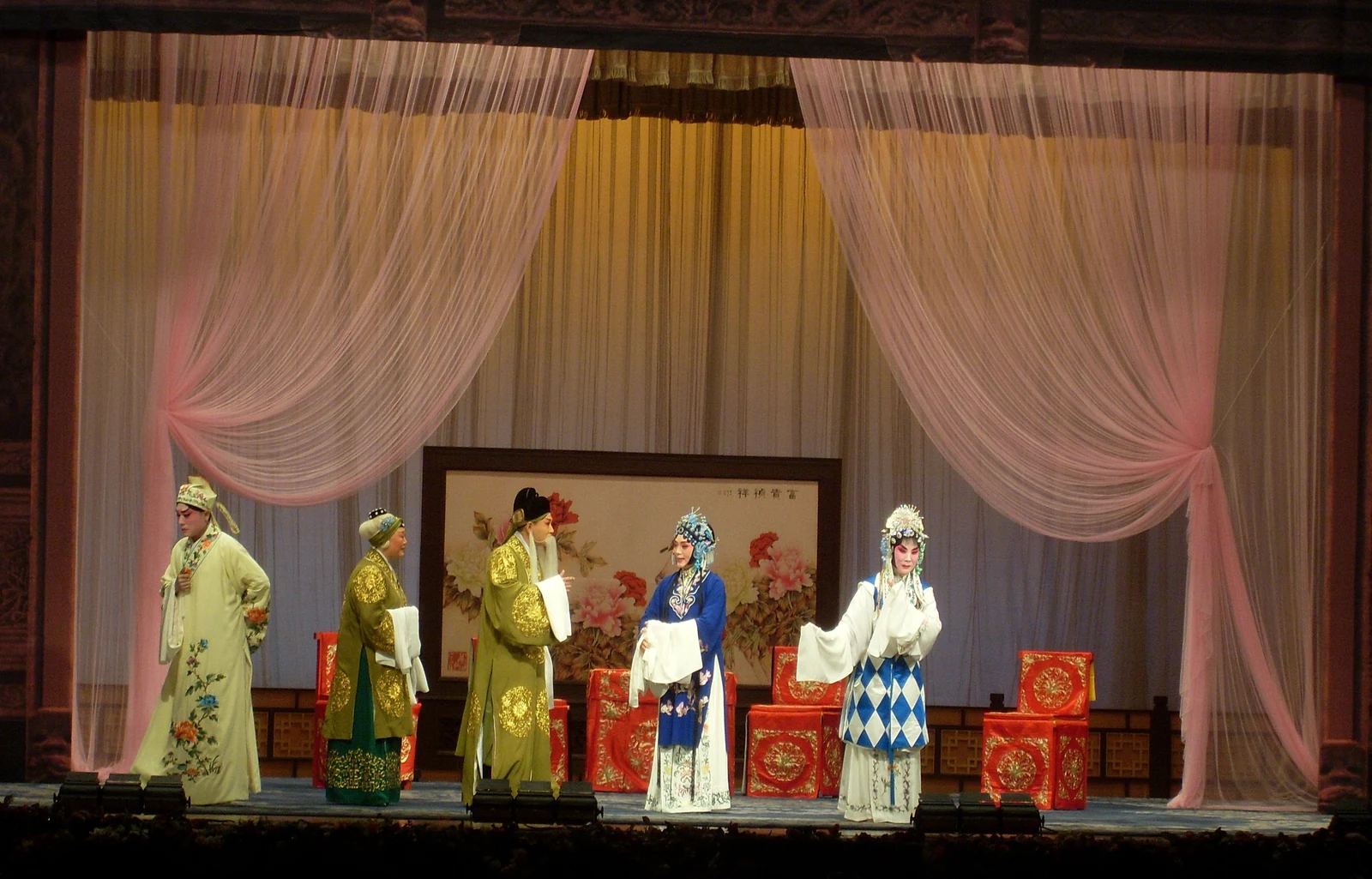
The leading instrument is a banhu, a bowed fiddle, and it carries the tune while the clapper marks the tempo. Pingju is a bangzi opera, built on banqiang, a system of set tunes varied by tempo and metre, so one melody can be slow and grieving in a scene and quick and joking in the next. The clapper and the fiddle between them carry a whole performance.
The form is also called Pingxi, and its older name was Pingqiang bangzi, a flat-tune clapper opera.
What distinguishes it is the words. The spoken passages and the sung lines stay close to ordinary northern speech, so an audience can follow the plot by ear, and the form travelled easily for that reason. Its home is Luanzhou, a county of Tangshan, and the city is still described as the place where Pingju began.
The roles began small. Pingju was a three-role opera, xiaosheng, the young man, xiaodan, the young woman, and xiaohualian, the clown, and its repertory includes Yang Naiwu and Xiao Baicai, Qin Xianglian, Liu Qiaoer, Hua Wei Mei, Yang Sanjie Sues and Taohua An. In the Republican period it was the most famous of China's regional operas, admired for passionate performance and romantic plots.
The cinema took it up early. In 1936 Zhang Shichuan made Red Begonia with Bai Yushuang, the actress known as the Queen of Pingju. Other celebrated names are Xin Fengxia and her teacher Hua Furong.