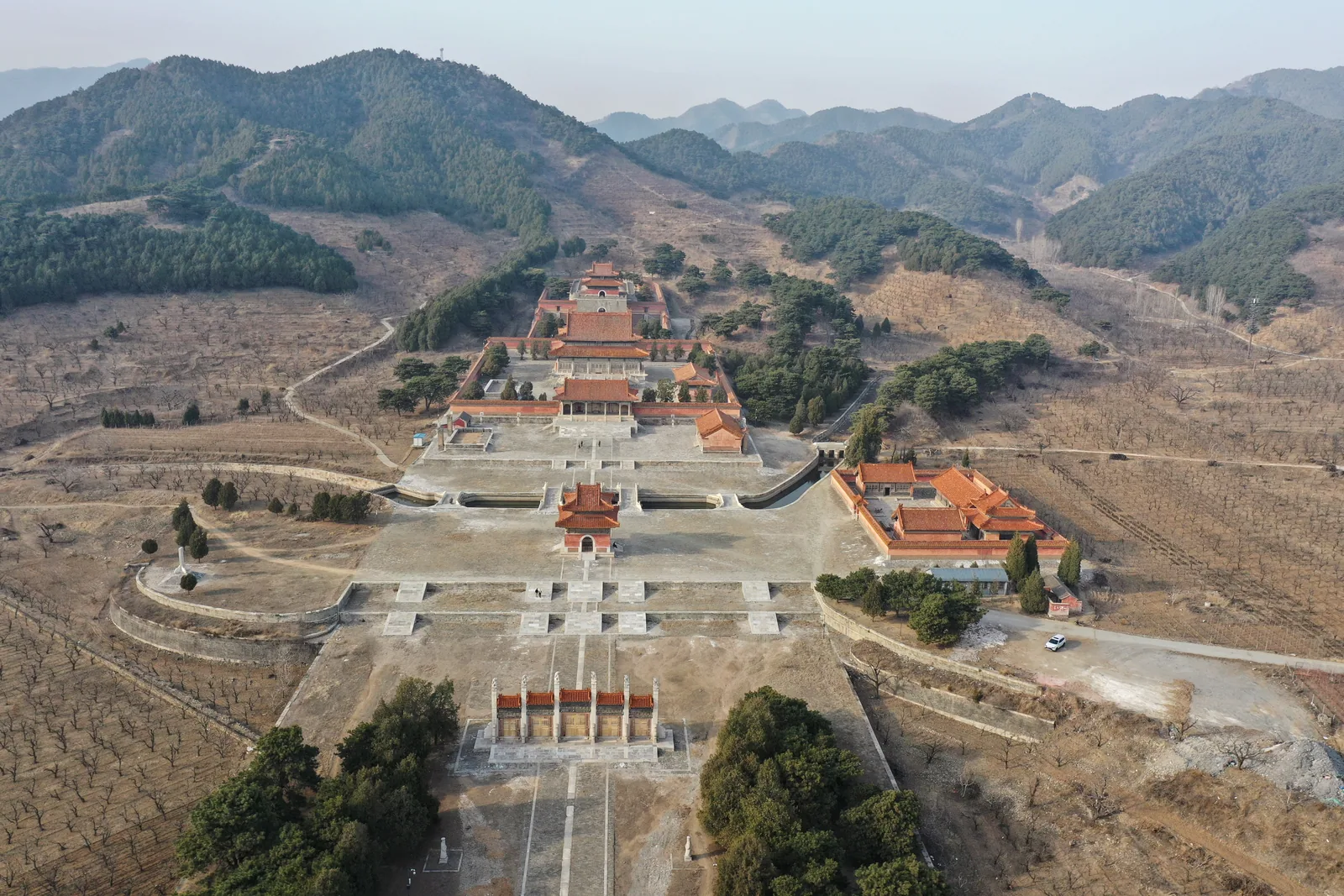
The spirit way of Xiaoling runs north from a stone archway. It passes pairs of dismounting stelae, a grand palace gate, a hall for changing clothes, a pavilion over a stele recording the emperor's merits, and a line of stone sculptures, then a dragon-and-phoenix gate and a sequence of bridges, one arch, seven arches, five arches, before the three-way three-arch bridges and a flat bridge bring it to the tomb.
Beyond the gate the palace section repeats the order of an imperial residence: a stele pavilion, halls for court officials east and west, the Long'en Gate, sacrificial burners, side halls, and the Long'en Hall, the Hall of Enormous Grace, where offerings were made. After it come the gate of the burial chamber, a two-pillar gate, stone altar pieces, a square city, a memorial tower, a glazed screen, a crescent city and the precious citadel, a grassed mound with the underground palace beneath. To the left of the palace section, behind its own wall, stand the offering kitchens where the sacrificial food was cooked, the warehouses that stored it, and a slaughterhouse for the oxen and sheep.
The finest burial chamber is at Yuling, the tomb of the Qianlong Emperor: nine vaults in a row, separated by four solid marble doors, at a depth of 54 metres. Every wall, ceiling and door carries Buddhist imagery, the four heavenly kings, the eight bodhisattvas and twenty-four Buddhas, with more than 30,000 words of Tibetan and Sanskrit scripture. The doors themselves weigh three tonnes each.