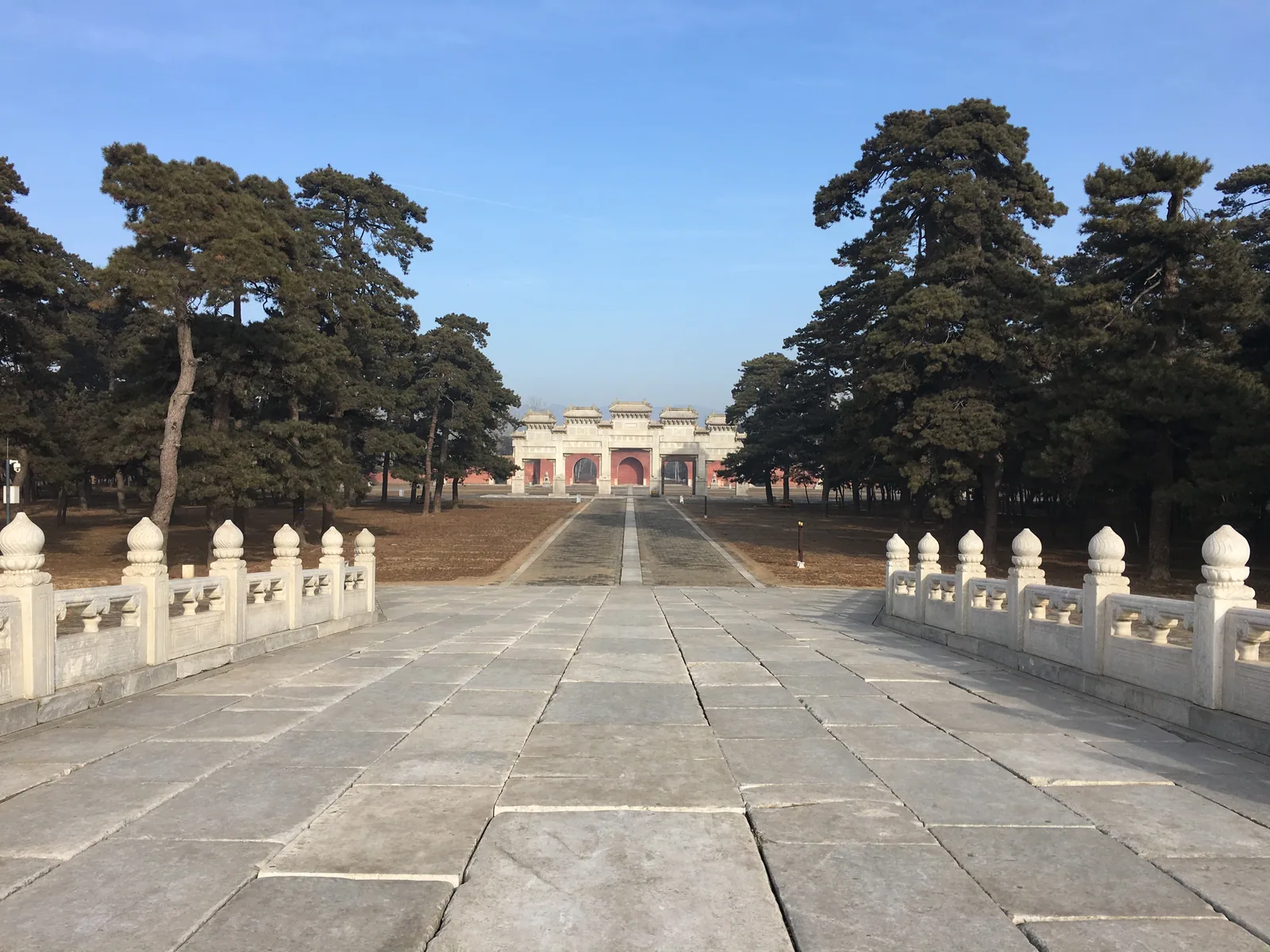
Look at the fabric of the Tailing, the first and largest of the Western Qing tombs, and the empire appears as a list of deliveries. The floor of its main hall, the Long'en Hall, is laid with gold bricks fired at Suzhou, far to the south on the Yangtze delta. The long wall bricks came from Linqing in Shandong. The roof tiles were made at the Liulichang kilns outside Beijing. The pale stone came from Dashiwo in the Fangshan hills south-west of the capital. Almost nothing in the tomb is local except the site. That site is a valley at the foot of the Yongning mountain in Yi County, with the Zijing pass to its west, the remains of the Yan lower capital to its east, and the Yi river and the Langya mountain to its south. The approach runs north on an axis: a flame-shaped archway, a five-arch stone bridge, three stone memorial archways, a pair of stone xiezhi, the single-horned beasts of justice, dismounting steles, the great red gate, the hall of abstinence and a paved spirit path. Ten main tomb compounds lie west to east across the valley, with more than 500,000 square metres of building floor, and the Tailing holds the central axis. One later tomb has a curiosity of its own: at the Changxiling, the seventh stone of the path before the terrace returns a sound amplified underground, and a semicircular wall around the mound carries a voice from one end to the other.
From the journal
Western Qing Tombs at Yixian: four emperors in a Hebei valley
The Western Qing tombs fill a valley under the Yongning mountain in Yi County, south-west of Beijing, with four imperial mausoleums laid out from 1729 into the twentieth century. The site is the western half of the single World Heritage property inscribed in 2000 with the Eastern tombs.
In the same city · Baoding ↗Gold bricks from Suzhou
A tomb that broke the rule
Construction was ordered in 1729, the seventh year of the Yongzheng reign. The emperor had first intended to lie at Malanyu, where his father Kangxi and his grandfather Shunzhi were buried, in what became the Eastern tombs. In that year he abandoned the Malanyu site with a stated reason, too much sand and gravel in the ground chosen, and moved to the Taiping valley under the Yongning mountain in Yi County. To make the new cemetery easier to manage, eighteen villages of Yu county in Shanxi were transferred to Yizhou in 1733, and the county was raised to a department directly under the province. The move broke the rule of son following father that Kangxi had used. Qianlong, his son, replaced it with an alternation: if a father lay in the east, the son lay in the west, and the reverse. He himself went east. The rule held for Jiaqing, then failed for Daoguang, who in 1828 found seepage in the underground chamber of the tomb prepared for him in the east, abandoned it, and rebuilt in the west; his son Xianfeng therefore went east, and Tongzhi after him. Four emperors lie here: Yongzheng in the Tailing, buried in 1737; Jiaqing in the Changling, begun in 1796 and finished in 1803; Daoguang in the Muling, built from 1832 and reduced in scale after the abandoned eastern attempt; and Guangxu in the Chongling, the last imperial tomb built in China, completed in 1915 after the dynasty had fallen. Nine empresses lie with them, and the last burial, of Consort Jin, took place in 1924.
Red posts, white posts, green posts
What surrounded the tombs was a boundary with a grammar of its own. Red posts were set every three li around the perimeter, 587 of them. Forty paces outside each red post stood a white post, and forty paces beyond that a green post. Inside the red posts ran the geomantic wall, twenty-one kilometres in circuit, and outside the wall a firebreak six to ten metres wide was kept clear. Beyond the green posts lay twenty li of official mountain. Ordinary people were forbidden inside, and the ban was enforced by two guard establishments, the East House and the West House, and by the offices of the household department and the board of war. Trespass brought arrest and sentence, at the extreme execution on the spot, and the record notes prosecutions for cutting timber that reached from villagers to the tomb guards themselves. In 1900 the Boxer movement reached Baoding, some guards joined it, and French troops with British, Italian and German units entered the province and occupied the tombs. The list of what was taken and not returned includes four gold vessels, 101 gilt-silver, 68 silver, 242 bronze and 3 tin. Repairs came to 288 items by 1902. The tombs were robbed repeatedly again in the 1920s and 1930s, the Chongling being looted in 1938, and its underground chamber opened to visitors in 1980. A cultural relics office set up in 1954 was the first body able to stop the robbing. In 2000 the Western tombs entered the World Heritage list as one property shared with the Eastern tombs at Zunhua.