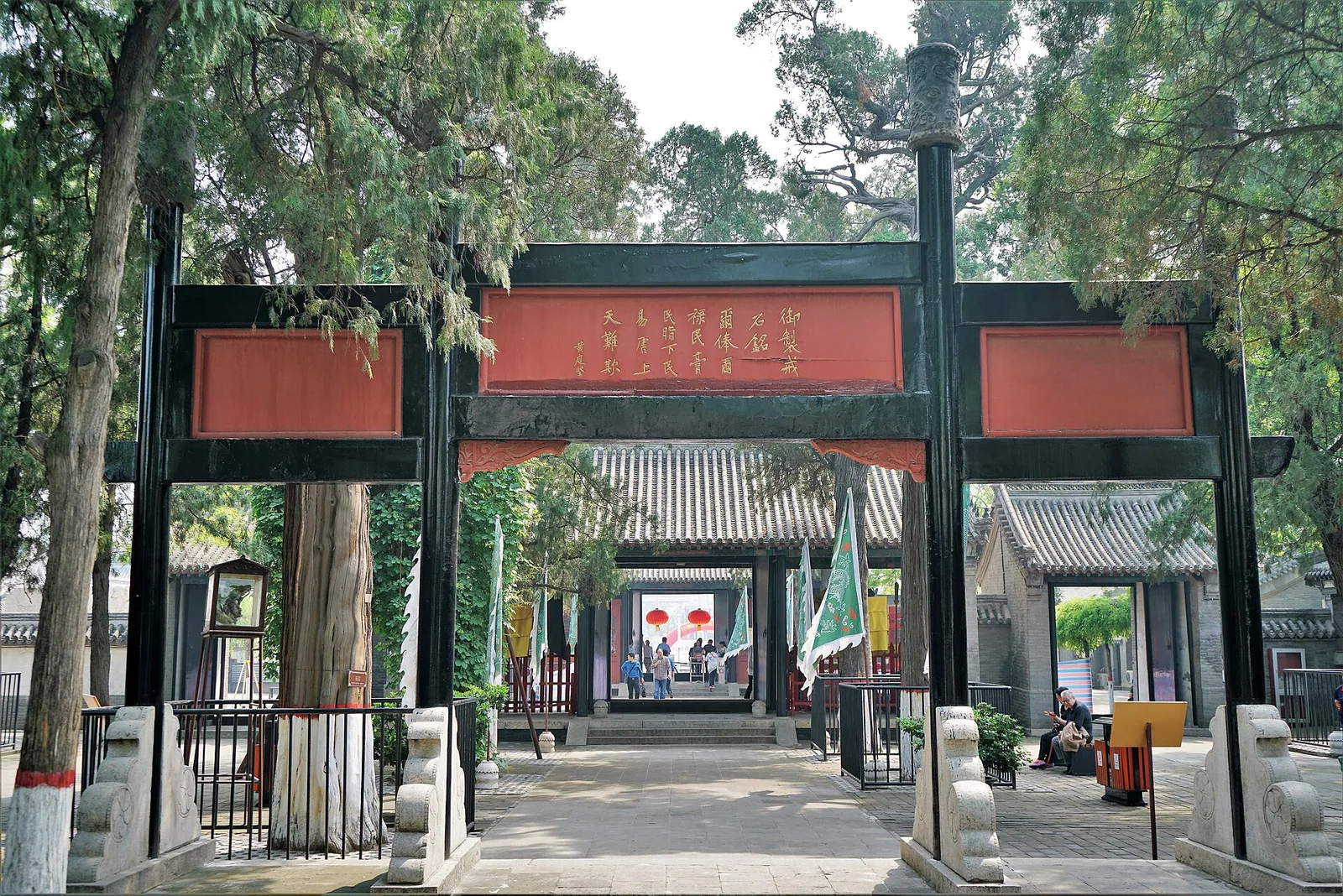
The governor-general's office in Baoding is a rectangle of courtyards on a north-south axis, with its gate facing south toward the Fu River. Its plan is the standard plan of a Chinese official building, only larger: gate, second gate, main hall, second hall, third hall and fourth hall, one behind the other, with matched ranges of rooms down the east and west sides and, outside the gate, screen wall, ceremonial gateposts and flagpoles. The site had been official ground for centuries before. Under the Yuan it was the seat of the Shuntian route government; under the Ming it held the prefectural office, the regional military commission and the brigade commander's office. The choice of the site is recorded as a matter of ground. The west half of Baoding stood higher than the east, and West Street ran along the top of that ridge like a spine. When the new office was built in the Qing, the site taken was the compound of the brigade commander, which faced south to the Fu River with West Street behind its back, and that was judged a good position. The east half of the city lay lower and downwind, and was not thought suitable for an office. Only two of the city's four levels of government buildings still stand: this one, and the office of the Qinghe circuit. The prefectural and county offices were demolished long ago, and their plans survive only in diagrams printed in the local gazetteers.
From the journal
Baoding and the Zhili Governor's Office: the seat of a province
Baoding became the capital of Zhili in 1669 and kept the office of the governor-general, the first of the Qing empire's eight great governorships. The surviving yamen on West Street shows how a province was administered, and the city lost the rank within a century of the empire's fall.
In the same city · Baoding ↗The ridge of West Street
The first of the eight governorships
Zhili means directly subordinate: the province took its name from the fact that it answered to the capital rather than to an ordinary provincial governor. In 1669, the eighth year of Kangxi, the Zhili governor moved his seat from Zhengding to Baoding, and Baoding became the provincial capital. In 1724, the second year of Yongzheng, the post was raised from governor to governor-general and the new office was built for it. In 1726 a circuit office was added, so that the city held four levels of administration, province, circuit, prefecture and county, at once. Under the Qing the province reached its greatest extent, covering modern Hebei, Beijing and Tianjin together with parts of Shandong, Shanxi, Henan, Liaoning and Inner Mongolia, and its governor-general was ranked first among the eight great governorships of the empire. The post combined military command, civil administration, the salt monopoly, river works and the northern trade portfolio, which took its holder beyond provincial business. Seventy-four men held it in ninety-nine appointments across 187 years, from Yongzheng to Xuantong. Among them were Li Wei, Tang Zhiyu and Fang Guancheng, and in the nineteenth century Zeng Guofan, who took the post in 1868, Li Hongzhang, who held it from 1870, and Yuan Shikai. Baoding was a garrison city as well as a seat of government: in the Song the prefecture was classed as military, and under the Qing five battalions were stationed in it, with the Huai Army added in the late nineteenth century.
A provincial capital that lost the province
Baoding's rank did not survive the empire. The city was the capital of Hebei from 1949 to 1958, when the provincial government moved to Tianjin, and again from 1966 until the revolutionary committee was set up in Shijiazhuang in 1968. What the Qing left behind is a city of institutions built around the office: the Lotus Pond academy, founded in 1733 as the province's highest school; the Huai Army guild hall that Li Hongzhang built in the south-west corner of the city after 1870; and the guild halls that arrived with officials and merchants from other provinces, more than ten of them from the Kangxi reign onward, of which eight still stood in 1948 and almost none can now be found except in old photographs. Before the office lost its empire, the city was already changing around it: the railway from Lugouqiao reached Baoding in 1899 and its station stood outside the west gate, a telephone service opened in 1900, and in 1903 an imperial lodging was built for Cixi, who stayed three days. The office itself is rated a 4A scenic area and is the centre of the old city's identity. The wider prefecture is the most populous in Hebei, rising from the plain in the east to the Taihang mountains in the west, with the Juma, Tang and Dasha rivers running east into Baiyangdian and the Daqing River. The old city has been largely rebuilt since the 1990s, and the surviving historic buildings now stand among modern blocks.