The name comes from a Tang poet. Li Bo and his brother had retired to the place to read, and the story goes that he kept a deer which was said to understand people and could walk tens of li to the county town to buy books, paper, ink and brushes for its master. Li Bo was afterwards called Master White Deer, and when he took office as governor of Jiangzhou he built a tower and pavilion there and gave the hollow its name. Bai Juyi, passing through on his way to exile, addressed him in a verse about the moss growing on the family's white-deer hollow.
From the journal
Reading under the pines at Bailudong
Before it was a monument, the academy was a reading room in a mountain, and its rules were written by a man who had been exiled there.
In the same city · Jiujiang ↗The deer in the story
The academy Zhu Xi rebuilt
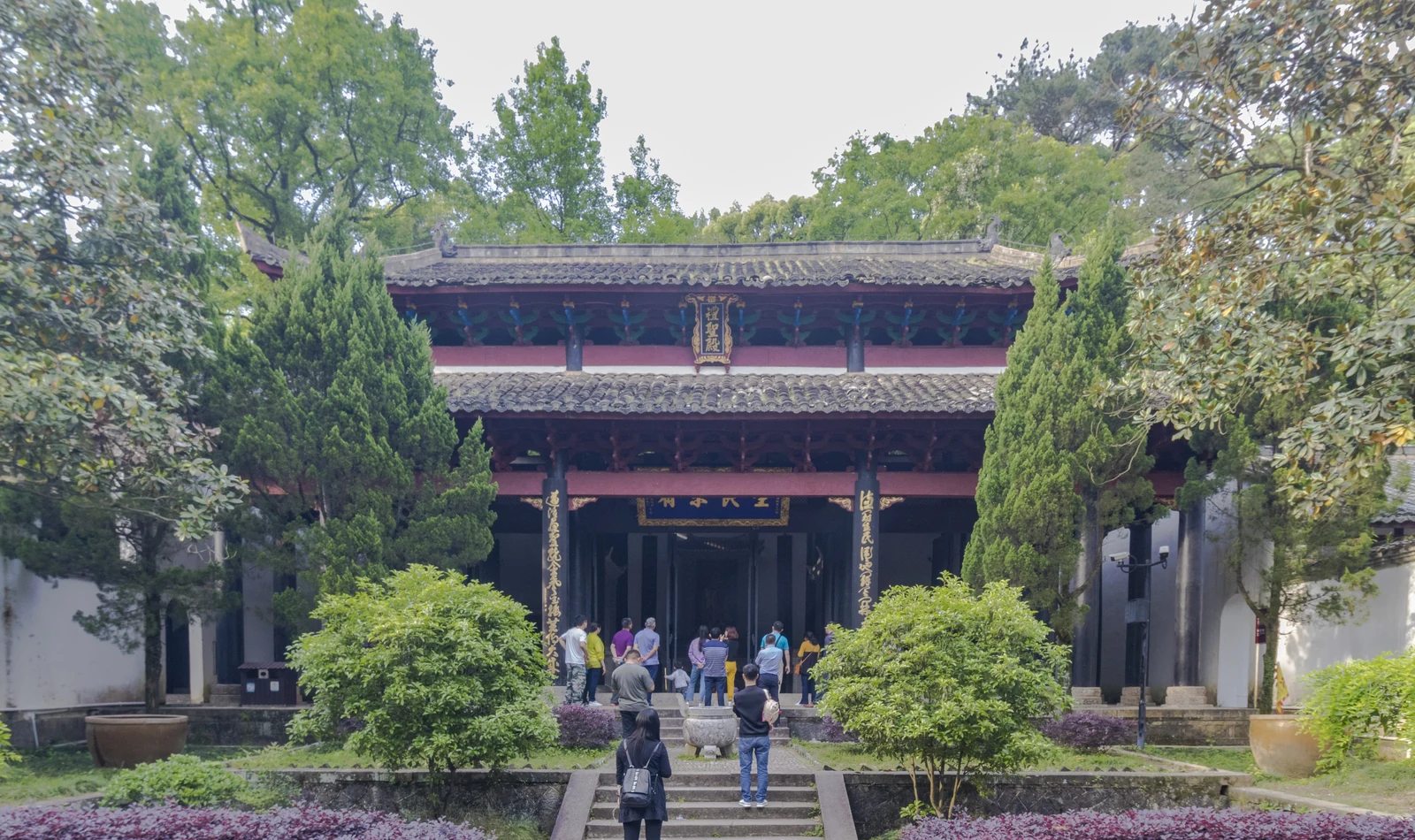
What stands today is not the Tang site but a Song academy raised on its ruins. After the early Song, the people of Jiujiang rebuilt the academy on the abandoned site, and Emperor Taizu ordered the Classics printed by the Imperial Academy to be presented to it; its reputation grew at once and it counted close on a hundred students. In the twelfth century Zhu Xi, as governor of Nankang, rebuilt the academy again, lectured there himself, and settled its rules and purpose, then petitioned for an imperial plaque and calligraphy.
One of the four
Bailudong was counted with Yuelu, Juyang and Shigu as the four great academies of the realm, and the comparison is meant to be literal: these were the places where reading was organised rather than merely done. The setting explains the practice. A hall in a mountain hollow, reached by a path rather than a street, is a place built for people who are going to stay. It is worth reading the academy's rules as a working document, because that is what Zhu Xi intended them to be.