From the journal

Laolongtou: The Dragon's Head Standing in the Tide

At Laolongtou the eastern end of the Ming Great Wall runs into the Bohai Sea. A fort was built here in 1381, a sea wall added in 1579, and the point wrecked in 1900. The stretch was repaired in 1984.

In the same city · Qinhuangdao ↗

Stone in moving water

The wall ends in water. Not at the edge of it, not above it, but in it: a stone platform carried out from the shore into the Bohai, with water on the seaward sides. The Chinese name, Laolongtou, means the old dragon's head, and the comparison is exact. The wall comes down from the mountains like a body, and this is the head, drinking from the sea.

A tower stands on the platform. The Chenghai Tower, the Tower of the Calm Sea, is two storeys high, with a nine-ridge hip-and-gable roof, three bays across and two deep. From its upper floor the water is visible on three sides, and the Shi River mouth lies to the west. The fort itself is a low, thick-walled enclosure, built to hold men and stores above the reach of the tide. The Bohai lies to its south and east; the coast road runs behind it on the north.

To the north the ground runs back to Shanhaiguan, and the wall follows it. This is the right wing of the pass defences, the southern half of the line that begins at the pass and ends here. The site is now a park, attached to the Shanhaiguan scenic area, and the wall runs from the platform north to the pass without a break.

The water is shallow close in, and the fort stands where the river's fresh water meets the salt of the bay.
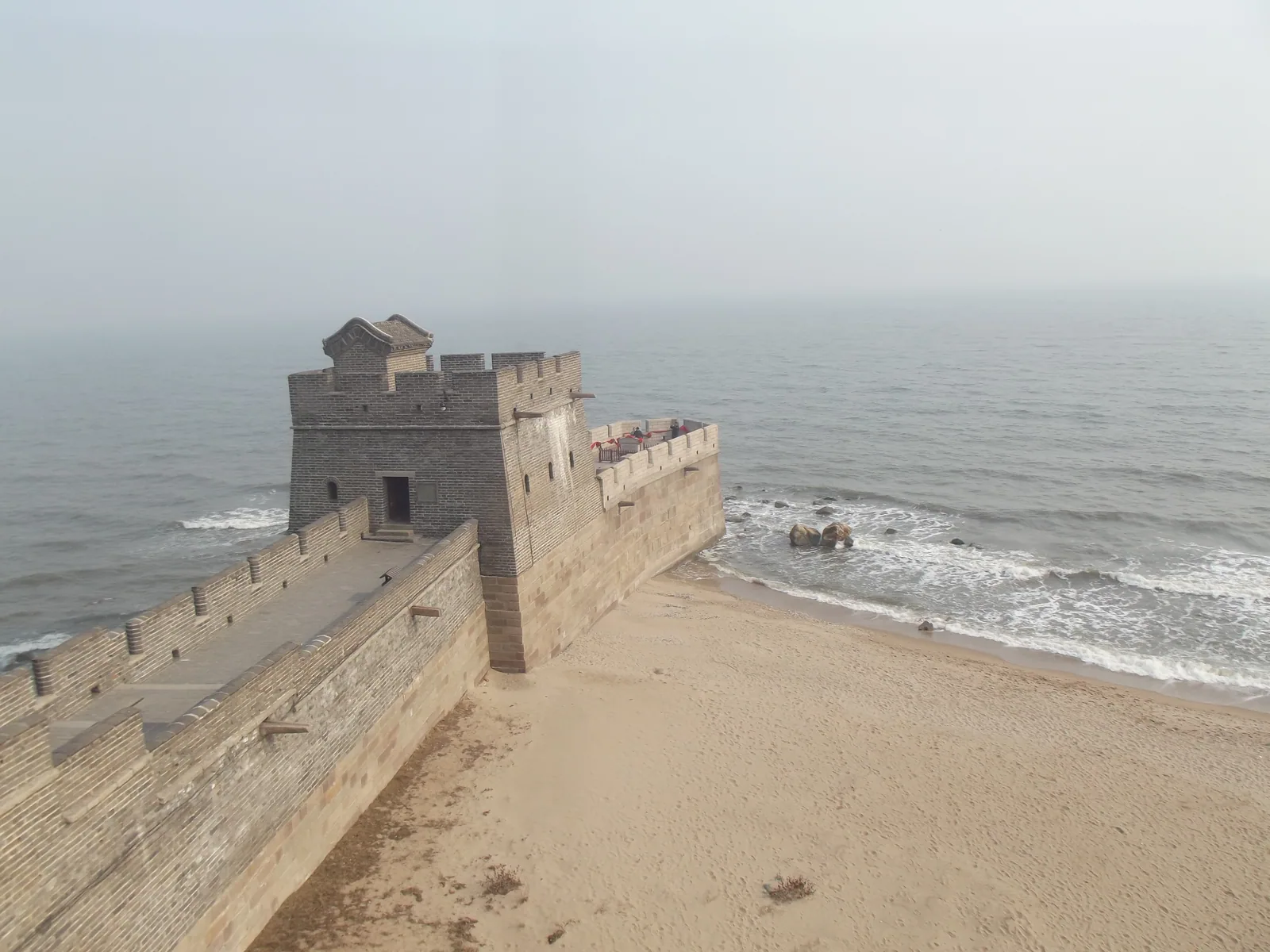
The Old Dragon's Head at Laolongtou, where the Ming wall and its sea fort run into the Bohai Sea.

A wall that had to be built twice

The first fort here dates from 1381, the year Xu Da built the pass city. It was the sea end of the Ming line, and the only place where that line enters the sea at all. Writers have called it the Great Wall on the Sea, and the claim is not poetic: no other point of the Ming wall stands in salt water.

The masonry in the water is later than the fort. In 1579, the seventh year of the Wanli reign, Qi Jiguang, then commander of the Ji and Liao defences, built the stone fort out into the Bohai. In 1633, the sixth year of Chongzhen, the Minister of War Yuan Chonghuan and others built the Ninghai Fort at Laolongtou, and the sea-viewing pavilion that already stood on the wall beside it was rebuilt as the Chenghai Tower. Fort, tower and wall work as one position: a stone base in the water, a tower to watch from, and a wall to bring men down to it. It also carries the claim of being the first place on the wall where a tower was built to look at the sea.

The position also explains the shape of the pass. Shanhaiguan's left wing ran north into the mountains through Jiaoshan, Sandaoguan and Jiumenkou; its right wing ran south to this point. Between the two, the pass controlled the coastal road, and the sea fort closed the last gap, the wet one.

The site is also described as the best-preserved Ming coastal defence barracks, which is a claim about the enclosure rather than the wall: the garrison's quarters and stores survived where other parts of the defences did not.

1900 and 1984

In 1644 the fort's purpose was tested from the land side. Li Zicheng brought more than forty thousand men against the pass, and Wu Sangui opened it to Dorgon, admitting a hundred and fifty thousand Qing troops. The fighting moved to the Shi River and lasted three days. The sea end of the wall was never breached; the gate behind it was simply unlocked.

In 1900, during the Eight-Nation Alliance, Laolongtou was damaged in the fighting at Shanhaiguan, and the fort was used as a camp by the allied troops. The wall that had been built to keep an army out of China was occupied by armies that had come in from the sea it faced.

The repair came in 1984. The stretch was rebuilt, and the site reopened as a park within the Shanhaiguan scenic area. The date matters because it marks a shift in how the wall was treated: not as a ruin to be studied, but as a structure to be maintained. The same decades saw the wall listed as a World Heritage property in 1987 and Shanhaiguan named a national historic city in 2001.

The reconstruction raises the usual question. A wall rebuilt in 1984 is a modern structure in an old shape, and the stone platform in the tide is exposed to a force that no other section of the wall faces. Salt water works at mortar; the tide removes and returns. Maintenance here is not a matter of clearing grass from a walkway, but of replacing stone at the waterline.

The old name survives all of it. The dragon's head still drinks, and the body of the wall still runs north to the pass, where the road goes through the gate and the mountains begin.

Continue exploring · Laolongtou ↗
Photo credits and rights
  1. The Old Dragon's Head at Laolongtou, where the Ming wall and its sea fort run into the Bohai Sea.S.flaischlen · CC BY-SA 4.0 Photo source ↗ Rights information ↗ Converted to WebP.