From the journal

Shanhaiguan: The Pass Where the Wall Meets the Road

Shanhaiguan was laid out in 1381 as a walled pass between the mountains and the Bohai. Its four gates, barbicans and corner towers were repaired repeatedly through the Ming, and the plaque over its east gate gave the pass the name it still carries.

In the same city · Qinhuangdao ↗

Four gates and four barbicans

At its greatest extent the pass city had a gate on each side, and outside each gate a barbican, a walled enclosure that trapped anyone who broke through the first door. Above each gate stood an archery tower. The east gate was the Zhendong Tower, Garrisoning the East; the west was Ying'en, Welcoming Grace; the south was Wangyang, Gazing at the Ocean; the north was Weiyuan, Overawing the Far. The south-eastern corner tower was Jingbian, Pacifying the Border, repaired in 1479, 1587 and 1591.

Flanking the east gate were three two-storey subsidiary towers, Linlü, Muying and Xin, built to strengthen the defence. Inside the city, at the centre, stood a bell and drum tower. It was first built slightly north of the centre, repaired in 1471, moved to the exact centre in 1586, and in 1611 had its top storey removed, leaving a single-storey building.

The barbicans were not only military. The east enclosure held a temple to Guandi, the god of war, and a shrine to Chen Gong; the west held another Guandi temple and a shrine to loyal officials; the south held a temple to Zengfu, the god who increases fortune; the north held a temple to the medicine king. The gate that carries the name is the east one: beneath the northern eave of the Zhendong Tower's top floor hung the board reading Tianxia Diyi Guan, the First Pass Under Heaven.
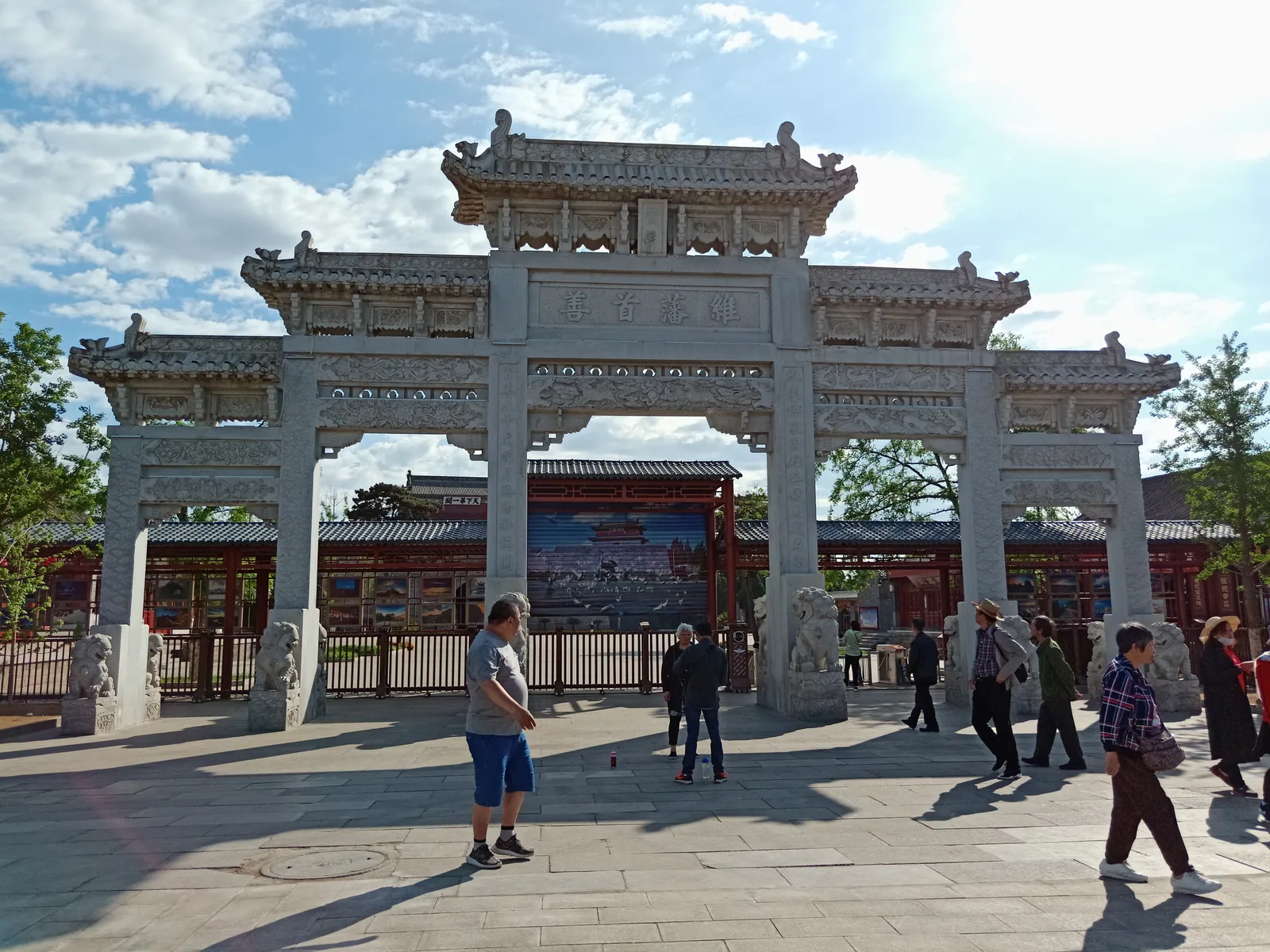
A stone paifang outside Shanhaiguan Pass.

A pass built in one year

In 1381, the fourteenth year of the Hongwu emperor, the Ming founder sent Xu Da, one of his founding generals, to build the pass. Xu Da established the Shanhai Guard under the Ji garrison, with ten units called suo and a population of more than thirty thousand. The guard's territory ran east to the Liaoning border, south to the sea, north eighty li to the Yiyuan Pass, and west to Funing County.

The defences were organised in two routes. The Shanhai route controlled ten smaller passes, among them the Naihaikou, Beishui, Hanmen, Jiaoshan, Sandaoguan and Yipianshi passes; the Shimen route covered the approaches inland. North of the city, across gentle ground, ran the left-wing wall, and where the ground rose, the wall climbed the ridge in succession through Jiaoshan, Sandaoguan and Jiumenkou. South of the city ran the right-wing wall, ending in a stone fort built out into the Bohai.

Under Qi Jiguang the line was thickened: twenty-three bastions along the pass front, fourteen beacon mounds running inward in 1570, and in 1579 a stone fort in the sea and a new eastern outer city of 0.24 square kilometres with two corner towers, seven bastions and a gate tower. In 1618 a garrison commander was appointed, with five towns, fourteen wings and thirty-six battalions inside and outside the pass. Between 1621 and 1625 the Minister of War Sun Chengzong built nine large and forty-nine small forts beyond the wall, the chain known as the Guan-Ning-Jin line.

The battle at the Shi River

In 1644 the Ming dynasty fell, and the pass became the hinge of the transition. Li Zicheng marched north with more than forty thousand men to take it from Wu Sangui, the Ming commander holding Shanhaiguan. Wu Sangui opened the gate to Dorgon and let in a hundred and fifty thousand Qing troops. The fighting at the Shi River lasted three days. The peasant army, outnumbered, withdrew to Lulong County, regrouped, was beaten again, and Li Zicheng fled back to the capital. The Qing entered China proper through the gate Wu Sangui had opened.

The record of repairs on the fabric is dense. The Zhendong Tower was repaired in 1556, 1585 and 1610; the west gate in 1558 and 1611; the Jingbian Tower in 1479, 1587 and 1591. The Weiyuan Tower was rebuilt in 1611 and later destroyed by fire, at a date the records do not fix. In 1633 Yuan Chonghuan and others built the south and north wing cities outside the pass, covering 0.216 square kilometres, to hold troops, grain and munitions, and converted the sea-viewing pavilion at the wall's end into the Chenghai Tower. Work on a western outer city began in 1643 and was never finished.

Shanhaiguan became a national historic city in 2001, one of five in Hebei. It is now a district of Qinhuangdao, about fifteen kilometres from the city centre, with an average annual temperature of 11.2 degrees Celsius and 613 millimetres of rain.

Continue exploring · Shanhaiguan ↗
Photo credits and rights
  1. A stone paifang outside Shanhaiguan Pass.PQ77wd · CC BY-SA 4.0 Photo source ↗ Rights information ↗ Converted to WebP.