From the journal

Jinshanling: Where the Great Wall Keeps Its Bricks

Jinshanling runs 10.5 kilometres along a ridge in Luanping County, Chengde, with five passes, sixty-seven towers and three beacon towers. Ming builders began it in 1570. Its first stretch has been returned to something like its original state; toward Simatai the wall is left to weather.

In the same city · Chengde ↗

The tower the cameras chose

A square tower stands at the brick crenellation, looking down the ridge. This is the point that Chinese state television filmed for the national anthem that opens its morning broadcast, which makes it perhaps the most-seen piece of masonry in the country: a wall running away along the ridge, a tower with a crenellated parapet, mountains behind.

The section it belongs to runs 10.5 kilometres along a spur of the Yan Mountains, on the border between Luanping County in Chengde and Miyun District in Beijing, about 125 kilometres north-east of the capital. Five passes cut through it; sixty-seven towers stand along the ridge; three beacon towers stand above them. Westward the wall runs to Gubeikou, eastward to the tower called Wangjinglou, whose name means looking toward the capital, and then on to Simatai. Some distance to the west lies Mutianyu.

The wall here is not one line but a response to ground. It climbs, steps down into saddles, bends around the head of a valley and climbs again, so that from any tower the next three are visible at different heights. The brickwork of the parapet, the crenellations through which archers shot, is the element that gives the section its reputation. Where the wall has been repaired, the courses are even and the edges sharp. Where it has not, the same bricks are rounded, the mortar is gone, and grass grows out of the joints.
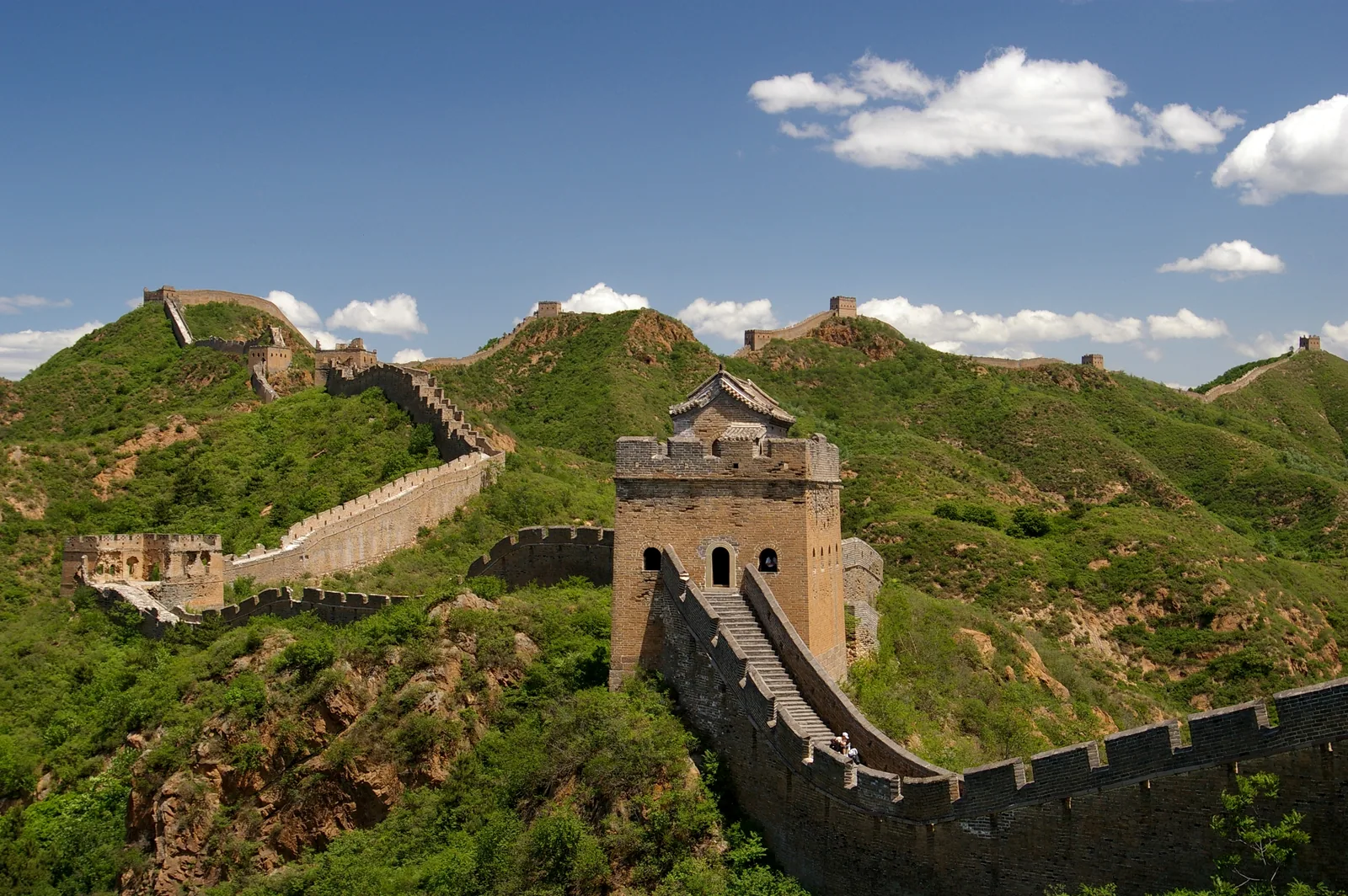
The Ming wall at Jinshanling on the Luanping ridge, with its watchtowers close enough to talk across.

The 1570s on the northern line

Building began in 1570, in the reign of the Longqing emperor, and continued into the Wanli period. The wall here was the northern line of the Ming state, and it was built to hold the passes between Gubeikou and the coast.

The 1570s were a decade of intensive work along the whole frontier. At Shanhaiguan, far to the east, the general Qi Jiguang, appointed commander of the Ji and Liao defences, added twenty-three bastions along the pass line, and in 1570 built fourteen beacon mounds running inward from the pass. The towers at Jinshanling belong to the same programme of fortification.

Five passes, sixty-seven towers and three beacon towers are the tally of a single section: infrastructure rather than a monument, and the listing of 1988 protects the wall, its towers and its passes as one unit.

The section was listed by the State Council in January 1988 in the third batch of national key cultural relics. It is also a national scenic area and a 5A-rated scenic area. The Great Wall itself had been inscribed on the World Heritage list in 1987, one of the four properties in Hebei, alongside the Chengde resort, the Grand Canal and the two Qing tomb complexes.

What survives is a system rather than a monument: beacon towers that carried messages along the ridge, garrison towers that held stores and men, and passes where the road crossed the line of the wall.

Two conditions of one wall

The restoration at Jinshanling is not uniform, and the difference is the most interesting thing about the place. The initial stretch has been returned to its original condition. Eastward toward Simatai and the wall deteriorates toward its natural state: the parapet loses its line, the wall loses its surface, and in places it becomes a ridge of rubble held together by root and soil. The section is 10.5 kilometres long, and the change from repaired stone to weathered stone happens within a few kilometres.

That gradient is unusual. Restoration usually presents a single surface, so that the visitor sees either a building or a ruin. Here both are continuous, joined by a few kilometres of path, and the join is legible. It also raises the question conservation cannot avoid: a wall that is repaired stops being a ruin, and a wall that is not repaired stops being a wall.

The State Council listed the section as a national key cultural relic in January 1988. The 5A rating and the scenic-area designation followed, and with them a cable car to the highest point along the wall. The national anthem footage from the brick crenellation is a reminder that the image of the wall is now produced as well as preserved.

The wall's argument was always visibility: to be seen from far off, and to see far off. On the ridge the two directions meet, and the towers, spaced so that each can signal to the next, are the evidence.

Continue exploring · Jinshanling Great Wall ↗
Photo credits and rights
  1. The Ming wall at Jinshanling on the Luanping ridge, with its watchtowers close enough to talk across.Jakub Hałun · CC BY-SA 4.0 Photo source ↗ Rights information ↗ Converted to WebP.