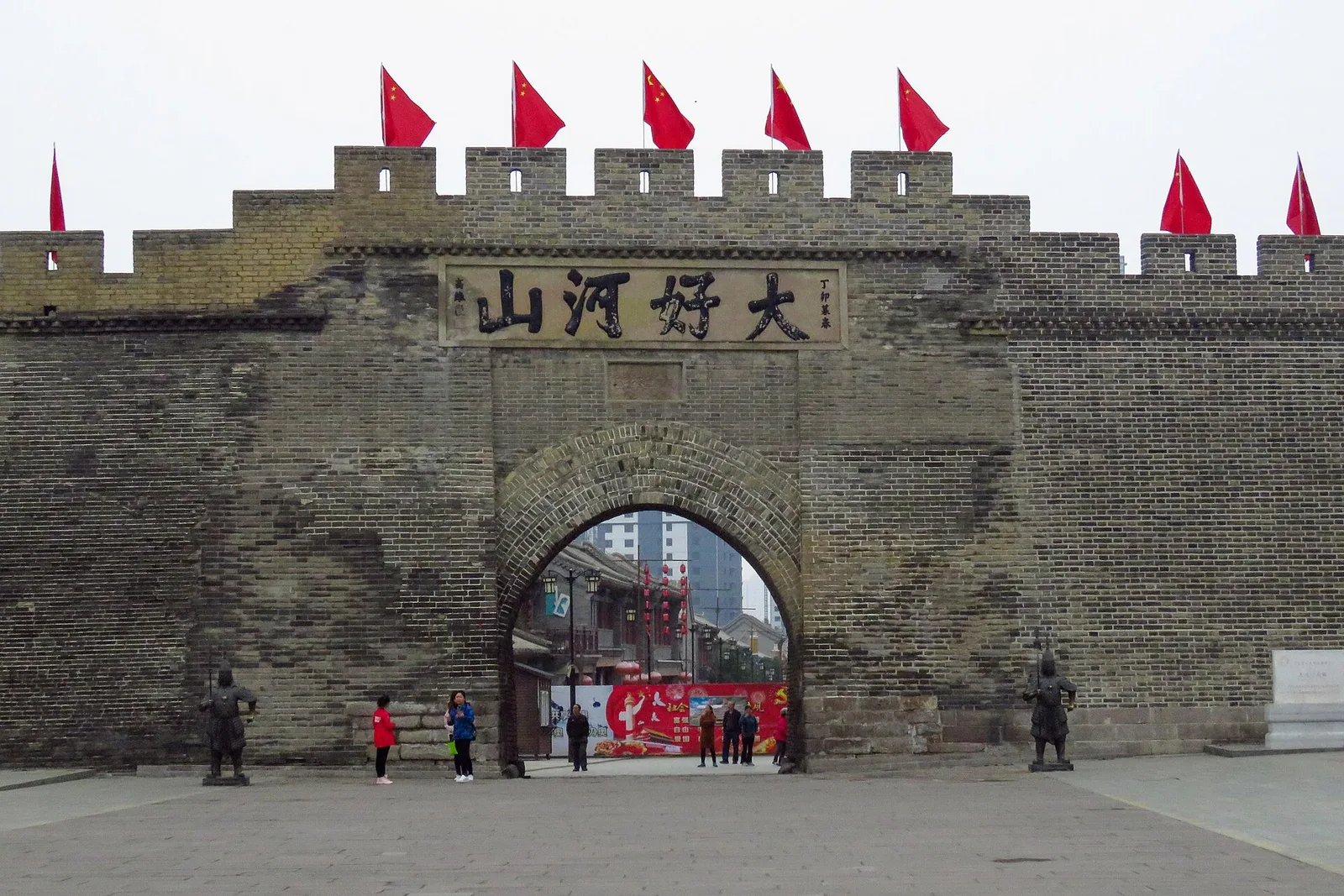
The gate is a passage through the wall: twelve metres high, nine metres wide, thirteen metres deep, with a platform on top measuring twelve metres by seven and a half. The outer edge carries a battlement 1.7 metres high; the inner edge a parapet of 0.8 metres, the height of a low wall at a person's waist. The wall above the gate is topped by towers 1.7 metres high. None of those numbers is decorative. They describe an opening built to be ridden through, loaded through and defended from above, with a platform wide enough to hold a structure and a wall on the inner side low enough to step over. Above the lintel sit four characters, 大好河山, magnificent rivers and mountains, mounted in the traditional Han style in 1927 at the initiative of Gao Weiyue, who governed the former province of Chahar. The name is a definition: 境 means border, 门 means gate. The gate stands in Qiaoxi district, north of the main urban area of Zhangjiakou, in a city that is the province's crossing into Inner Mongolia. West of the opening the wall runs about a hundred metres across level ground, faced in brick. Past that the brick stops, hard rock begins, and the wall follows the mountain line, much of it still standing. Two materials for two kinds of ground. The gate is the hinge between them: a built thing on the plain, a followed thing on the ridge.
From the journal
Dajingmen: the Great Wall Gate That Opened a Border Market
Dajingmen at Zhangjiakou is the only one of the Great Wall's four great passes called a gate. It was built in 1644 beside a border market that had traded with the steppe since 1571, and its four-character inscription dates from 1927.
In the same city · Zhangjiakou ↗The passage and the four characters
A market before a gate
The market came first. Zhangjiakou had been a garrison town long before it was a market; the old description of the place is the screen and shield of the capital, Beijing's northern gate. From 1571, the fifth year of the Longqing reign, a border market formed on the flat ground outside the later gate, below Yuanbao Mountain. The records call it a tribute market. Livestock, hides, medicinal herbs, woollen cloth and silver came from the Mongolian steppe and from further west; silk, tea, porcelain and white sugar went out. Zhangjiakou became an inland port for barter between north China and the steppe. The gate itself was built in 1644, the first year of the Shunzhi reign, after the Ming had given way to the Qing. Under the Ming the wall had marked a frontier; under the Qing the same road became a transit route for merchants trading into Mongolia, and the town grew as a station on it. The gate is one of the four great passes of the wall, with Shanhaiguan, Juyongguan and Jiayuguan, and the only one of the four named a gate rather than a pass. In 1860 the Treaty of Beijing opened Zhangjiakou, with Kulun and Kashgar, to foreign trade. The road running north was the Zhangku road, the route to Kulun that was also called the grassland silk road; camel trains had used it since the Yuan dynasty, and by the middle of the Qing it was tied to the Kyakhta trade.
Four dates in one structure
Read the gate in layers and the dates separate. A market from 1571. A gate from 1644. An inscription from 1927. A railway from 1909, when the line from Beijing opened, surveyed and built under Zhan Tianyou without foreign capital or foreign staff. Each belongs to a different arrangement of the same place, and the structure holds them without resolving them. The inscription is the clearest case: four characters in a vigorous Yan style of brushwork, placed on a gate built nearly three centuries earlier, by an official of a province, Chahar, that no longer exists. The wall makes the same point in stone. A hundred metres of brick facing on the plain, where the ground allowed a straight run; hard rock on the slope, where the wall had to take what the mountain gave it. The battlements face out and the parapet faces in, and the difference in height is a small lesson in how the wall thought about direction. Zhangjiakou describes itself in functions rather than monuments: a city on the Beijing–Baotou line, the end of the Beijing–Zhangjiakou expressway, a crossing between Hebei and Inner Mongolia, a goods distribution centre, a military position, a land trading port. A gate is where such abstractions were once counted, animal by animal and bale by bale. The town has carried other names as well, Zhangyuan and Wanquan among them, and the gate has outlasted all of them.