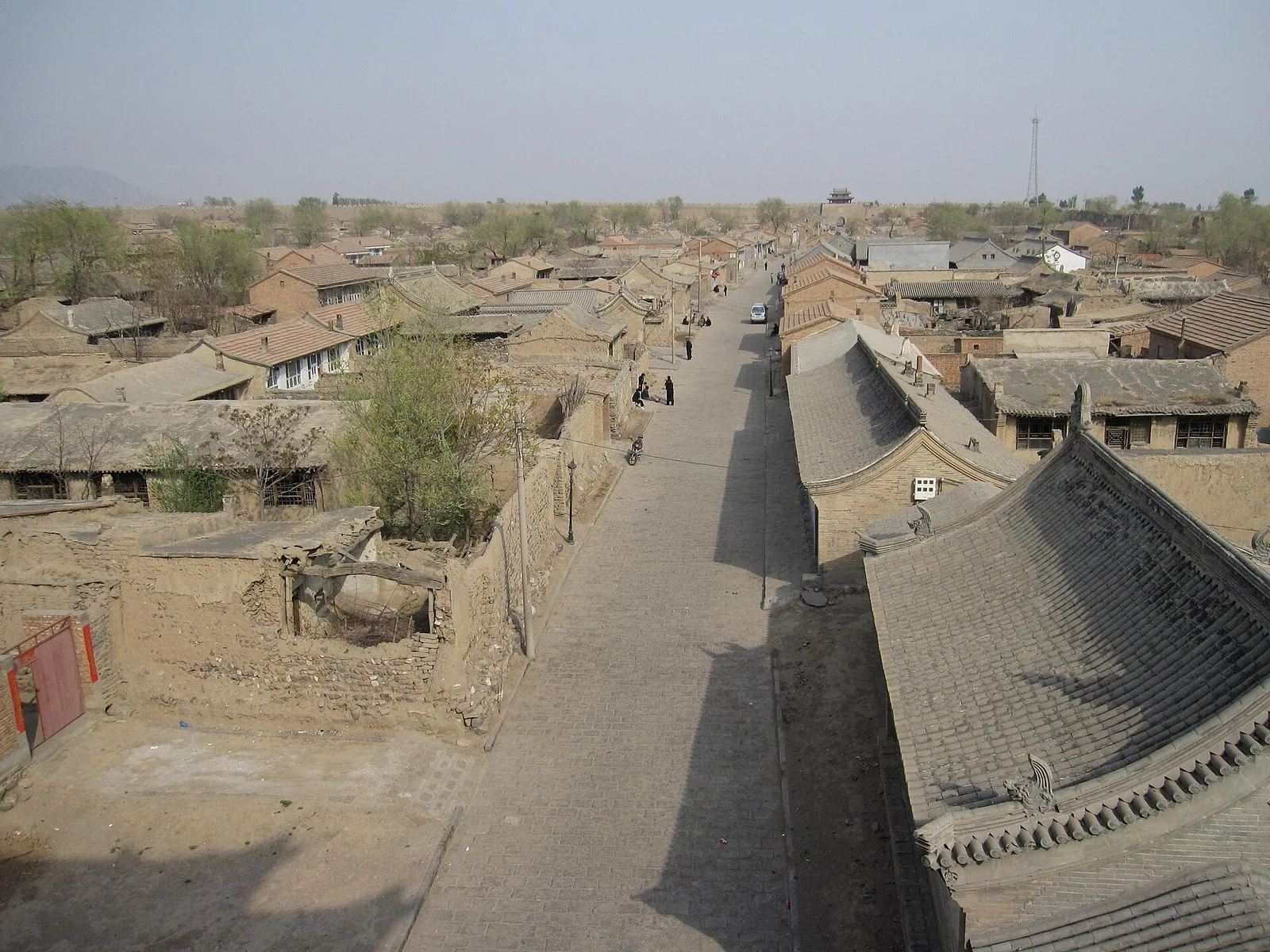
The town is a square of wall on the flat ground below Jiming Mountain, in Huailai County. Parts of the brick facing survive, and the town still sits inside its line. The wall encloses the whole settlement, not a temple or an office, and that is the first thing to notice about it: the unit of protection here is a town. Inside, the streets keep the shape of a station rather than a village: an office for the official in charge, a hall for the courier administration, a hostel for travellers, a granary, a store for carrying gear, stables. Twenty-two buildings have been repaired and accepted. The list reads like a street directory of the seventeenth century: the Jade Emperor Pavilion, the Kuixing Tower, the office of the garrison commander, the post hostel, the courier magistrate's office, the Wenchang Palace, the Yongning Temple, the stage of the Dragon God temple and the stage of the Guandi temple, with the old houses of the Yang, Meng, Li, Huang and Yan families, the Ma inn, the Desheng inn, the Wanbaochang shop, a medicine shop, the Yan and Chen shops, a pawnshop and the Chongxinyong. Two temple interiors still carry painting, the Taishan Xinggong and the God of Wealth temple. On the gate of the latter hangs a wooden plaque with four characters: different surnames, one heart. The phrase comes from the oath of Liu Bei, Guan Yu and Zhang Fei, and it fits a station, where people who were not kin had to keep faith with one another.
From the journal
Jimingyi: the Courier Station That Kept the Road North
Jimingyi in Huailai County is the largest surviving post station in China: a walled square below Jiming Mountain, set up in 1420, where dispatches and travellers crossed until the courier service ended in 1914. Twenty-two of its buildings have been repaired.
In the same city · Zhangjiakou ↗A square below Jiming Mountain
Four hundred and ninety-four years
The station was set up in 1420, the eighteenth year of the Yongle reign, on the base of a Yuan courier post, and it became the first great station on the road north out of the capital. Its other name is Jiming Mountain station, after the mountain it stands below. From then until 1914 it moved dispatches, officials and goods towards the northwest and on to Russia. Its working life is given as 494 years. In 1913 the Beiyang government announced that the old post stations would be abolished and a modern postal service opened in their place, and the courier function ended the following year. After that the town became a village inside its own walls. The site was recorded again in 1980; in 2001 it entered the fifth batch of national key cultural relics. The World Monuments Fund put it among its hundred endangered sites in 2003 and again in 2005, and at the end of 2005 the village was named a Chinese historic and cultural village. The building travellers remember is the He family house, where the empress dowager Cixi spent the first night of her flight west after the Eight-Nation Alliance entered Beijing; she later gave the family four characters, joy and blessing received. In 2019 the tea road, which ran from Wuyi Mountain through Hebei and Inner Mongolia to Kyakhta, entered China's tentative World Heritage list, and Jimingyi was one of five Zhangjiakou sites in the plan.
Repair, residents and a trail
The repairs finished in 2016, when the twenty-two buildings passed acceptance; the wall had been consolidated in 2011, and in 2010 the site had been named one of the province's ten great cultural landscapes. What that leaves is a monument with people living inside it, which is both the difficulty and the point. The conservation argument made for Jimingyi is that a courier town is a working settlement and not a stage set, so the original residents should stay and the commercial rebuilding of its streets should be restrained. It also argues for recording: measured drawings and digital models of the wall and the magistrate's office. The buildings divide into three kinds of evidence. The postal works, the office, hostel, granary and stables, show how the system ran. The temples and the Wenchang Palace, where the station school was kept, show what the people of a garrison town asked of the unseen. The shops, pawnshop and inns show that the road carried trade as well as paper. In 2023 the cultural and tourism bureaus of Beijing's Yanqing district and Zhangjiakou opened a heritage trail and made Jimingyi its fifth stop. The station is now reached as a sight, which is a different function from the one it was built for. The temple murals, in the Taishan Xinggong and the God of Wealth temple, are the part of the interior that repair cannot replace, since painting on plaster survives less well than brick. The walls are the same; the traffic is not.