Daxiangguo stands in the middle of Kaifeng, not on a mountain. The provincial culture and tourism department's account begins with the site: the old residence of Lord Xinling of Wei, then a temple founded in 555, the sixth year of Tianbao under the Northern Qi, and named Jianguo. It was destroyed, rebuilt in the early Tang by the monk Huiyun, and renamed Xiangguo when Emperor Ruizong, who had been prince of Xiang, came to the throne. Under the Northern Song it was enlarged repeatedly to more than 500 mu with thousands of monks, and served as the national centre of Buddhism. The Yellow River flood of 1642 emptied it; most of what stands now is Qing rebuilding, and in 1927 Feng Yuxiang turned it into a market.
From the journal
The Temple in the Market
Daxiangguo has been destroyed by a river, turned into a market and rebuilt in the Qing, and it still keeps a Buddhist repertoire of more than 200 pieces.
In the same city · Kaifeng ↗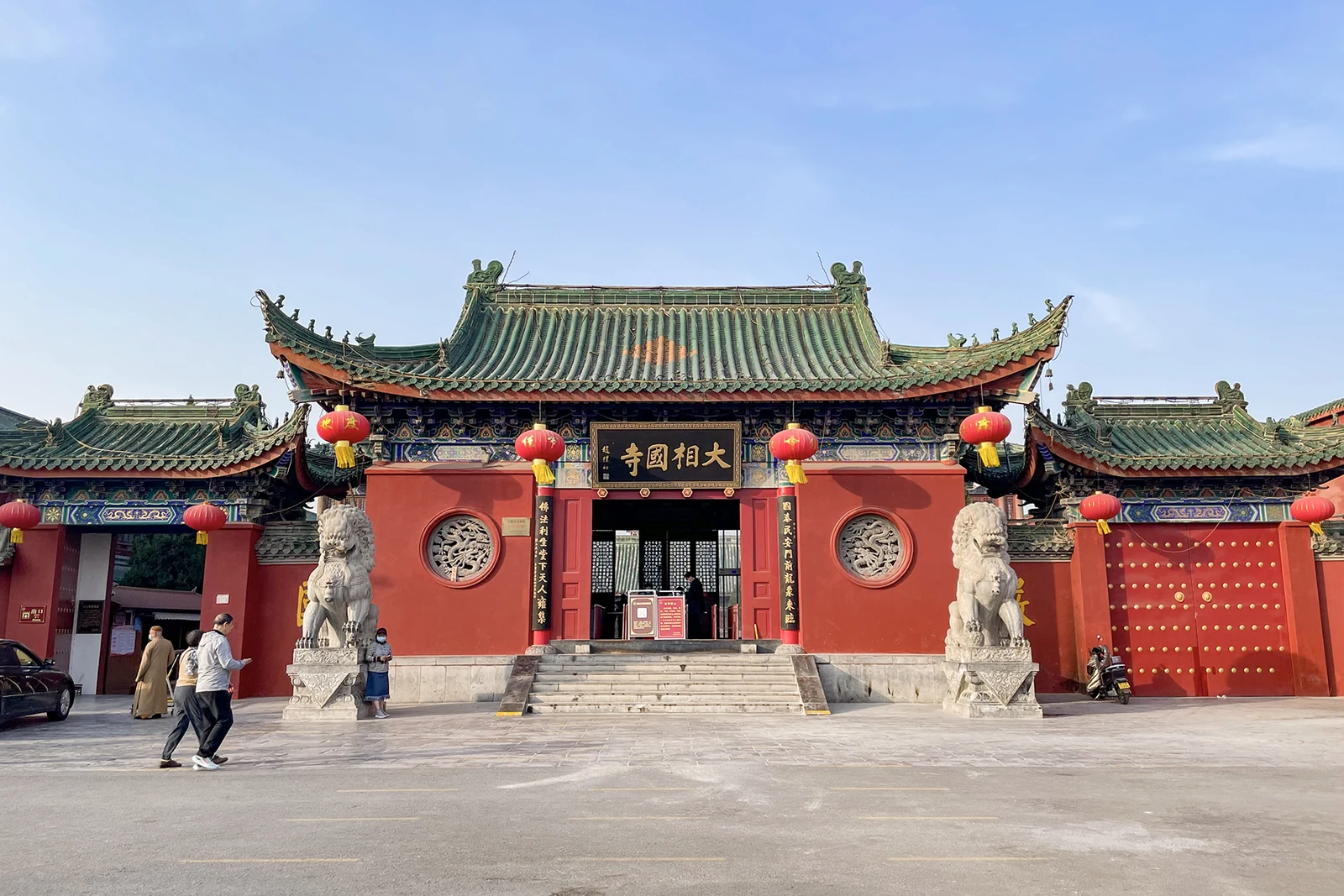
A Temple in the Market
The Bell and the Octagon
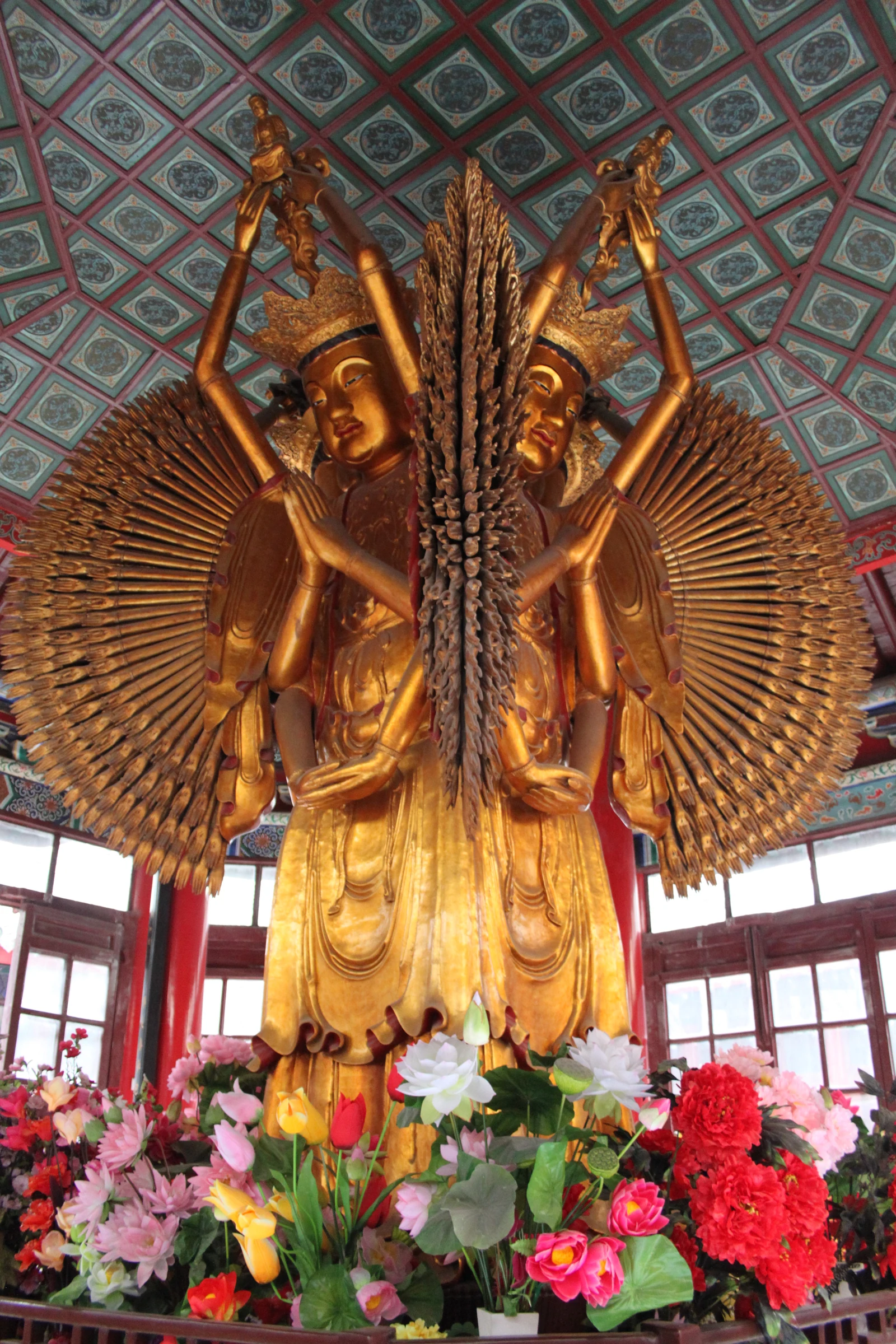
The plan is a single axis: gate, bell and drum towers, Heavenly King hall, the Great Hero hall, the octagonal glazed hall, the sutra library and the master's hall. The octagonal hall is the building people remember, and the object inside it is the reason. A four-faced thousand-hand Guanyin stands three metres high and weighs about two tonnes, carved from a single ginkgo trunk by an unnamed craftsman in the Qianlong period over 58 years; each face has six large hands and tiers of small ones, and every palm carries an eye, 1,048 in all. The hall was built in the Qianlong reign, and its octagonal plan is described by the province as without parallel among Chinese Buddhist buildings.
Two Hundred Pieces
The temple's other survival is sound. Kaifeng's municipal government describes the Buddhist music of Daxiangguo as originating in the Tang and Northern Song, drawing on court, monastic and folk music, with a repertoire of more than 200 pieces. The vocal part is built on the syllable, the ji, whose text is the language of the Buddha's sermons and whose structure is given as thirty-two Sanskrit syllables. That detail is the clearest sign that this is not simply temple background music: it is a liturgical form with a fixed phonetic core, performed alongside instrumental pieces, and it survived in a temple that had been a market, a ruin and a reconstruction within living memory.
The Orchestra Since 2002
The modern ensemble is recent. In July 2002 the temple founded the Daxiangguo Buddhist orchestra, and the municipal page records that it arranged more than forty programmes, among them White Horse Carrying the Sutra and the Frost Bell of the Prime Minister. The music entered the first provincial list of intangible cultural heritage in 2007 and the second national list in 2008. Whether the orchestra plays for a tour group or a festival, the structure is the same: voices on the ji, instruments around them, and a repertoire that the page counts in the hundreds but that a visitor will hear as a handful of pieces in a hall. The listing protects the repertoire; the performance is what a visitor can check.