The Bian Que temple stands at Shentou, a village 21.8 kilometres west of the Neiqiu county seat, on the slope below the hill called Mount Que. It has carried several names: Temple of the Magpie King, the Queshan Shrine, and the Queshan Shrine of the God Who Answers. The oldest documentary trace is a geography of the Northern Wei. In the twenty-first year of the Taihe era, 497, the record lists, among the places of Zhongqiu, a shrine on Mount Que, and Zhongqiu is Neiqiu. A stele of 1268, recording a restoration and titled for the Queshan Shrine of the God Who Answers, says that images had been kept and sacrifices made there since the Han and the Tang, that the shrine had been damaged several times at the end of the Five Dynasties, and that a military commissioner rebuilt it in the Xiande era of the Later Zhou; the inscriptions of that time, it adds, already gave the god the title of king. A gazetteer of Shunde prefecture, printed in 1750, repeats the identification in one line: the temple on Mount Que is for sacrificing to Bian Que. A county gazetteer of 1668 puts the same sentence another way, notes that the founding date is unknown, records that Emperor Renzong of the Song conferred the title God Who Answers, and adds that in the first ten days of the third month worshippers came from a thousand li around.
From the journal
Bian Que and the temple at Neiqiu built for a physician
The Bian Que temple stands at Shentou, west of Neiqiu in Hebei, and is first recorded in 497. Its steles trace a cult that gave a Warring States physician the rank of a king, while the biography behind the name rests on the stories in the Records of the Grand Historian.
In the same city · Xingtai ↗A shrine below Mount Que
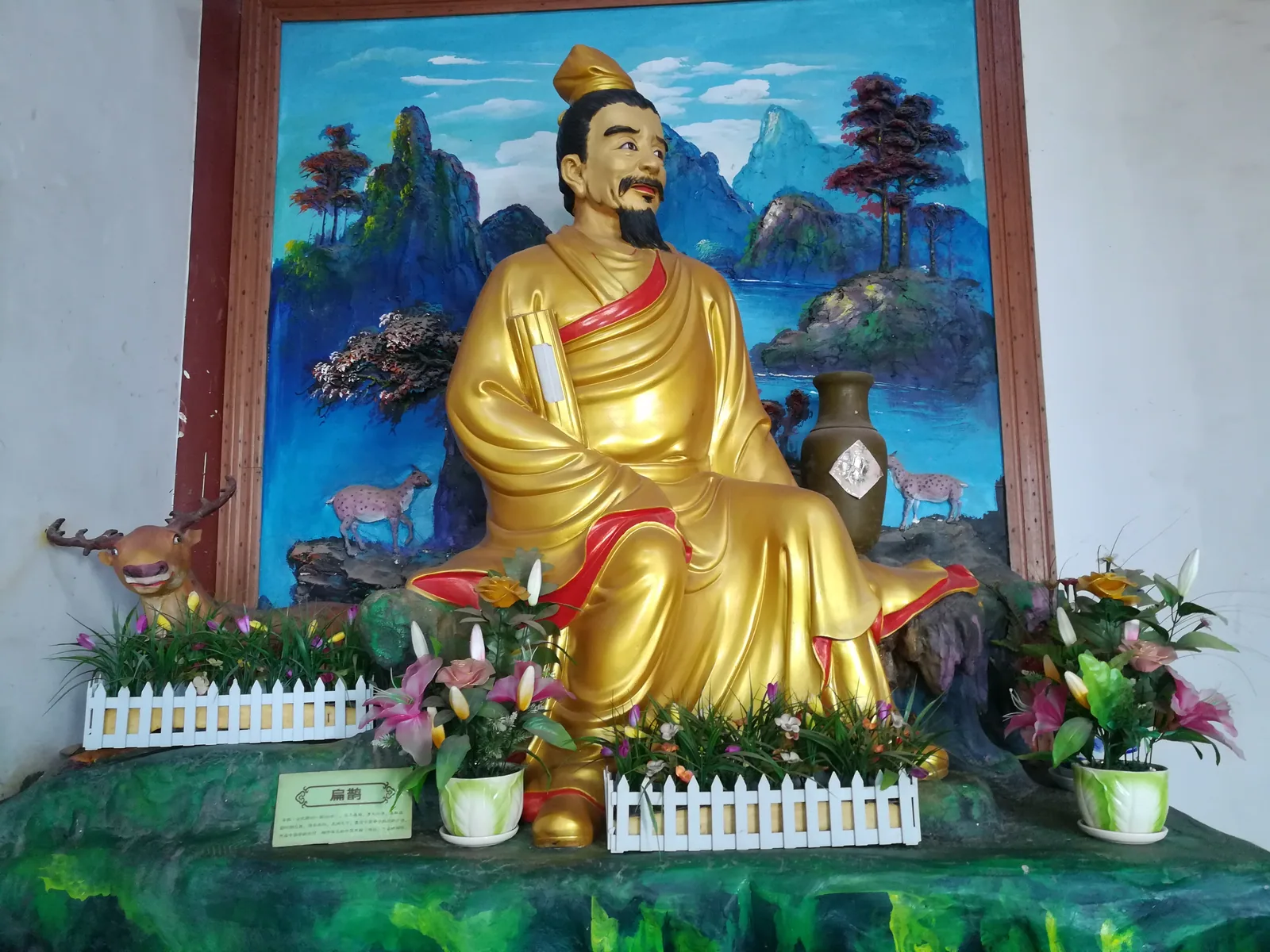
The physician behind the name
Bian Que is dated to about 407 to 310 BC, in the Warring States period, and the name is not a name. His family name was Qin and his personal name Yueren. Bian Que had belonged to an older legendary doctor of the Yellow Emperor's time, and the historian Sima Qian records that the physician took it while working in the state of Zhao; he was also called Lu Yi, the doctor of Lu, after another place where he practised. Tradition makes him a native of Mozhou, in what is now Renqiu in Hebei. He is counted with Hua Tuo, Zhang Zhongjing and Li Shizhen among the four great physicians of imperial China, and he is credited with establishing pulse diagnosis. The Records of the Grand Historian gives four cases: the medicine he received from an old man at the hostel where he worked, which let him see into bodies; the diagnosis of Zhao Jianzi; the revival of the heir of Guo; and the examination of a ruler who refused treatment. The Guo story is the most concrete. The prince lay in a coma, Bian Que set a single needle at the Baihui point on the crown, the prince woke, took herbal medicine, and recovered within twenty days. The Canon of Eighty-One Difficulties is attributed to him; the Inner and Outer Classics bearing his name are lost, and some texts on bamboo slips unearthed in Chengdu may have been composed by him.
What the steles carry
The temple's history is legible mainly in its repairs. A stele records work on the galleries in 1031, in the Tiansheng era, after which the buildings were said to shine in all directions. Another records a restoration of 1069, under Shenzong, leaving double eaves and dense ranges of side halls. In 1190 the county magistrate Zhao Shi supervised a rebuilding, had the beams painted and the purlins carved, and the inscription boasts that the temple had never before been so complete. In 1223 a deputy military commissioner rebuilt the old platform, and a physician of the imperial medical office collected materials and labour. Further works are recorded in 1487, 1587, 1621 and 1896. The 1668 gazetteer notes that the Yuan scholar Wang E and the Ming official Xie Qian both left records of the shrine, and that the poems written about it over the centuries were too many to list. The pattern is the point. A shrine first mentioned in 497 has a continuous record of patronage across fourteen centuries, from a Northern Wei geography to a Qing restoration, and its god rose from a local figure to a king by the tenth century and then to a title conferred by a Song emperor. The site is listed as a national key cultural relic. What the steles cannot settle is the biography. They record a cult and its buildings, not a life, and the man behind the title is known through Sima Qian's stories rather than through anything written in his own time.