From the journal

Xiangtangshan: Northern Qi caves and the sutras cut in stone

The Xiangtangshan caves near Handan were carved for the Northern Qi court in the sixth century, with sutras cut into the rock and a possible imperial burial chamber above a central pillar. Many of their sculptures were later removed to museums abroad.

In the same city · Handan ↗

The pillar and the empty chamber

In the northern group of the Xiangtangshan caves, the largest cave is built around a central pillar. Three faces of the pillar carry a main Buddha, with bodhisattvas, guardian figures, flying apsaras and niches in the shape of stupas around them. Above the pillar is an empty niche, a small chamber cut high in the rock. Historical sources and scholars have identified it as the burial chamber of Gao Yang, the first Northern Qi emperor, or of his father Gao Huan. No coffin or grave goods have been found there, so the identification remains an argument rather than a fact.

The cave is one of three main caves in the northern group, on Mount Gu, the Drum Mountain, near Hecun village. A southern group lies on Mount Fu, and a small third site at Shuiyusi is known as Little Xiangtangshan. All of it is cut into the dense limestone of the Taihang Mountains, about twenty kilometres southwest of Handan and about the same distance northwest of the site of Ye, the Northern Qi capital.

The stone takes carving well. It also takes damage. On many figures the heads and hands are gone, cut from the wall and sold. Some faces now in the caves are twentieth-century replacements in stone or clay, added so that worship could continue; in the South Cave, the clay figures on the altar stand in for stone originals that were removed. A cave that looks complete at first glance is a composite of sixth-century carving and later repair.
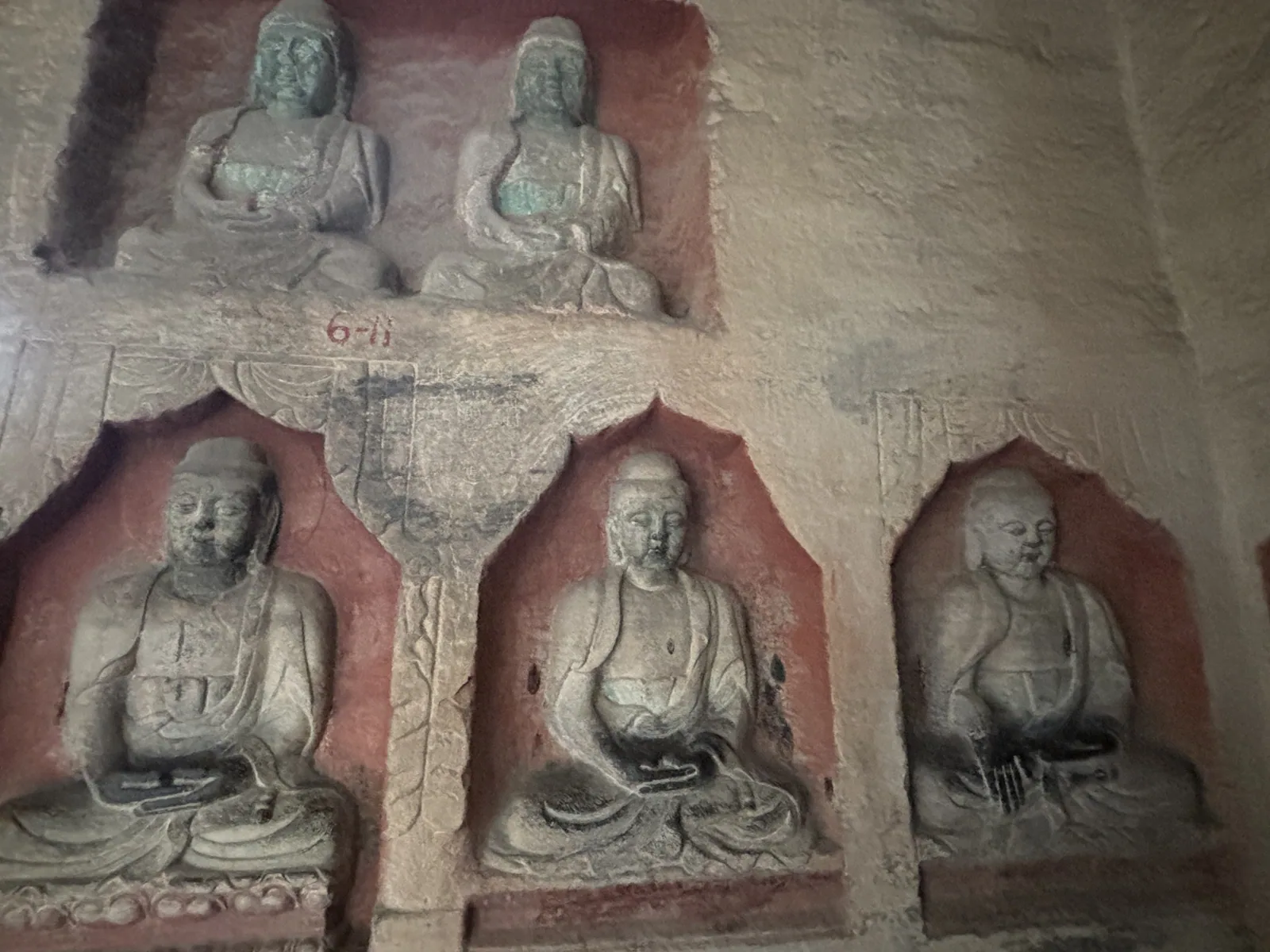
Buddhist relief sculptures at the Xiangtangshan Grottoes.

A court between two capitals

The caves belong to the sixth century and to the Northern Qi, one of the Northern Dynasties. The dynasty ruled from Ye, on the plain, but Jinyang to the west was also a centre of power, and the court and its officials moved between the two along a road that passed near the Drum Mountain. The road is one reason the site mattered. The other is imperial patronage. According to a later source, the writings of the monk Min Fen, the northern group was commissioned by Wen Xuan, the first Northern Qi emperor, and the scale and ornament of the caves support the claim that this was a royal project.

The southern group was not royal. Its construction began in 565 on the initiative of a monk, Hui Yi of the Linghua temple, and continued with the sponsorship of Gao Anahong, king of Huai Ying and one of the highest officials of the dynasty. Work there probably stopped around 577, when Northern Qi was annexed by Northern Zhou. Because no emperor paid for them, the southern caves are smaller.

Between 568 and 572 the official Tang Yong had sutras cut into the rock at the Drum Mountain. The inscription recording the work gives the motive: paper, bamboo slips and silk all deteriorate, so the text was cut into stone in order to last. The sutras include the Vimalakirti, the Sutra of Innumerable Meanings, the Srimala and the Maitreya; the southern caves add the Avatamsaka and the Lotus. The programme is among the earliest large-scale cliff-cut sutra projects in China, and its script, square and heavy with clerical traces, is a principal source for Northern Qi calligraphy.

Scattered pieces, reassembled on screen

Sculpture was being removed and sold abroad as early as 1909. The American collector Charles Freer bought a number of pieces from the dealer C.T. Loo, who is suspected of arranging their export without permission. Heads, hands, standing figures and relief panels were chiselled off the walls and sold on, and the destruction continued into the middle of the twentieth century.

The pieces are now scattered. Documented holdings include the Metropolitan Museum of Art, the Freer Gallery, the Cleveland Museum of Art, the Denver Art Museum, the University of Pennsylvania Museum, the Victoria and Albert Museum, the Harvard Art Museums, the Miho Museum, the Osaka Municipal Museum of Art, the Rietberg Museum, the Palace Museum in Beijing and the Nelson-Atkins Museum.

Scholarship has tried to put the caves back together. The Center for the Art of East Asia at the University of Chicago ran a multi-year project using 3D scanning and archival photography to match dispersed sculptures to their original positions, published as the monograph and travelling exhibition Echoes of the Past. Harvard's Chinese Art Media Lab later made an immersive exhibition, The Caves of Echoing Chambers. In 2008 Peking University teams scanned two of the northern caves and confirmed that several overseas pieces came from one of them. The site has been a Major Historical and Cultural Site Protected at the National Level since 1961, designation 1-40.

Display now works from those records. Where an original cannot return, a printed or digital copy can stand in its place, and the caves are shown as an ensemble that exists partly in Hebei and partly in museums elsewhere.

Continue exploring · Xiangtangshan Grottoes ↗
Photo credits and rights
  1. Buddhist relief sculptures at the Xiangtangshan Grottoes.Thebrainchamber1 · CC BY-SA 4.0 Photo source ↗ Rights information ↗ Converted to WebP.