Start in the cemetery, because it is the part of Shaolin that adds up. The official scenic description records 228 brick and stone tomb pagodas from the Tang, Five Dynasties, Song, Jin, Yuan, Ming and Qing periods, plus three modern ones, most of them carrying a stone or brick name tablet. Seven dynasties in one grove, and the tablets are the point: they are how you date a tower whose carving style alone would only narrow the guess. The whole inhabited complex is compact, with the monastery's buildings, the pagoda forest, the martial arts hall, the First Patriarch's Hermitage, the Bodhidharma Cave and China's earliest stone que gates all packed into an area the scenic authority gives as 2.18 square kilometres. The core building, the Changzhuyuan, is dated to 495 CE, in the nineteenth year of the Northern Wei Taihe era.
From the journal
Counting Pagodas at Shaolin, and the Gate That Outlived the Monastery
Inside Shaolin's wooded Mount Song valley, the most legible thing is not the famous wall but the cemetery: 228 tomb pagodas from seven dynasties, each with its name tablet, standing beside a temple whose main courtyard was founded in 495 CE.
In the same city · Zhengzhou ↗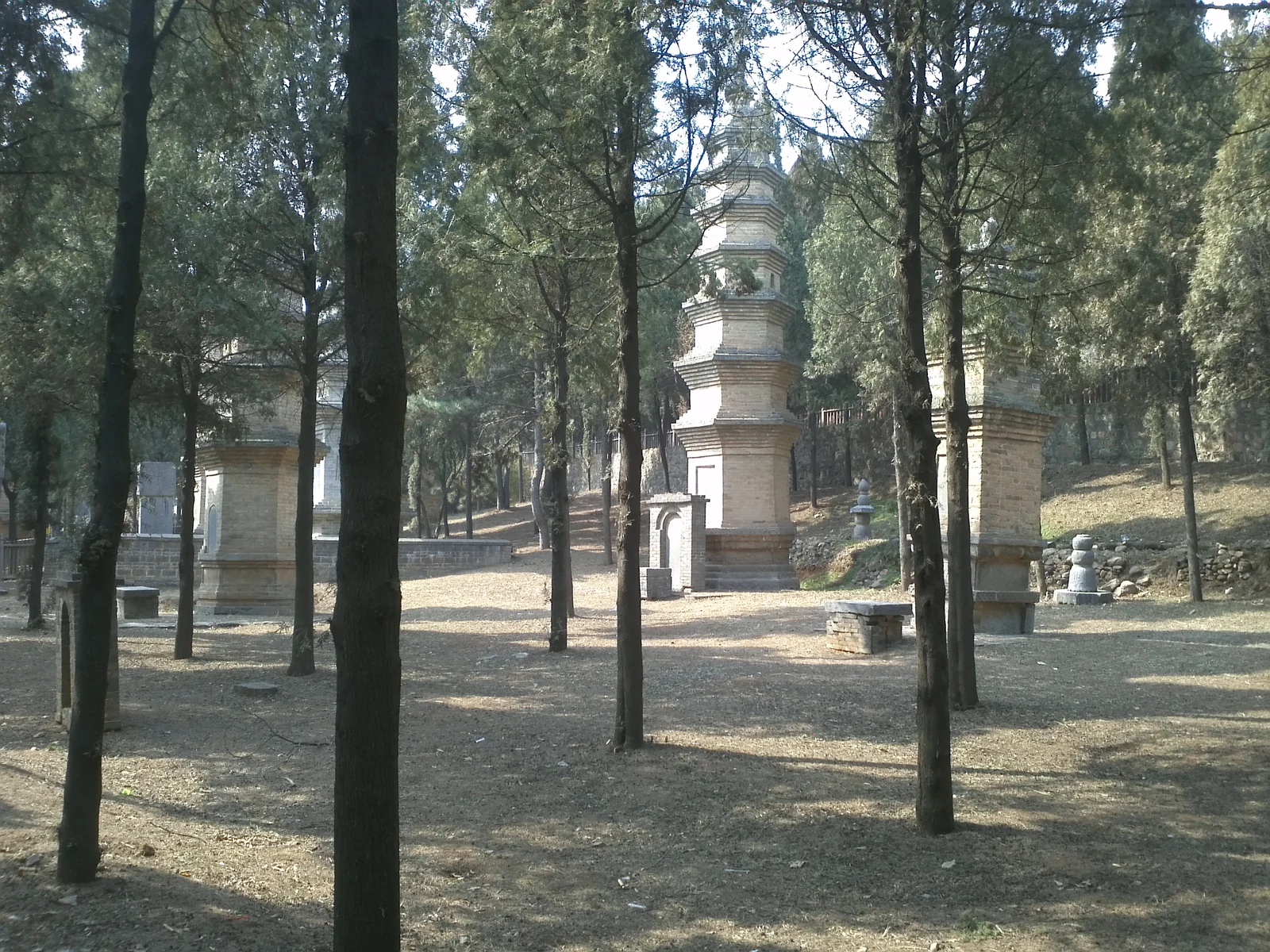
Counting
Three Sites, One Designation
Beyond the monastery, the Mount Song scenic area gathers two more sites under a single World Heritage designation. Songyang Academy, the first of the four great academies of the Northern Song, began as a Buddhist monastery in 484 CE, was used by Taoists under the Sui and Tang, and became a school where Fan Zhongyan, Cheng Hao, Cheng Yi and Sima Guang lectured; part of Sima Guang's Zizhi Tongjian was completed inside it. The Songyue Temple Pagoda was built between 508 and 520 CE, stands about 45 metres tall and is described by the scenic authority as the earliest surviving brick pagoda with multiple eaves. The World Heritage Committee inscribed the Dengfeng group on 1 August 2010, Beijing time, at its 34th session, and the pagoda is explicitly one of the components included.
Bodies, Not Badges
What makes Shaolin distinctive is harder to photograph than the pagodas. Dengfeng's county government defines Shaolin kung fu as a cultural system that formed historically in the specific Buddhist cultural environment of the temple, based on Buddhist belief, expressing Chan wisdom, and taking the martial practice of the monastery's monks as its main form of expression. It was placed among the national intangible cultural heritage protection list in May 2006. Around that sit smaller anchors: the Bodhidharma Cave, a natural hollow in Wuru Peak, where tradition holds the first Chan patriarch sat facing the wall from 527 to 536 CE; and the Shaoshi Que, the stone gate for a temple of the Shaoshi mountains, dated to roughly 118 to 123 CE. Practise in the courtyard, then walk out to the gate and read the characters.