Hangu Pass stands in Lingbao City, which the Sanmenxia municipal government calls the western gate of Henan, where Henan, Shaanxi and Shanxi meet. The site's position is the whole argument. The pass is described as backed by high plateau to the west, facing a sheer ravine to the east, joined to the Qinling range on the south and blocked by the Yellow River on the north. It sits on the old road that ran west to Chang'an and east to Luoyang, which is why the road and the gate share one name in the sources. The tourism area is a national AAAA scenic site of 3.13 square kilometres, and the city lists its parts by name: the Taichu Temple, the Wangqi Terrace, the De Hall, the Zhanzi Tower, the Chicken Crow Terrace, a stele forest, the pass museum, the gate tower and the old pass road.
From the journal
Between Plateau and Ravine: The Road Through Hangu Pass
At the western gate of Henan, a narrow road carries the memory of the classics, the classics' author and the old road between two capitals.
In the same city · Sanmenxia ↗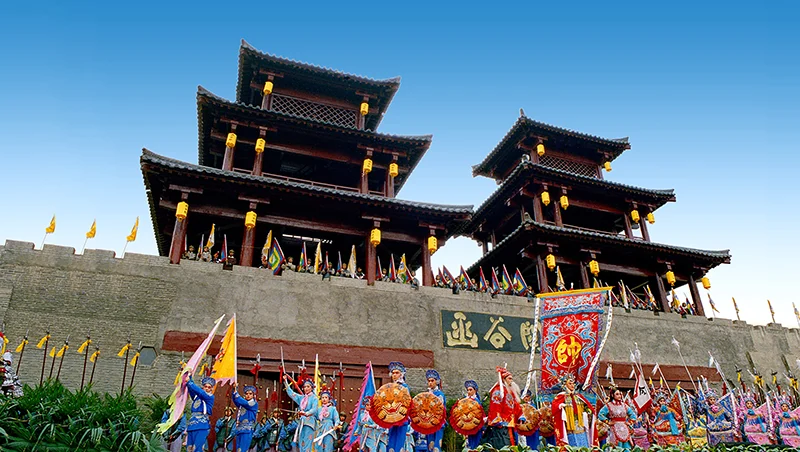
Why a gate goes where a gate goes
A text written at a bottleneck
The Sanmenxia government describes Hangu Pass as the sacred place where Laozi, the ancient philosopher, wrote the Daodejing. It joins this to two more things the place is said to have produced: the passage sits at the junction of Henan's culture and the Qin-Jin culture of Shanxi and Shaanxi, and it is the origin of stories such as the purple air coming from the east and the rooster crowing at Hangu. The city then makes a neat three-part summary - a famous person, a famous book and a famous pass - which is a good description of what a site like this is. Whether a given text was written at a given gate is a matter scholars argue about; what is not in dispute is that for centuries travellers, soldiers and pilgrims treated this narrow ground as where the old road tightened and the stories of the classics began.
The cultural crossroads behind the wall
Read the same municipal page as a description of circulation rather than of a monument, and Hangu Pass becomes a piece of transport infrastructure with a cultural function. It controlled a throat: the passage between a plateau you cannot cross easily and a ravine you cannot climb, with the river sealing the north and the mountains sealing the south. The city links the pass to the strategic role it played - a garrison point through which the fires and smoke of successive campaigns passed - and to the role it played in the movement of people and texts. For a visitor today the sequence is short and legible: a gate tower on the old road, a stele forest where inscriptions have accumulated, a hall named for the virtue of the place, and a museum that holds the site's own paperwork and material culture.