Shennong Mountain is named after an act rather than a person. The city's page says the name comes from the tradition that the Yan Emperor Shennong distinguished the five grains, tasted a hundred herbs and set up an altar to sacrifice to heaven here, and the provincial page repeats the formula: agriculture and medicine beginning on this slope. At the summit is the altar itself, described by the province as the first altar of high-mountain sacrifice in China, and known also as the Shennong altar or, from the purple mist said to gather there, the Zijin altar. A later story adds Laozi, who is said to have built a furnace on the summit and ascended from it. The legends are stacked, and the page presents them as legends.
From the journal
The Ridge Like a Wall
Shennong Mountain is a limestone ridge of 11.5 kilometres with 16,000 pines on it, three thousand macaques below it and two official figures for its area.
In the same city · Jiaozuo ↗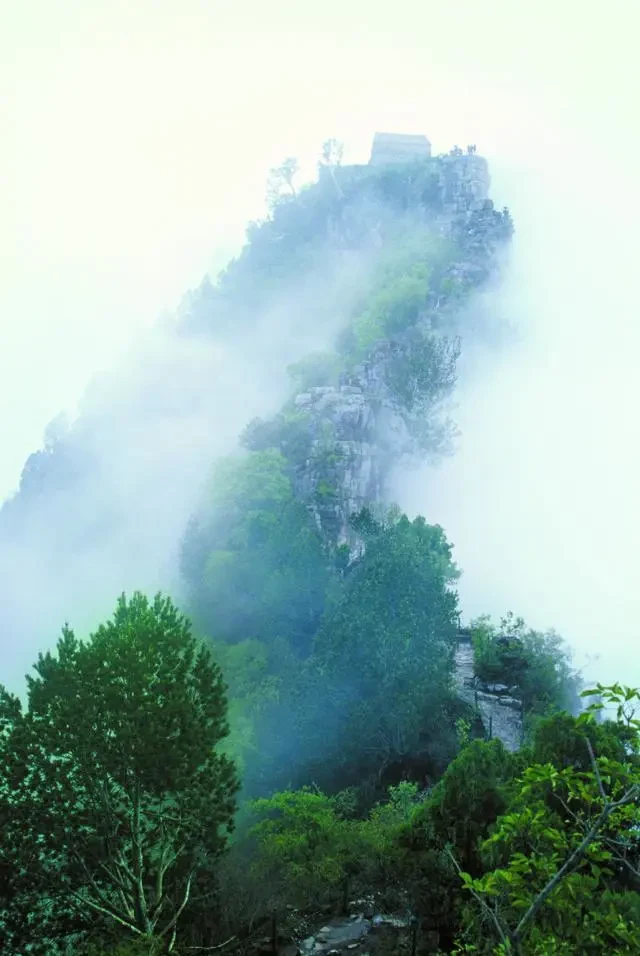
The Name and the Legend
Ninety-Six or One Hundred Two
The mountain's measurements depend on who is measuring. The Jiaozuo municipal page gives the scenic area as 102 square kilometres; the provincial culture and tourism department gives about 96. Both agree on the main summit, Zijinding, at 1,028 metres, and on the three great gates below it, which the city page says were built 154 years earlier than the gates on Mount Tai. Both agree, too, on the structure of the massif: two rivers, the Xianshen and the Yunyang, cut it into three north-south spurs called Yangluo, Zijin and Yunyang, so that the mountain is a set of ridges rather than a single cone, with valleys between them and peaks rising inside the valleys.
The Dragon Ridge
The signature landscape is a limestone ridge. White Pine Ridge runs 11.5 kilometres; from a distance, its rock walls resemble masonry, giving rise to the name dragon-ridge wall. White-bark pines grow from ledges and cliff faces, their shapes bent by wind. The provincial page counts more than 16,000 trees, while the city page gives 15,600; neither explains the difference in date or counting method. Whatever the count, the trees and pale rock give the ridge its distinctive profile, with cloud spilling down its slopes in wet weather.
Three Thousand Macaques
Animals are part of the visit. The mountain holds more than 3,000 Taihang macaques in nine troops, the most numerous of the second-class protected animals here, and the same page has them moving on cliff faces and interacting with visitors. The vegetation figures are equally specific: cover above 90 per cent, 1,912 plant species, more than 300 medicinal herbs and 260 land vertebrates. The macaques are the reason for the warnings at the entrances about food, and the reason the mountain is also a national macaque nature reserve. A visitor who sees one troop has seen the species the reserve was created for; a visitor who sees none has still walked a ridge that exists because of the rock beneath it.