When construction of the Chinese Eastern Railway began in 1897, Russian technicians and railway workers arrived in this mountain settlement. By 1903–04, a distinct Old Street had formed, extending for more than a kilometre with over 50 Russian-style buildings. A 2021 tourism profile counted 256 Russian-style buildings in town, 104 of them protected structures. Buildings along the street share a warm palette but vary in doorway scale and porch profile: stone walls capped with tile, yellow façades edged in white around windows and corners, high doors, broad surrounds and projecting porches. These details give the houses a domestic scale distinct from the railway's operating buildings.
From the journal
Hengdaohezi: houses, a church and a railway town
A railway settlement left a street of Russian-style homes, a wooden Orthodox church and a fan-shaped locomotive depot, each tied to a different part of town life.
In the same city · Mudanjiang ↗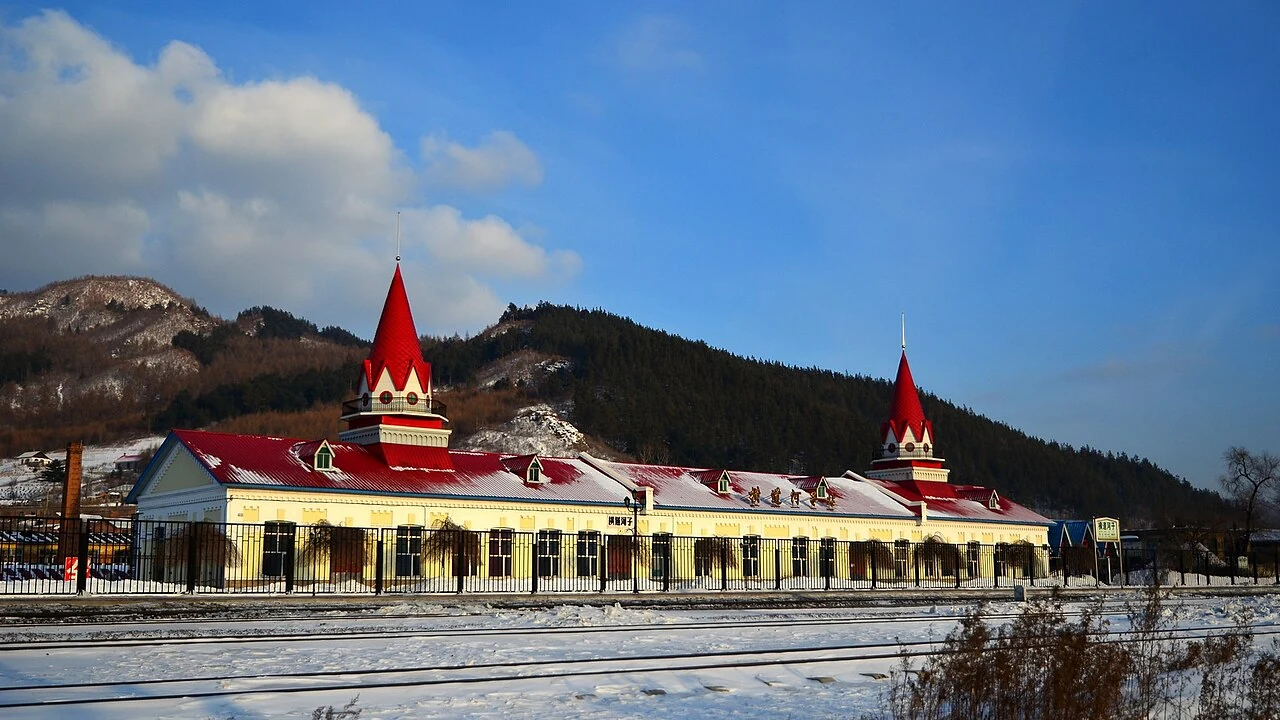
Homes along the railway street
Work, worship and music
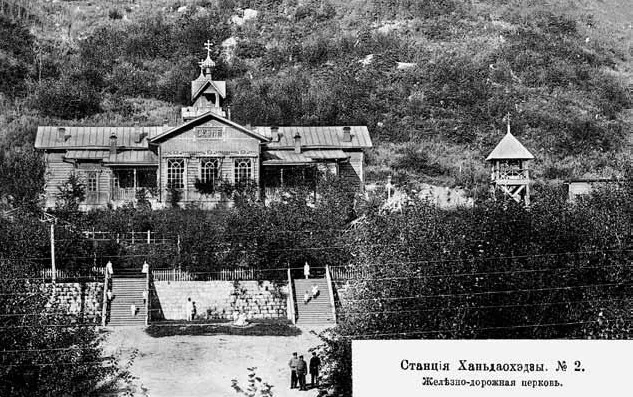
The Church of the Entry of the Theotokos was built in 1901 as a one-storey, roughly 400-square-metre wooden Russian log structure. Its timber is fitted, interlocked and carved with joinery that brings Russian building style together with Chinese mortise-and-tenon technique. The locomotive shed is an equally deliberate machine: fifteen brick bays fan out from a central turntable, which aligns the track at each bay to turn and move engines into or out of the shed. With an iron-sheet roof and more than 2,000 square metres of floor area, it was built for winter storage and repair and remained in railway use until 1990. Railway work also carried cultural life into the settlement. In 1928, sixteen-year-old Wang Rongting arrived from Harbin to work as a station signalman; while learning Russian and music in town, he encountered Russian folk music that later influenced his compositions as Wang Luobin. The houses, church and depot therefore preserve three connected but distinct histories: domestic life, worship and railway labor.