Chenjiagou sits five kilometres east of Wenxian County town on the Qingfeng ridge, and the Jiaozuo municipal government describes it as the birthplace of Chinese taijiquan, the first national intangible cultural heritage item of that name. The village is laid out as a small pilgrimage of places: the ancestral hall for the Chen family, the ancestral grove behind it, the place where Yang Luchan studied, the tomb of Chen Zhaopi, the Donggou practice ground, the taijiquan museum, and the Chinese Taijiquan Culture Park. This is not a reconstructed set. The China Intangible Cultural Heritage network states that the practice formed in Chenjiagou in the mid-seventeenth century and that Chen Wangting of the Chen clan is credited with compiling it, a lineage that later produced the Yang and Wu schools. The 2020 UNESCO inscription, decision 15.COM 8.b.21, names Wenxian County as the element's origin.
From the journal
Push Hands at Dawn: Chenjiagou and the Making of Taijiquan
In a village in Wenxian County, UNESCO-inscribed taijiquan is still taught in an ancestral hall, a shallow gully and a purpose-built museum of the art.
In the same city · Jiaozuo ↗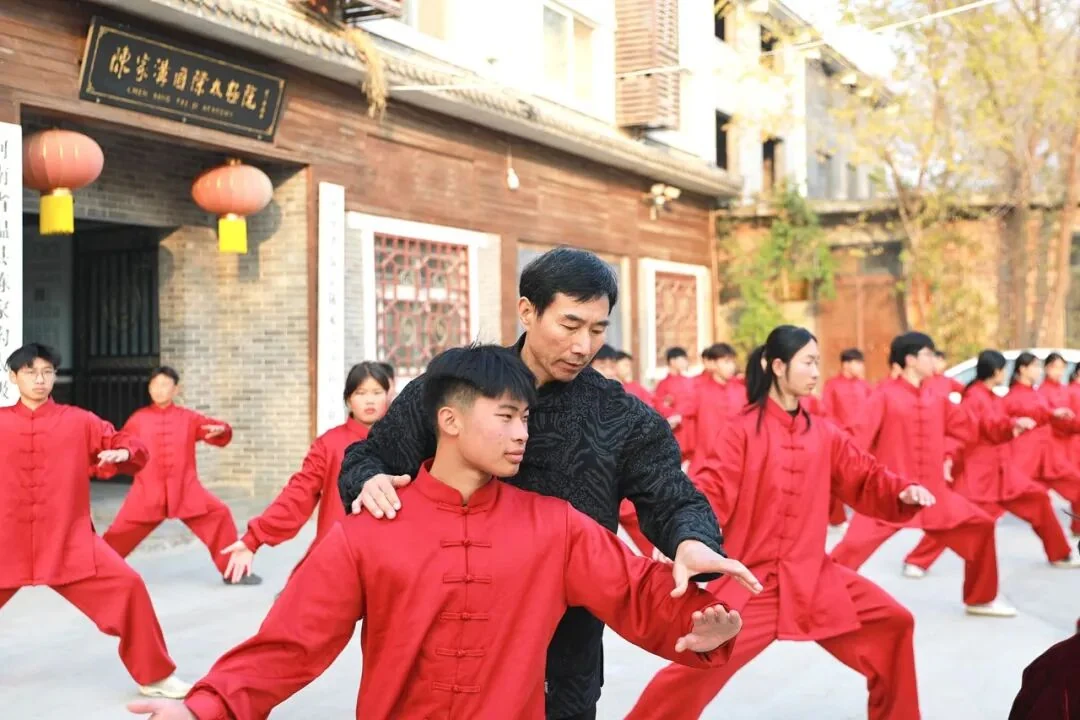
A village organised around an ancestor
Five halls, three thousand objects
The China Taijiquan Museum in the valley is described by the municipal government as the country's first museum built on a national intangible cultural heritage representative project and the first single-sport museum of its kind. It is organised into five sections named from the tradition's own vocabulary: Tai Chi Basic Culture, History in the Hall of the Two Forms, the derivative schools in the Hall of the Four Images, the theory in the Hall of Literary Cultivation, and the boxing method in the Hall of the Three Examinations. The inventory is the tangible part of an intangible art: the same page counts more than 800 categories of martial texts, manuals and historical material on the great masters, with nearly 3,000 precious objects and close to ten thousand more documents on the art. Beside it, the Donggou gully runs about 1.5 kilometres long and holds two practice platforms.
What the inscription actually claims
UNESCO's entry for the element is precise about what is being protected. Taijiquan is described as a traditional physical practice characterised by relaxed, circular movements working in concert with breath regulation and the cultivation of a righteous and neutral mind, whose basic movements centre on five steps and eight techniques, performed as routines, exercises and paired hand-pushing. The entry records transmission through clan-based and master-apprentice models, the latter established by the traditional apprenticeship ceremony, and notes that the element has been taken into the formal education system. The Chinese network adds the numbers that matter to a village practice: more than 80 sets of routines and weapons forms, and more than 20 methods of paired hand-pushing, developed from the Chen-family practice rather than borrowed from anywhere else.