From the journal

Zhaozhou Bridge: the arch that carries its road in the open

Li Chun's stone bridge over the Xiao River has stood since the Sui dynasty, its shallow arch held by twenty-eight curved ribs and pierced at both shoulders by small flood arches. The span is still walked across, and its repairs, its rediscovery in the 1930s and its place on China's tentative World Heritage list are part of the story.

In the same city · Shijiazhuang ↗

Twenty-eight ribs of limestone

The deck of the bridge is nine metres wide and divided into three lanes, and it rests on an arch that never reaches a half-circle. The curve is a segment of about eighty-four degrees, springing from abutments that take the load both downwards and sideways. Under the roadway, twenty-eight curved ribs of limestone stand side by side. Each rib is roughly thirty-five centimetres wide, built from blocks between seventy and one hundred and nine centimetres long, and the blocks are tied in pairs with iron cramps. Because the ribs are separate, the arch can shift a little when its supports move, and a broken block does not bring the span down.

At each end of the main arch, two smaller arches open through the spandrel. They are not ornament. They cut the weight of the bridge by about fifteen per cent, something close to seven hundred tonnes, and in a flood they let water pass through the shoulders instead of striking them. The central span measures 37.37 metres and rises 7.3 metres, a rise of about one fifth of the span, where a semicircular arch would rise by half. The flatter curve uses about forty per cent less stone, and it keeps the roadway low enough for carts while leaving headroom beneath for boats. Floods, wars and earthquakes have passed over and under it since, and the separate ribs, the iron ties and the four openings are the reasons given for its survival.
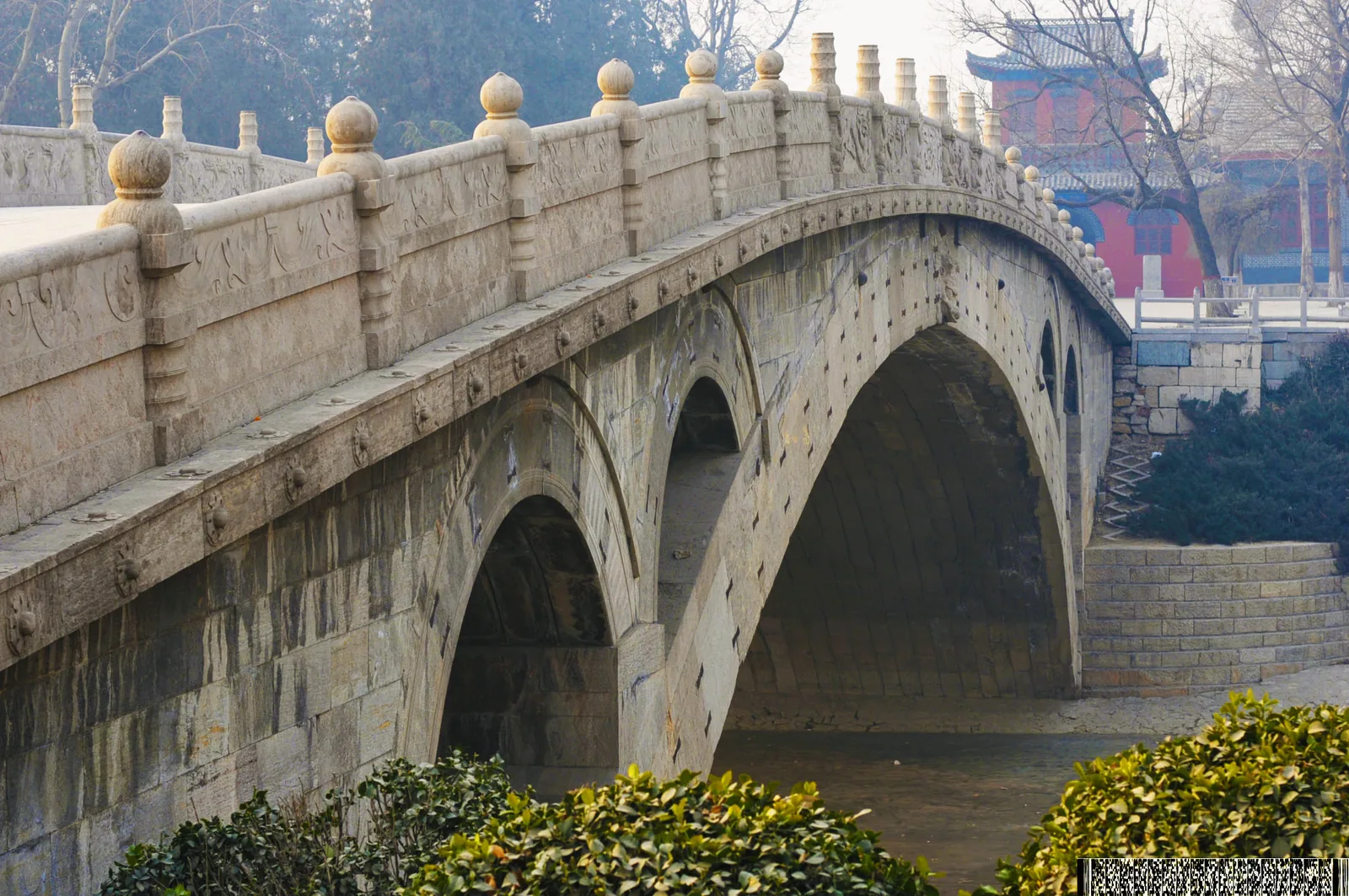
Zhaozhou Bridge over the Xiao River in Zhao County, with four smaller arches above its main span.

A crossing on the road south

From 581 the Sui dynasty reasserted control over the regions that had broken away since the Han. Its public works were large: two imperial capitals rebuilt, the Grand Canal cut to 2,400 kilometres, fortifications improved along the northern frontier. Goods moving south and south-west from the North China Plain towards Kaifeng and Luoyang crossed the Xiao River near Luanzhou, later Zhaozhou and now Zhao County. The river ran west to east through low ground on both banks. It was an artery for transport and an obstacle to anyone moving overland.

A craftsman named Li Chun, who directed masons and other workmen, built the bridge there. Chinese histories credit him with the design; no contemporary document describes the work, and later chronicles mention it only briefly. The date given is 595 to 605. The bridge was called Anji, Safe Crossing, and also Dashi, the Great Stone Bridge.

Its innovation was to reject the semicircular arch. A shallower segmental curve was thought unable to pass the weight of a bridge down to its abutments. Li Chun's arch did so in stone alone, and later engineers copied it. An inscription set up by Tang officials seventy years afterwards praises the wedge-shaped stones and the slender-waisted iron cramps that bind them, and remarks that no one knows on what principle he made it. Legend gave the work instead to Lu Ban, who was said to have built it in a single night.

What the repairs changed

Ming writers compared the arch to a new moon rising above the clouds and to a long rainbow over a waterfall, and after that the bridge dropped out of notice. In the 1930s Liang Sicheng, an architect at Tsinghua University, found it again on a survey of old buildings in Hebei. He measured it, drew it and published a report, and the bridge returned to the record. By the time he arrived, the carved surfaces of the original stone were gone; a few had been replaced in the Ming dynasty.

The structure had been repaired under the Tang, Song, Ming and Qing, and by the late Qing it was badly damaged. Work carried out in 1952 and 1956 has been criticised since for changing its appearance and its structural technique. The parapet, the balustrades and the posts were replaced with new carving in the style of the Sui period, and Liang Sicheng was among those who argued that the old bridge, as an old bridge, had effectively gone.

Its standing has grown anyway. In 1961 it was listed in the first batch of national key cultural relics, together with the Yongtong Bridge in the same county and the Luding Bridge in Sichuan. The American Society of Civil Engineers named it an International Historic Civil Engineering Landmark in 1991. In 1996 the State Bureau of Cultural Relics submitted a nomination for the World Heritage List, on the argument that the open-shouldered arch began here. It stands on China's tentative list, as entry 95, and is not inscribed.

Continue exploring · Zhaozhou Bridge (Anji Bridge) ↗
Photo credits and rights
  1. Zhaozhou Bridge over the Xiao River in Zhao County, with four smaller arches above its main span.crazlei · CC BY 2.0 Photo source ↗ Rights information ↗ Converted to WebP.