The approach is short and worth measuring, because the account of this place depends on where it sits. A regional news page on Shangqiu's heritage places the tomb about 1.5 kilometres southwest of the old city, in a commanding position over the plain, and identifies the mound as the burial place of Suiren, one of the Three Sovereigns and the ancestor of fire in Chinese tradition. The official pages can confirm the site's place in the city's scheme: the provincial government portal records that the Huoshen Terrace, the Suihuang Mausoleum and the South Lake are run together by the company that operates the ancient city's scenic sites. The folklore is transmitted as folklore; the geography is what can be checked.
From the journal
Drilling for Fire
At the Suihuang mausoleum, the founding act of Chinese culture is a piece of wood, a bird and a spark, told as a story rather than a proven date.
In the same city · Shangqiu ↗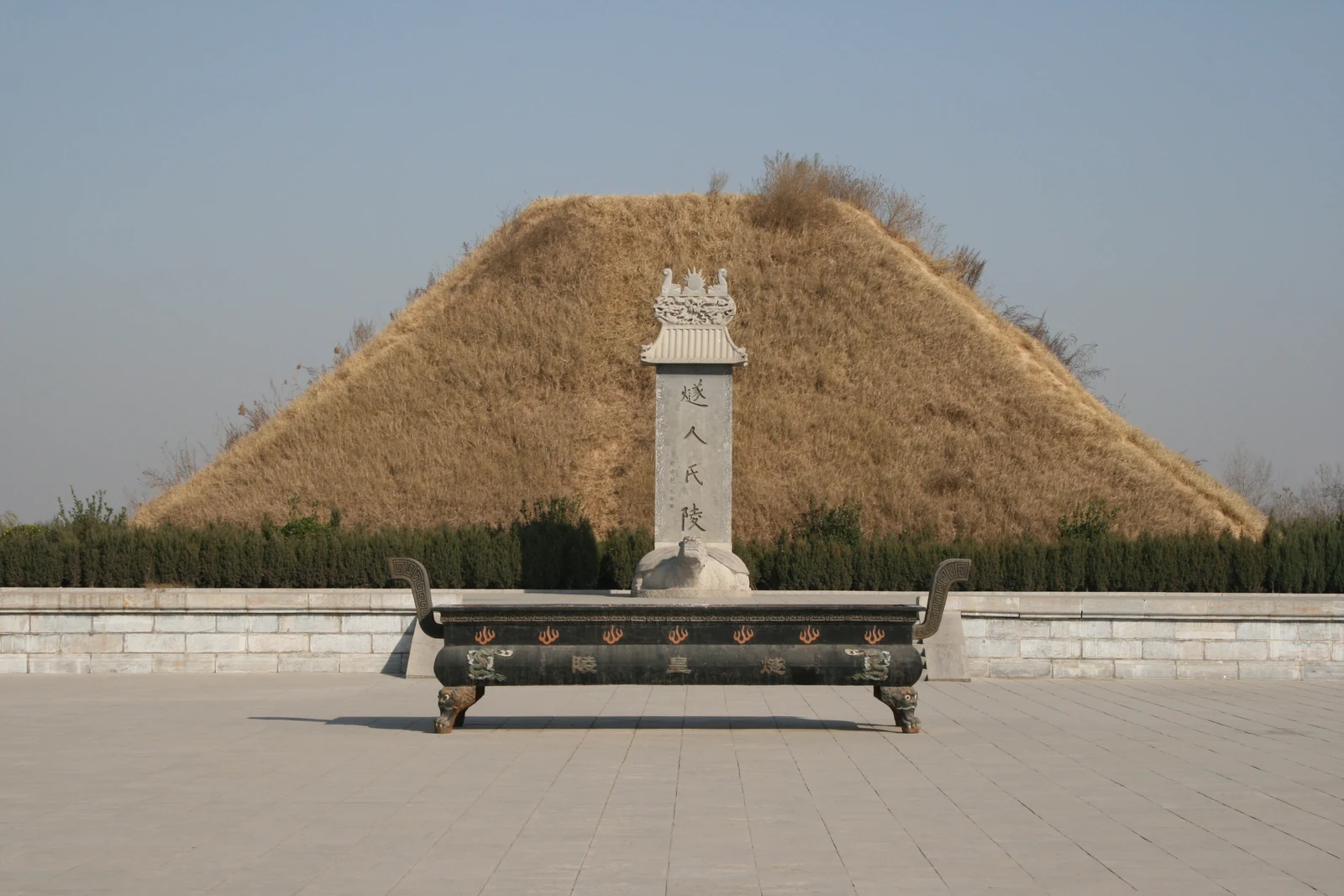
A Kilometre and a Half from the Gate
The Moment the Bird Pecked
The story is told in the media account as two versions of one accident. In the first, people ate raw food until somebody noticed a bird pecking at a flint-wood tree and throwing off sparks; the man who watched folded down a branch of that wood and drilled for fire, and taught the method, so that people could roast food, give light, keep warm and smelt metal. In the second version, a hunter in the woods of Shangqiu saw sparks when his stone struck the rocks, and used stone on stone to ignite tinder. The page adds a detail that belongs to the recent past rather than the ancient one, noting that this stone-striking method was still in use in rural Shangqiu as little as thirty years ago.
A Mound Rebuilt as a Park
What stands on the site today is a twentieth-century landscape. The account records that government work repaired the tomb and expanded the grounds, setting up a range of stone sculpture, planting trees and flowers and turning the enclosure into a site with visitor value; the neighbouring Huoshen Terrace now presents a staged fire ritual drawing on Shangqiu's fire and Shang culture. So the tomb is best read as two things at once: a modern commemorative park, laid out around a mound, and a repository of the founding story of fire told by a regional media outlet rather than an excavated site. If a reader wants the hard ground under the mound itself, this batch of sources does not provide it, and that limit is worth stating plainly.