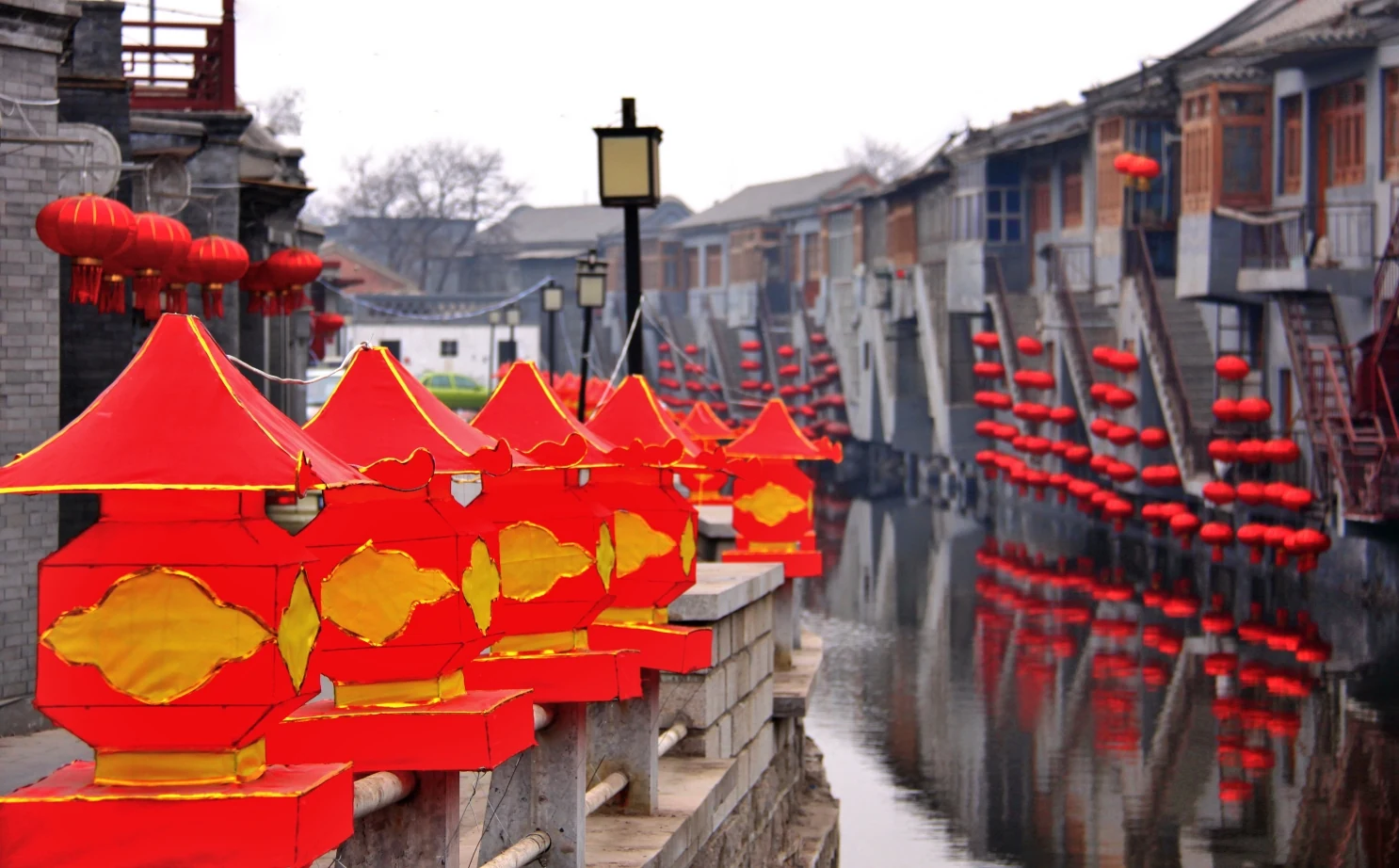
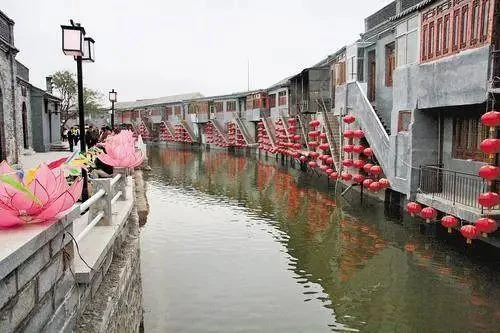
Wumiao Qianjie, the street in front of the War God Temple, runs more than seven hundred metres through the old centre of Shengfang. At its southern end stands a memorial archway, its carved ornament dense, its eaves lifted on bracket sets. A century ago a temple to Guan Yu, the deified general, stood on the same street, temple to the south and arch to the north. The archway standing now was rebuilt from old photographs, so its carving reproduces a building that otherwise survives only as an image.
East of the arch is the Wenchang Pavilion, also called Kuixing Lou, the tower of the god of literature. It was first built in 1519, the fourteenth year of the Zhengde reign of the Ming, and rises three storeys to thirty-three chi, a little over ten metres.
At the far end, where the street meets Zhongshan Street, stand two buildings of a different sort. One is the old theatre, Jiucheng Lou, first put up in the Qianlong period, sitting south and facing north up the street. The other is the Wang family compound, begun in 1880, the sixth year of the Guangxu reign. Its rooms set Byzantine ornament beside Chinese roofs of hip-and-gable profile and details the sources call African. Nothing in the record explains the mixture; the house simply holds it.
These three are what the town calls its treasures: theatre, archway, pavilion. They are, respectively, a stage, a memorial gateway, and a tower of learning.