From the journal

Why the emperor's porcelain was broken

At Jingdezhen's imperial kiln, a rejected vessel could be smashed and buried. Archaeologists and conservators have made those fragments tell another story.

In the same city · Jingdezhen ↗

Begin with the seams

A repaired porcelain vessel asks for a different kind of looking. Its outline may be graceful, its painted decoration confident, yet the joins run across both. The cracks are part of what can be learned from it. At the imperial kiln site in Jingdezhen, broken porcelain is evidence of the choices made before a vessel ever reached a palace.

The name imperial kiln describes workshops producing for the court. Ming and Qing emperors depended on the skill concentrated in this Jiangxi town, but the finished wares that travelled away are only half the story. The ground around the workshops kept what was left behind. A site visit can therefore begin with an apparent failure: something made with care that was never allowed to serve its intended owner.
A workplace beneath the city

The remains at Zhushan include kilns, workshop areas, walls, roads and wells. They belong to a place organised around making things, rather than to a single isolated furnace. The surviving street surroundings, shops and workshops help place the archaeological remains inside a city whose history grew with porcelain.

Different pieces of evidence answer different questions. A kiln concerns firing; a workshop concerns what happened before or after it. A discarded fragment may preserve a shape or decoration absent from surviving complete collections. The view of court porcelain changes when attention moves from the finished object to the working ground: a vessel becomes one outcome of materials, specialised labour and repeated decisions.

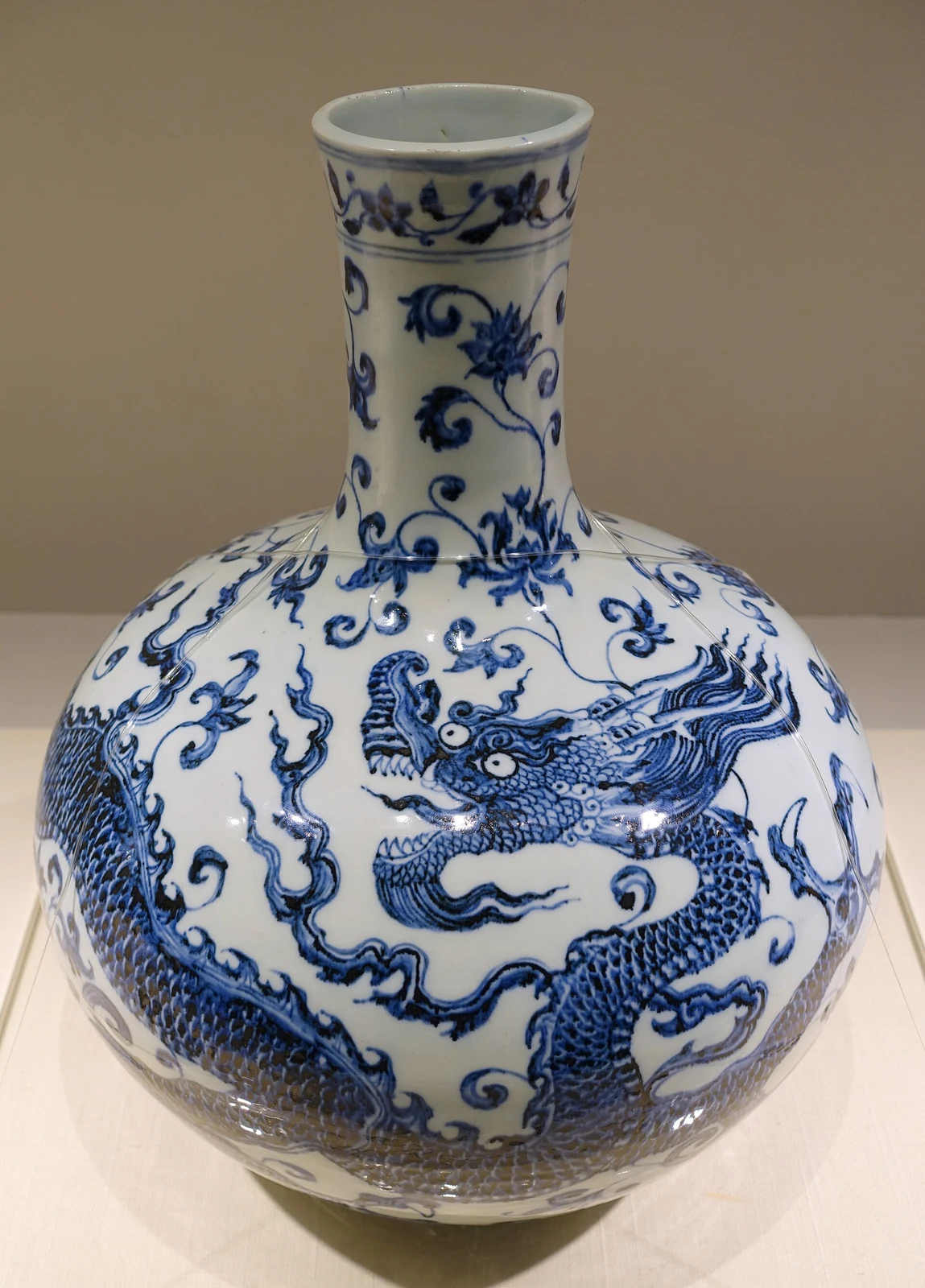
Yongle blue-and-white dragon jar from Jingdezhen
A blue-and-white jar with a dragon, made at Jingdezhen in the Yongle period (1403–1424); now in the Matsuoka Museum of Art, Tokyo.

Rejection left its own archive

Rejected imperial wares were deliberately broken and buried. The fragments were not simply the remains of an ancient accident. At some excavated deposits, researchers have identified evidence of a further breaking after the first damage. Disposal was itself part of the organisation of production.

Archaeological work also distinguishes between deposits formed at different stages of manufacture. A piece could be rejected before the last operation, as well as after completion. This matters because a pit of fragments can reveal a moment in the working process, instead of merely supplying pieces for an attractive reconstructed vase.

The archaeological record makes the strictness of selection tangible. It also preserves material that would otherwise be missing from the story told by palace collections. What was refused a future as a usable vessel acquired a different future underground.

What putting the pieces together can restore

A joint archaeological team involving Peking University and the Jiangxi and Jingdezhen institutes excavated large quantities of Ming porcelain fragments in 2003–2004. The work became a collaboration between archaeological research and conservation; a later university exhibition presented restored excavated wares.

A reconstruction can make the curve of a bowl or the proportions of a jar intelligible again. It does not erase the history of its burial. Read alongside excavation records, the repaired object can help explain manufacturing techniques, changing forms and the administration of a court workshop.

The seams are useful here. They invite a slower look at the object as both a crafted thing and a piece of evidence. The story includes the people who shaped and fired it, those who rejected it, and those who much later worked out how its surviving parts belonged together.

Beyond the imperial kiln

The 2026 World Heritage inscription concerns the Jingdezhen Handicraft Porcelain Industry Sites, a series of five component parts. The imperial kiln belongs within this larger industrial landscape, alongside evidence of raw materials, production, transport and social organisation.

Porcelain stone and kaolin, fuel and waterways connected the town with the surrounding country. Civilian kilns and commercial organisations also belonged to that world. Following this wider system prevents the emperor's workshop from standing for every potter in Jingdezhen.

The fragments lead outward as well as backward: from a repaired vessel to a working city, and from the city to the places that supplied it. Continue towards Yaoli to follow that connection between the porcelain town and its mountain hinterland.

Continue exploring · Imperial Kiln Site ↗
Photo credits and rights
  1. A blue-and-white jar with a dragon, made at Jingdezhen in the Yongle period (1403–1424); now in the Matsuoka Museum of Art, Tokyo.Daderot / Public domain · Public domain Photo source ↗ Rights information ↗