In July 1927 a committee of three men was appointed to prepare a Henan Museum, with premises in a former law school on Sanshengmiao Street in Kaifeng; the museum's own institutional history names Guo Xujing, Xu Jinquan and He Rizhang as the committee and Feng Yuxiang, then provincial governor, as the patron. In May 1928 it was renamed the Museum of Nationalities, and on 1 December 1930 it took back the name Henan Museum and was classed as an organ of social education. Its first displays in 1928 leaned on models because the collection was thin; within a decade, after excavations at Yinxu, Xinzheng and Huixian, it held material that mattered.
From the journal
Sixty-Eight Crates
Henan Museum was founded in a Kaifeng schoolyard in 1927, moved its collection twice under fire, and opened a pyramid-roofed building on Nongye Road in 1998.
In the same city · Zhengzhou ↗
A Schoolyard in Kaifeng
The Crates
The collection left in 1937. The museum's history records that staff selected 5,678 objects, 1,162 rubbings and 1,472 sets of books, packed them into 68 crates, and sent them to Hankou, where they were stored in the French concession. In September 1938, as the war moved south, the crates went on to Chongqing. In November 1949, 38 of the 68 crates were chosen and shipped to Taiwan, carrying 5,119 objects and 1,450 sets of books. The history does not soften the result: much of what stayed in Kaifeng after the occupation was lost, and a museum that had spent twenty years assembling a national collection was left without its best material.
The Pyramid on Nongye Road
The institution rebuilt after 1949, was designated a local-history museum in 1953, and moved with the provincial capital from Kaifeng to Zhengzhou in 1961. In July 1997 the provincial government merged it with the Central Plains Stone Carving Museum to form Henan Museum; the new building opened on 1 May 1998 on Nongye Road, on a site of more than 100,000 square metres, after five years of construction and an investment of nearly 300 million yuan. The main hall stands in the middle of the plot with a pyramidal roof, the storerooms behind it and four smaller blocks at the corners. It is a museum built to look like a treasury, and the shape is the first thing visitors describe.
What Is on the Walls
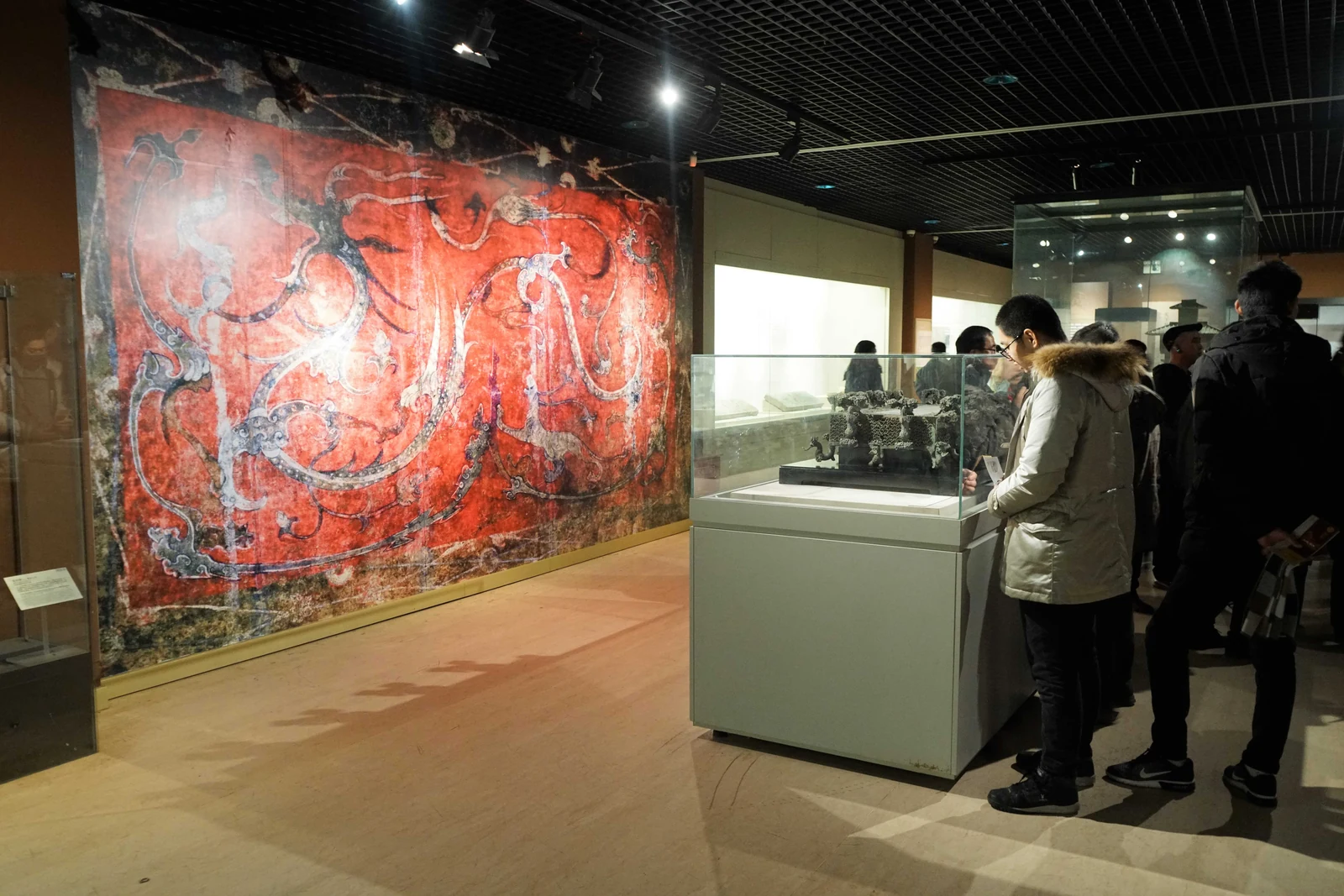
The displays are organised as an argument about the centre. The permanent exhibition is titled Yangyang Huaxia, Ze Zhong Jian Du, roughly the splendour of China and the choice of the middle as the capital, and it is flanked by galleries on Ming and Qing Henan, ancient stone carving of the central plains, Chu bronzes from Danxi, Ming and Qing treasures, the red culture of Henan, and a rotation of national treasures. Two support spaces are named on the museum's about page: a social-education room and a hall for ancient music, where the Huaxia Ancient Music Orchestra works on instruments reconstructed from excavated pieces. The museum was admitted in 2009 to the first group of centrally and locally co-built national museums.