The Guo state tomb field is the burial ground of the kings and nobles of Guo, a Western Zhou vassal kingdom, and the Sanmenxia daily describes the cemetery as a group of high-status burials dating from the late Western Zhou to the Spring and Autumn period. The state mattered because of what it did for the Zhou royal house: the same exhibition text casts Guo as the royal house's left arm, and a kingdom fielded as an armed partner has tombs that yield bronze and war gear alike. The cemetery was discovered from the 1990s and its standing is unusually secure - the Sanmenxia government records it as having been selected for the national top-ten archaeological discoveries in 1990 and 1991 in consecutive years. A site museum has been built directly on the cemetery, and it now works as a research base for Zhou culture in the central plains.
From the journal
Named Bells and Chariot Wheels: The Guo State Tombs
The burial ground of a small Western Zhou kingdom near Sanmenxia, where bronzes carry their owners' names and a site museum rebuilds a chariot.
In the same city · Sanmenxia ↗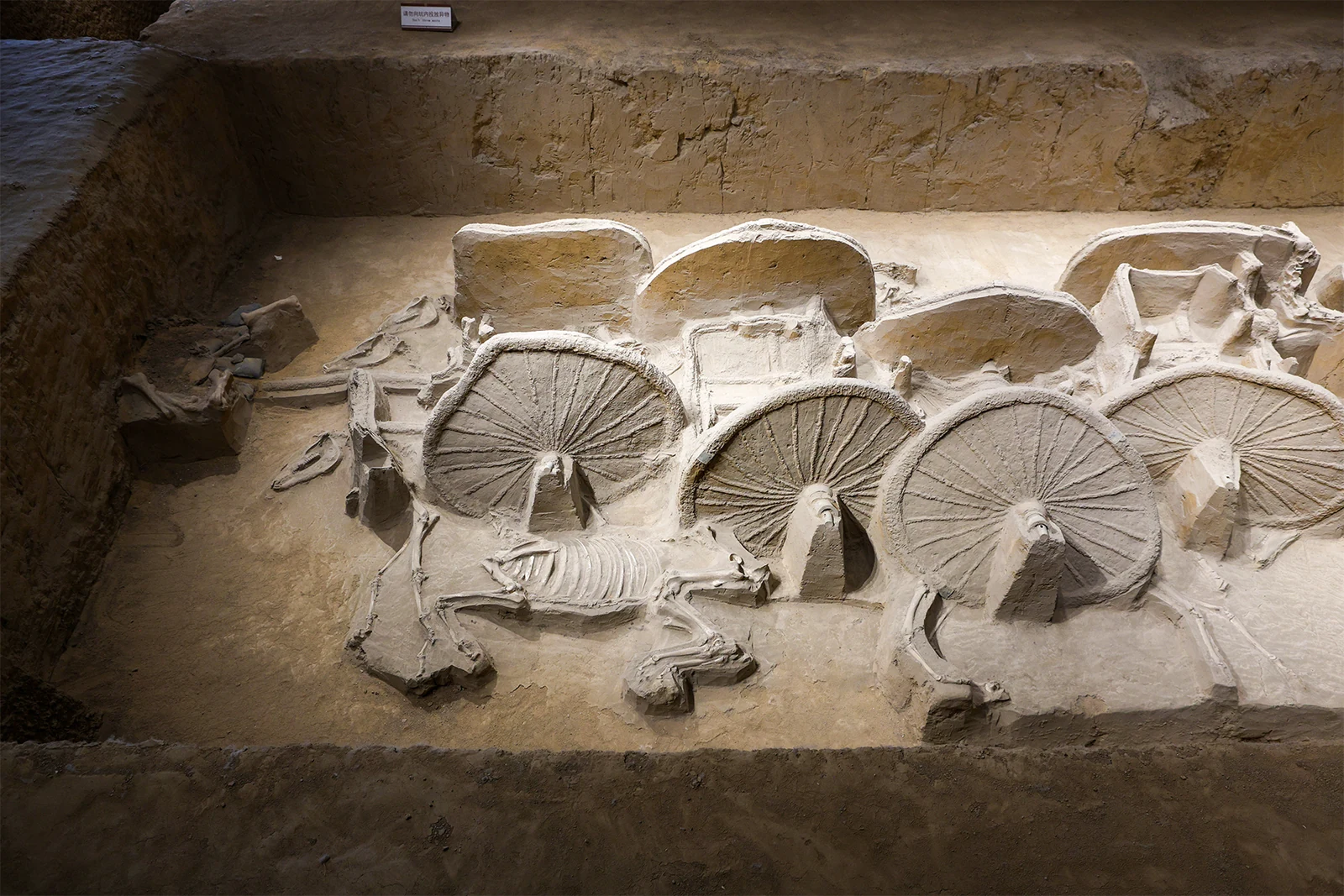
A small state on the western frontier
Two tomb numbers, two names
Archaeology here is specific enough to be checked, because the tombs carry numbers and the bronzes carry names. The Sanmenxia daily reports that the state television documentary series on the cemetery showed bronze objects inscribed with the name 'Guo Ji' excavated from tomb M2001, confirming that the occupant was the king of Guo, and that it followed the excavation of the larger tomb M2009 of Guo Zhong. The same tomb field produced other firsts: the Sanmenxia government notes that the cemetery has been included among the century's hundred major Henan archaeological projects, and that a related site, the Shangyangcheng city site, was among the five major Henan discoveries of 2018. For a visitor this means something precise can be pointed at - a vessel, a bell, a pit - rather than a general impression of antiquity.
A chariot rebuilt inside a museum hall
In May 2025 the Miaodigou Museum in Sanmenxia opened 'The Shining Guo', an exhibition of archaeological results from the Guo state built around 320 objects and sets. Its design joined scene reconstruction with the objects themselves: a model of the Shangyangcheng city wall, a replica of a set of chime bells excavated from the Guo Ji tomb in 1990, and a detailed model of a Western Zhou war chariot. The exhibition also showed, for the first time, a large set of photographs and original excavation records from the dig, including material on city walls and moats that the exhibition text says provides first-hand evidence for locating the Guo capital. The show was organised by the Sanmenxia municipal bureau of culture, radio, television and tourism with the city's Yangshao culture research centre, and was supported by the Guo state museum, the Miaodigou museum and the Sanmenxia museum.