The technique here is subtraction. At the Baofengshan scenic area of the Mangdangshan Han culture park, the tombs of the king of Liang's queen, of Liang Xiaowang Liu Wu and of the Liang gong king were cut into the living rock, forming what the provincial tourism description calls chambers made by splitting the mountain and hiding in stone. The queen's tomb is the largest of the three open to visitors, its underground palace laid out with two passageways, three corridors, two main chambers and thirty-four side chambers. The scenic park itself, in Yongcheng at the meeting point of Henan, Shandong, Jiangsu and Anhui, is organised into four open areas: the Baofengshan royal tombs, the Hanxingyuan, the Fuzishan and the Chensheng mausoleum.
From the journal
Cutting a Hill for a Tomb
At Mangdangshan the kings of Liang did not build their mausoleums but removed the hills themselves, leaving chambers of rock, a painted mural and a platform on the summit.
In the same city · Shangqiu ↗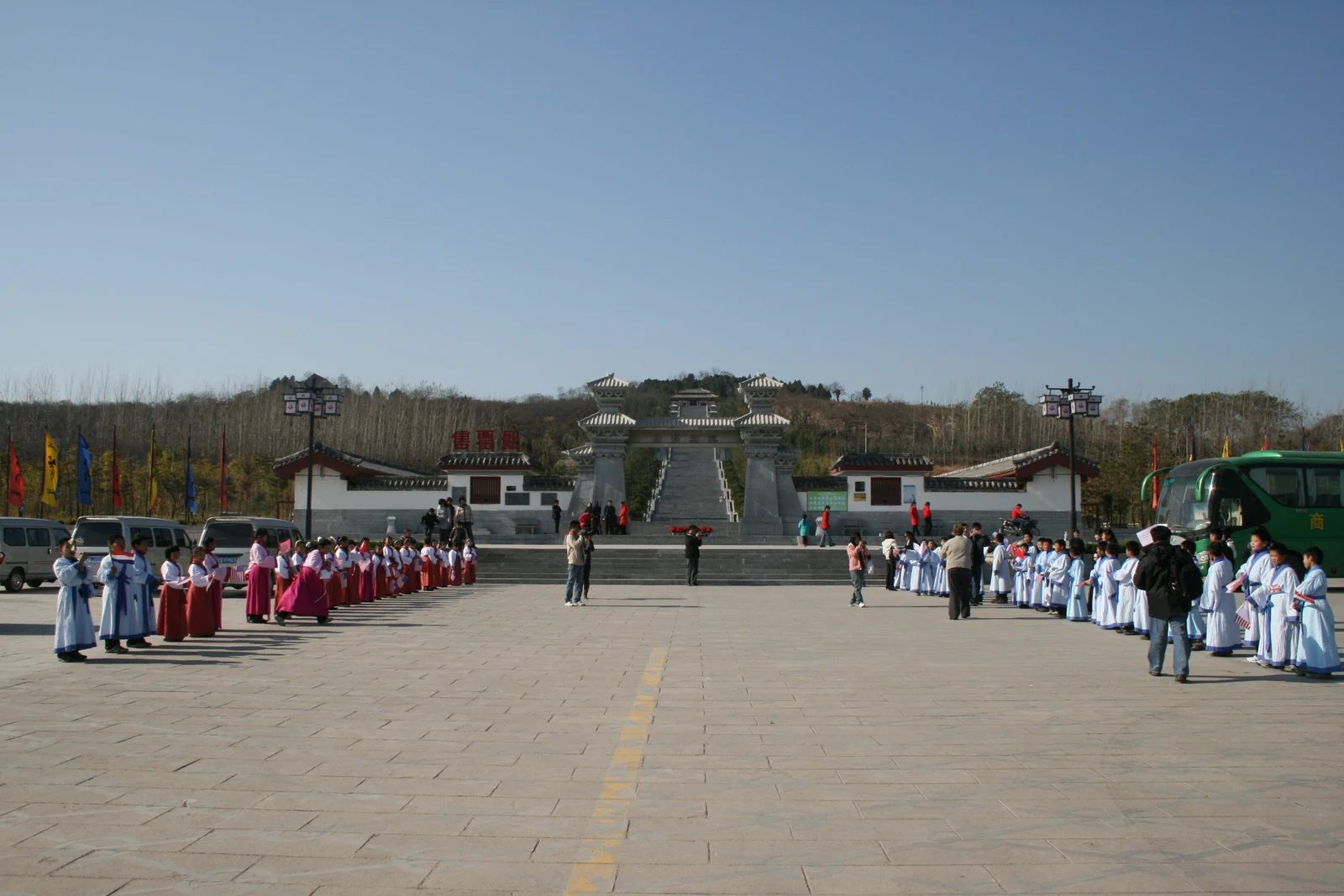
Mausoleums Made by Removal
The Wall Painting That Came Out in 1991
One chamber carries the site's most famous object. The tomb of the Liang gong king was discovered in 1986, excavated from 1987 and completed in 1991, and its underground palace gave up a painted mural of the four directional spirits in cloud and ribbon patterns, which the provincial account describes as an object that caused a stir in archaeology and art history. The page also reports the coins and the chariots: 2.25 million Han banliang coins weighing 5.5 tonnes, more than ten thousand gilt fittings, and forty-odd figures of cavalry and attendants. The same account characterises the Liang royal tomb complex as being praised by scholars as the first stone chamber under heaven; that phrase belongs to the source, not to an independent judgement here.
A Platform on the Summit
Above the tombs, on the main peak, the archaeology is of a different kind. The Henan cultural heritage office describes the Mangdangshan Han ritual platform as a rare early Western Han stone-and-timber high-platform building, discovered by an excavation team in 2006 and covering 1,055 square metres, with dressed stone walls and rammed-earth work still legible on the site. It was listed as a national monument in the seventh batch in 2013. Its position matters: a hall for sacrifice to the ancestors of the Liang kings, set above the peaks where they were buried, turns the mountain itself into a piece of ritual architecture rather than a setting for one.